To live in the midst of the world without wishing its pleasures; to be a member of each family, yet belonging to none; to share all sufferings; to penetrate all secrets; to heal all wounds; to go from men to God and offer Him their prayers; to return from God to men to bring pardon and hope; to have a heart of fire for charity and a heart of bronze for chastity; to teach and to pardon, console and bless always—what a glorious life!—Dominican Father Jean Baptiste Lacordaire
I had other plans. A painting sits on the easel, and sketches rest on a side table. On the desk are notes that need to be shaped into a dvar Torah for the Sabbath following Thanksgiving. Also on the desk is an essay revision that remains incomplete. Among the papers on the desk is an essay by Richard John Neuhaus. The piece is titled “Born Toward Dying.”
Neuhaus, born in Ontario in 1936, was a Lutheran cleric. After moving to the States, and graduating from Concordia Theological Seminary, he served in a poor parish in Bedford-Stuyvesant, a borough in Brooklyn, New York. His sermons often addressed social justice and civil rights issues. During the 1960s he co-founded Clergy and Laymen Concerned About Vietnam with Jesuit Father Daniel Berrigan and Rabbi Abraham Joshua Heschel. In 1990, he converted to Roman Catholicism and was ordained a priest. Neuhaus was a man of child-like faith. Among his accomplishments, and there were many, he was the founder and editor in chief of the journal First Things. He died in New York on 8 November, 2009.
In her tribute, Mary Angelita Ruiz wrote of Neuhaus,
In so many ways he was a titan of a man, the last person one might call childlike: learned in an astonishing variety of subjects, prodigiously productive, incisive, disciplined, unflagging, avuncular (his own appellation). His mind was always at work, his pen almost as frequently so. He spoke in the cadences of a preacher, in and out of the pulpit. He exuded an irresistible energy and held the attention of any room.… He led a life, as he would say, of “high adventure.
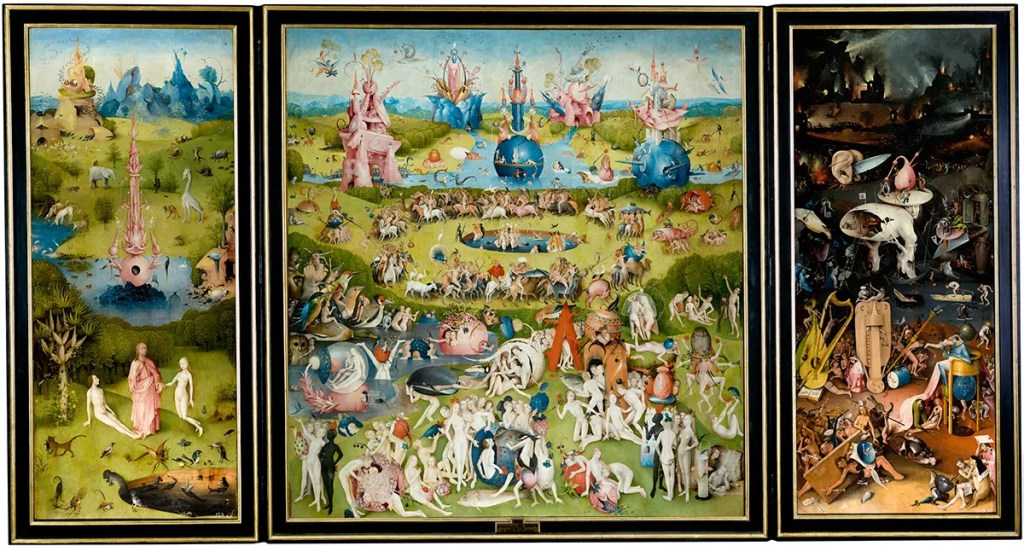
This past Tuesday evening, 3 November, I watched the news reports of the results of the off-year election. Wednesday was spent in the studio painting after writing a few letters and reading The New York Times and The Atlantic’s election coverage. Today, Thursday, the 5th, I awoke thinking about Neuhaus’s article “Born Toward Dying” and Hieronymus Bosch’s oil-on-oak triptych The Garden of Earthly Delights. Bosch’s depicts figures of Adam and Eve and exotic animals in the Garden of Eden in the left panel. The central panel shows figures engaged in self-absorbed joy and fantastical creatures. The final panel, on the right, is a hellscape showing humanity succumbing to evil and reaping judgment.
“Born Toward Dying” is both a statement of faith and an affirmation of life. In those brief early morning minutes, I reflected on the election, what it may or may not mean for the future of the country’s domestic and foreign policies and the citizens. Others of my generation and I will be, and already are, stepping aside, though one could argue we are being shoved aside. In President John F. Kennedy’s words, the torch is being passed to a new generation.
I have a dim view of Senator-elect Abdul El-Sayed and other Socialist Democrats and the “Proud Boy” and “Epstein Elite.” I am troubled by jarring statements from El-Sayed, such as, “If you’re Chuck Schumer, I’m pretty damn dangerous,” as well as his refusal to say Israel has a right to exist. His double-speak following an attack on a Michigan synagogue also raises questions. “Anti-Semitism has no place in our communities. Ever. Full stop… I condemn what he did. There is never a justification for attacking innocent people or houses of worship.” Then, he added, as if to explain the attack and the attacker. “Hurt people hurt people. (He) lost family… in an airstrike in Lebanon last week.” And I am disturbed by his inability to disassociate from antisemites.
Questions come to mind when I hear these and similar comments by others, including AOC’s laughing off statement, “Woke 1 was crazy,” as she weighs a presidential run in 2028. Can the new congressional members work with Democratic moderates who won in conservative districts? Can the new members understand that the majority of voters were primarily concerned with “pocketbook” issues and are keen on ending the Trumpian divisiveness, chaos, and greed? Will they—progressives, moderates, and conservatives— grasp that the person who voted against their legislative proposal today could side with them on another bill tomorrow? The Republican Party, the Trumpians, drunk on power, forgot this lesson. Writing legislation and passing laws isn’t about retribution. What is required is a willingness to have a bipartisan approach to policy that speaks for the majority and protects the rights of the minority. Will they come prepared for their committee meetings, or will they merely cling, as did the Republicans, to their ideological positions to pass a purity test? Will they use their power to gain more power, or to serve the citizenry and unite them? There are numerous other questions.
Currently, the Democratic Party is in the Garden of Eden frame of Bosch’s painting. Some members have already begun to step into the center frame with its self-absorption. Populist movements, from either extreme of the political spectrum, are fickle. Judgment is always the next frame over.
My hope is that the voices of titans, those men and women who can live the words of Jean Baptiste Lacordaire, will be heard above the din of empty rhetoric. People like Septima Poinsette Clark, Dr. Martin Luther King, Rabbi Abraham Joshua Heschel, Fannie Lou Hamer, Thomas Merton, Sister Mary Antona Ebo, Rita Schwerner Bender, Richard John Neuhaus.
This morning, my thoughts went past politics to the life I have been fortunate to have had. A good life. The past seven years of contending with health issues serve as a reminder of the goodness of life, the gift that each day is. But even on the more frequent best of days, I live with the always maybe.
“Most of us,” Neuhaus writes, “are at ease in discussing what makes for a good life, but we typically become tongue-tied and nervous when the discussion turns to a good death. As children of a culture radically, even religiously, devoted to youth and health, many find it incomprehensible, indeed offensive, that the word “good” should in any way be associated with death. Death, it is thought, is an unmitigated evil, the very antithesis of all that is good.”
But the reality is the antithesis of the good life is indifference and the selfishness we show in our dealing with others.
Image: Title: The Garden of Earthly Delights Artist: Hieronymus Bosch
Source: https://colourlex.com/project/hieronymus-bosch-the-garden-of-earthly-delights/


Leave a Reply