Author’s Note: The following is an excerpt from the second of my talks in a series titled “The Journey.” This four part series was scheduled for the members of the Beth Israel Congregation of Ann Arbor, Michigan.
The Torah refers to impure spirits (demons). Yehezkel Kaufmann, the historian and biblical scholar, writes that these spirits have neither destructive power nor function in human lives. There are no allusions to Satan as a powerful, co-equal power to the Divine. Instead, Satan is portrayed as a member of God’s court (Job 1:6-12). Adonai is the One God. There are no other gods. There are references to the Nephilim (Genesis 6:4), or Rahab (a name applied to the ocean’s abyss, Egypt, and for arrogance, noise, and tumult), Leviathan, and demons, the impure beings. However, they are not mentioned by the Second Temple period. Additionally, unlike the pantheon of gods in Mesopotamian culture, the biblical text attributes neither a description nor power to them. They, too, are subject to Adonai’s authority. This is unique to the development of Israelite religion and our faith’s worldview.
The snake (nȃchȃsh) in Eden that tempts Chavah (Eve). Her name is derived from the root “to breathe” or “to live.” The Hebrew word for snake comes from the prime root nȃchash: to hiss, to whisper (i.e., a magic spell). Other meanings include enchantment, learning by experience, and diligent observation.
The snake is not equal to God. Biblical or Rabbinic sources offer no evidence of belief in cosmic evil. The Torah account represents the snake as a creature created by the Divine. The serpent is described as shrewd and able to speak (Genesis 3:1), and the Rabbis portray it as having legs and arms (Genesis Rabbah 20:5).
Israelite religion, as Kaufmann explains, “strove to transform evil from the metaphysical to the moral realm of sin.” The Divine One did not create evil as a separate force. Various passages of the TaNaKh mention God’s anger (Exodus 32; Numbers 11) and jealousy (Exodus 34:14; Deuteronomy 4:24). But what is the underlying motive? Maimonides writes that God’s anger and jealousy are directed at idolatry (The Guide of the Perplexed, 1:36). The psalmist writes: “Righteousness and justice are the base of Your throne;/ steadfast love and faithfulness stand before You” (Psalm 89:15). This is, generally speaking, the basis for our understanding of God’s anger.
We live with the memory of the Holocaust and in the shadows of October 7th and rising antisemitism and anti-Zionism. We bear witness daily to tremendous injustices. We ask, where is God? Where is Divine justice? Why is God silent? Is evil an attribute of the Divine nature?
In Judaism, we acknowledge there are two inclinations— yetzer hara, the “evil inclination,” and yetzer hatov, the “good inclination.” In the 13th century rabbinic discussion of the 613 commandments, Sefer HaChinukh (Book of Education), we read:
“To not wander after the thoughts of the heart and the vision of the eyes: That we not wander after the thoughts of the heart and the vision of the eyes, as it is stated (Numbers 15:39), ‛Do not wander after your hearts and your eyes.’ The content of this negative commandment is that we were prevented from dedicating our thoughts to think about opinions that are antithetical to the ones on which the Torah is built, as that may lead one to apostasy. Rather, if the spirit to pursue these bad opinions should arise, one should minimize his thinking about them… “(Sefer HaChinukh 387:1).
When we attribute evil to Adonai, we are speaking, I believe, about free will. We choose between acting out of yetzer hara, the “evil inclination,” and yetzer hatov, the “good inclination.” In what direction, and to what, will we dedicate our thoughts and actions? The whispering voice of yetzer hara is the snake within us. To whom do we attribute the voice of the yetzer hatov?
Rabbi Abigail Treu raises an important point when commenting on Exodus Rabbah 45:5.
“And he said, ‛Oh, let me behold Your Presence!’ Rabbi Judah ben Nehemiah said: since Moses was a novice in prophecy, God said—if I reveal Myself unto him with a loud voice, I will frighten him, and if in a low voice, he will think lightly of the prophecy. So, what did the Holy One, blessed be He, do? He revealed himself to him in the voice of his father.”
In another midrash, Rabbi Treu continues, “With what voice did God speak to Moses? With Moses’s voice” (Brachot Chapter 6 Keitzad Mevarchin, 45a). The voice we hear, as she states, is “A voice of love, authority, of earliest connection.”
The voice of God whispers to us through the Torah, which we hear in our own voice. The snake also whispers to us in our own voice—a voice of contradiction and doubt.
God gave Adam and Eve two commandments. The first was to procreate (Genesis 1:28). The second was not to eat of the fruit of the tree of knowledge of good and evil (Genesis 2:16-17). Eve and Adam decided/choose to “wander after the thoughts of the heart and the vision of the eyes.” Their “snakes” coaxed them to doubt and criticize God; to view the command not to eat of the fruit out of jealousy, a sense of oppression, and repression. Their freedom becomes defiance.
Franz Rosenzweig made a noteworthy statement, [“There is]…no faithfulness without defiance” (The Star of Redemption,170. See Michael Fishbane, The Garments of Torah, 144, endnote 6). Our defiance is our desire for independence. Our freedom leads to self-absorption, but when God and revelation challenge us, we begin our journey of faith. Our freedom turns us from self-absorption to the “other” and the world.
The snake’s voice distorts what we know is right, moral, and ethical, as it did for the first human beings.
Their act disorients them. They perceive their nakedness. In response to God’s questions, Adam responded, “I was afraid because I was naked” (Genesis 3:16). This is not physical nakedness, but a nakedness of conscious awareness of guilt for being disobedient to God’s command. They blamed one another to avoid responsibility, and they blamed the snake as if it were outside of themselves. Neither took responsibility. This leaves them separated and isolated from one another, caught up in self-centeredness, the “Me” rather than the “Other” (God) and the “other.” When Adam and Eve’s connection is broken, they are left to confront their individual morality (Franz Rosenzweig, ibid; Michael Fishbane, ibid., 100).
Our focus on the story is often on the judgment and punishment, and finally the expulsion from Eden. We miss the question God asks: “Where are you?” (Genesis 3:9).
“Did God not know where Adam was? He asked in order to open the way to repentance” (Midrash Tanchuma, Tazri’a 1:9).
As a people, we experience the Gates of Repentance opening during the High Holy Days. A new year, a fresh start for the renewal of our spiritual lives. However, our faith teaches us that teshuvah (to return, to find one’s way back to the soul, and remember who we are before Adonai) is possible at any time. Adam’s response, “Here I am,” said in fear because he knows before Whom he stands, is the response to that freedom from guilt.
Rabbinic theology did not view free will as contradictory to God’s foreknowledge. Mordecai Kaplan understands Akiva’s expression, “Everything is foreseen, yet freedom of choice is given”, to mean “Everything is beheld and freedom of choice is given” (Abot 3, 19). In other words, God knows human thoughts and actions, but we decide whether to obey or disobey the Divine will. That will is for human beings to act in righteousness and with justice.
We decide how we will live. The Genesis is an account of conflicting voices that carry through the Torah and human history.
The snake slithers through the garden, always whispering. The choice is ours: which voice will we listen to?
The Snake in the Garden ©2026 Charles van Heck
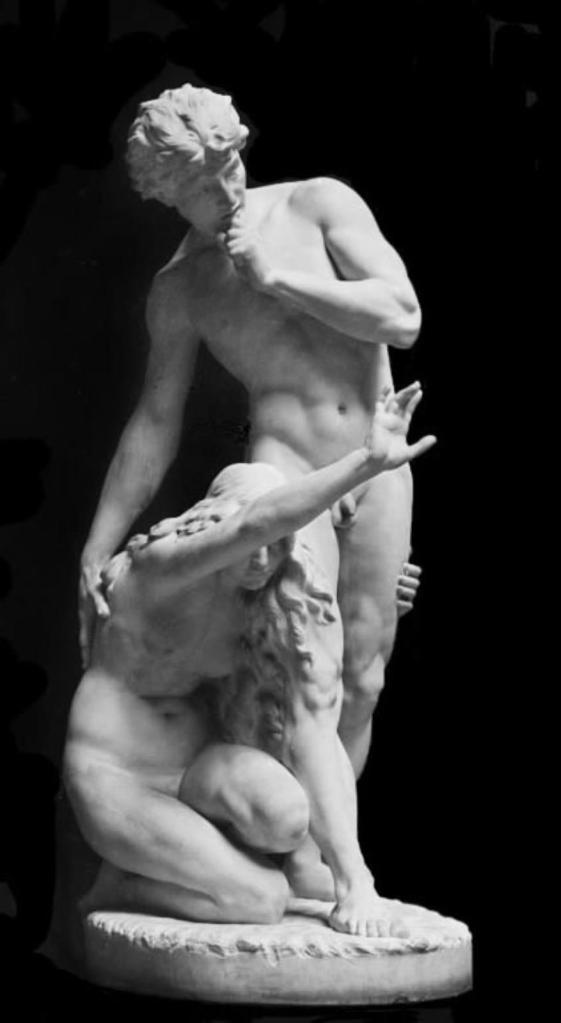
Image: Adam og Eva; Adam og Eva. Og Adam hørte Guds stemme; Adam and Eve
Creator: Julius Schultz
Repository: Statens Museum for Kunst Accession Number: KMS5305


Leave a Reply