Author’s Note: The following is an excerpt from the first of my talks in a series titled “The Journey.” This four part series was scheduled for members of the Beth Israel Congregation in Ann Arbor, Michigan.
Martin Buber, when translating the Bible from Hebrew to German, sought to faithfully convey the message of the words, not just their meaning, but the breath on which they were spoken. He wanted to capture not merely the text, but its similarities in sound and cadence.
We either forget or give scant attention to the fact that the spoken word is enshrined in the written word of our Jewish Bible. When we make the connection, we can appreciate that the first five books, the Torah, are a dialogue—words spoken on breaths—between God and Israel. Our lives are rooted in that dialogue. Dialogue is at the heart of Jewish spirituality, and our identity as individuals and as a community.
Our Sages and Rabbis throughout history have compelled us to open the Torah and explore the depth of its meaning and how it applies to our lives. And as they wrestled, we, too, grapple with the meaning and authority of the words. Today, in a period of word desacralization, this is harder. The Torah and the Siddur challenge us to consider the sacredness of language. We can neither trivialize nor debase words. To do so undermines both dialogue between the Divine and humanity and the holiness of our humanity—both our own and that of others.
The opening words, “Bereshit Bara Elohim Et Ha-Shamaim V-Et Ha-Aretz” (Genesis 1:1) articulate a faith that God originates creation, including humanity. Rabbi Abraham Joshua Heschel observes, “The Bible tells us nothing about God in Himself; all its sayings refer to His relationship to man.” The act of creation is the beginning of that relationship. That relationship is often baffling when we look back on our history and current events—the Holocaust, October 7, the rise of antisemitism and anti-Zionism.
But when we examine the Biblical text closely, it reveals the uniqueness of our humanity.
In the opening verse, “the earth being unformed and void, with darkness over the surface of the deep and a wind from God sweeping over the water” (Genesis 1:2). The Hebrew word for wind is ru-ah. This translates as either wind, breath, or spirit. Traditionally, we translate ru-ah as wind. But the psalmist uses “breath” to describe the Divine’s creative activity.
“By the word of GOD the heavens were made,/by the breath of God’s mouth, all their host” (Psalm 33.6).
Commenting on Genesis 2:7, in his Perush al ha-Torah (Commentary on the Torah), Radak (David Kimhi), a Medieval scholar, makes the observation:
“ G’d blew into man some of the spirit prevailing in the highest regions on earth. Whereas the life force of the animals is described as נפש חיים, something abstract but originating in physical earth, man’s life force is called here נשמה, to alert us to the fact that the origin of this life force is not physical, has not been supplied by earth, in fact could not have been supplied by earth. Our verse illustrates what G’d had meant when He had announced that man would be בצלמנו כדמותנו, “in Our image, Our likeness” (Genesis 1:26).”
Nachmanides (Rabbi Moshe ben Nachman), a 13th-century Sephardic rabbi and scholar commenting on Genesis 2:7 delves further into the meaning of the creation of humanity in Ramban al Ha Torah; (Ramban: Commentary on the Torah).
“…let us make man, the earth to bring forth the body from its elements as it did with cattle and beasts, as it is written, And the Eternal G-d formed man of the dust of the ground (Genesis 2:7), and He, blessed be He, to give the spirit from His mouth, the Supreme One, as it is written, And He breathed into his nostrils the breath of life. And He said, In our image, and after our likeness, as man will then be similar to both. In the capacity of his body, he will be similar to the earth from which he was taken, and in spirit he will be similar to the higher beings, because it [the spirit] is not a body and will not die” (Ramban: Commentary on the Torah, Rabbi Charles B. Chavel, vol. 1, p. 52).
The Birkot ha-Shachar (the Dawn Blessings), are prayers of gratitude for our soul: “You created it,/You formed it,/You breathed it into me.” We also express gratitude for our bodies: “Barukh attah Adonai, our God, sovereign of time and space, who crafted the human body with wisdom…” (Siddur Lev Shalem, 99).
Our lungs are one aspect of the complexity of our bodies. Dr. Michael J. Stephen of the American Lung Association speaks to the intricacy of our lungs. “The lungs are a miracle of design, packing some 480 million gas exchange units, or alveoli, into a small area. Arranged on end, the tubes of our lungs would stretch for fifteen hundred miles. Each day we take some 20,000 breaths, about 7.5 million breaths each year. This work is all done by an organ that resembles a sponge, with a thin lacy structure, the alveoli under constant stress from being in direct contact with the environment and all its pollutants, bacteria and viruses.”
“The spirit of God formed me;/The breath of Shaddai sustains me” (Job 33.4). Each day, we use a small portion of our breaths to acknowledge the Divine in words by reciting the Shema.
Shema Yisrael, Adonai Eloheinu, Adonai Echad (שְׁמַע יִשְׂרָאֵל יְהוָה אֱלֹהֵינוּ יְהוָה אֶחָד). (Siddur Lev Shalem, 155) Deuteronomy 6:4).
This prayer of six words is structured not to be rushed. There are deliberate pauses; notice the commas in both the transliteration and English. We pause to reflect on the words and take a breath. In our breathing, as we exhale, we return to God the breaths we have inhaled. These are the breaths the Divine has given us. In our daily breaths, we acknowledge the Oneness, the breath of Adonai that permeates creation. It is the Divine’s breath that created and sustains life—the entirety of creation, ranging from the universe’s smallest particles, the neutrino, to gluons—bosons that bind together quarks, and the massless particles with zero mass (keeping in mind that all fundamental particles have no size), to the galaxies and our bodies. In the Shema, we acknowledge the unity, the Oneness of God, and the unity of all creation within that Oneness.
Gratitude doesn’t come naturally to us. Rabbi Jonathan Sacks notes, “The word Modeh, ‘I give thanks,” comes from the same root as Yehudi, meaning ‘Jew.’ We acquired this name from Jacob’s fourth son, named by his mother Leah who, at his birth said, “This time I will thank God” (Gen. 29:35). Jewishness is thankfulness: not the most obvious definition of Jewish identity, but by far the most life-enhancing.”
Our life journey begins with that breath into the dust. Genesis 2:7 reminds us that we are both of the earth, dust, and spirit. However, the Birkot ha-Shachar ( the Morning Blessing) reminds us to live in gratitude for the life we have, while the Shema reminds us of before Whom we stand and our responsibilities not only for ourselves, but for others.
Taking A Breath With Gratitude ©2026 Charles van Heck
Title:
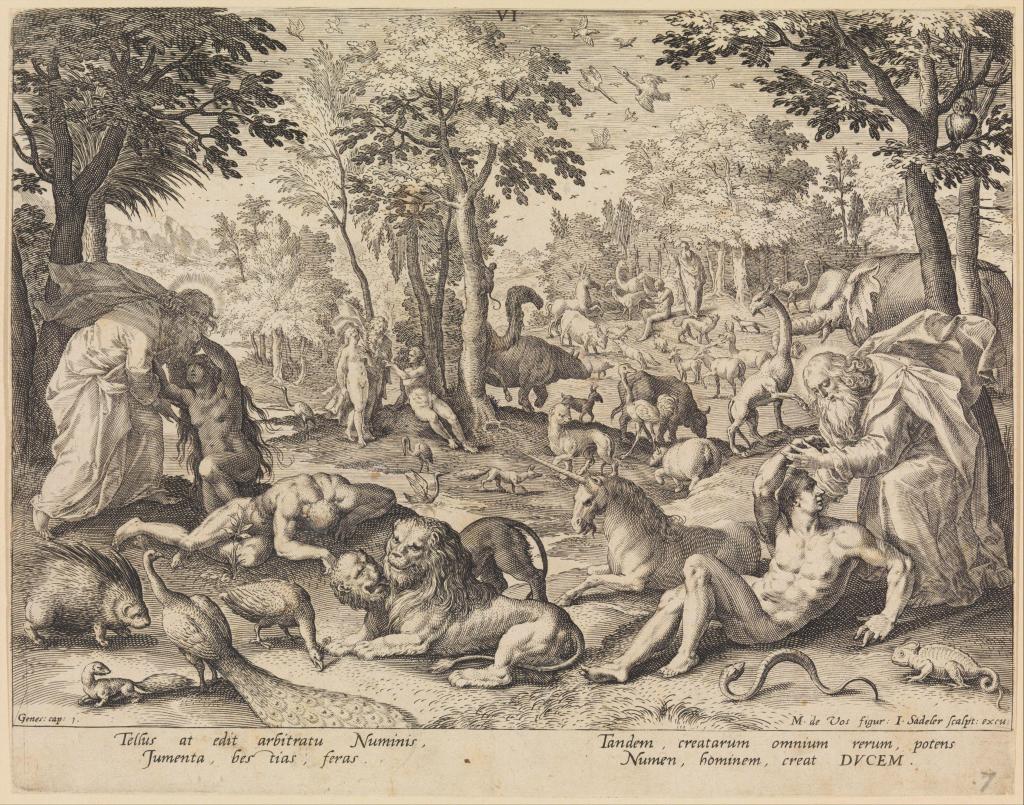
The Sixth Day: The Creation of Animals, Adam and Eve from The Creation of the World
Creator:
Artist: Johann Sadeler I (Netherlandish, Brussels 1550–1600/1601 Venice)
Artist: After Maerten de Vos (Netherlandish, Antwerp 1532–1603 Antwerp)
Credit Line
The Metropolitan Museum of Art; Drawings and Prints, The Elisha Whittelsey Collection, The Elisha Whittelsey Fund, 1951 51.501.1769(7)
https://www.jstor.org/stable/community.18749275
This item is openly available as part of an Open Artstor collection.


Leave a Reply