by Amber Harvey
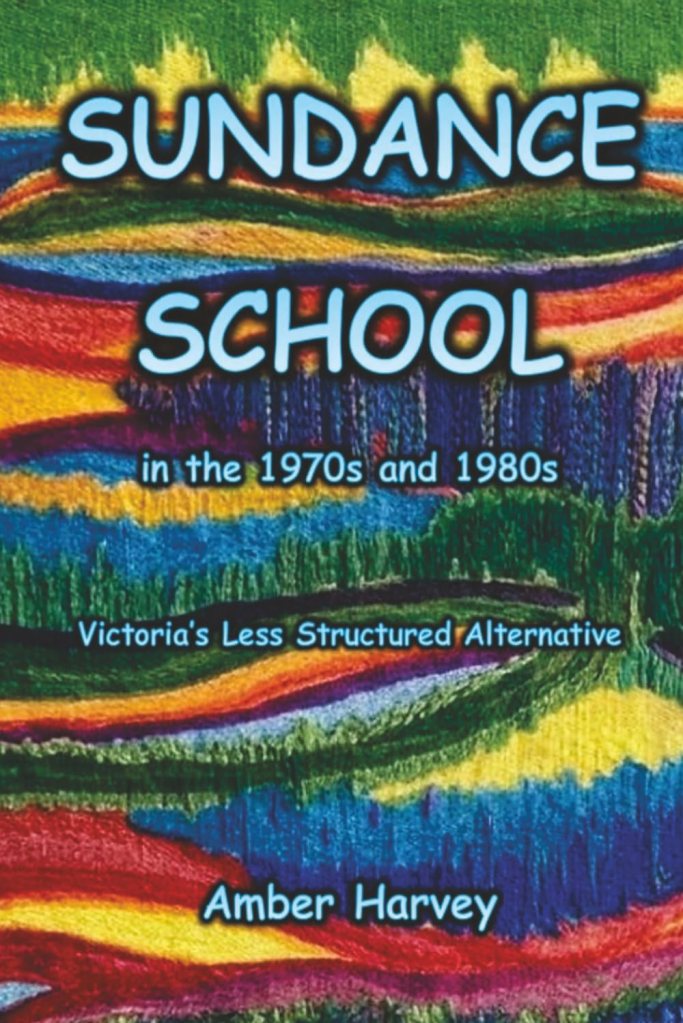
Sundance School was an experimental elementary school set up in Victoria, BC, Canada, in the early 1970s. Adults, who were adamant that their children would not have the same school experiences their parents had endured, approached the school board and persuaded them to give the idea of a less-structured school a three-year trial. The school board agreed that if it was seen to be successful, they would continue to support it. The Sundance School continued as an alternative for 17 years.
My first child joined Sundance School in 1976 and our second child in 1981, when I came on board as a teacher. We detested the top-down approach to educating children, where the teacher made all the choices, and the children had to go along with them. My husband and I, like other parents, didn’t agree with kids being expected to sit at desks for hours every day, despite their need to move and play. We wanted children to have a choice in what they learned and when they learned it. We wanted them to be able to build on their individual strengths. Also, we didn’t like how conflict was often handled in schools, where children were reprimanded but not taught peaceful conflict-resolution skills. We were against expecting children to remain silent for much of the day when their thoughts and feelings were important and needed to be expressed. Of equal importance was a more active role for parents. Too often this is limited to dropping their kids off, picking them up, reading report cards, and, once in a while, driving on a field trip or baking cookies for a bake sale.
Those who founded the school opposed the lock-step style in which all children were taught the same things at the same time in the same way and were expected to have the same learning goals. No two learners are identical in their learning needs, and grading student work according to some arbitrary standard was pointless. Fortunately, Standardized Tests were not yet in vogue, so that wasn’t an issue for the school to contend with.
Sundance parents and teachers strove to create a school where children’s voices mattered, a school entirely different from the schools of the time. Our goal was to do everything in a new and kinder way, to make a school that didn’t harm children. This meant meeting the needs of the whole child—their bodies, their minds, their emotions, and their inner spark of uniqueness. We were committed to creating a completely more egalitarian and more child-centered educational experience for our children. To accomplish this, the staff and parents had to be creative as we went along.
Although called a “less-structured” school, our school had its own, alternative structures to those of the traditional schools. We were organized as multi-aged families, met in circles rather than sitting at desks in lines. The students chose their classes, what we called “offerings,” and everyone was addressed by their first names. Children helped make decisions, solved problems, and could always choose to play outside.
Our curriculum similar to all public schools, in that we taught reading, writing, and arithmetic, as well as science, social studies, fine arts, physical education, and so on. The differences lay in how we taught the subjects by letting students participate fully. They did not just learn about history; they lived it. They participated as though they were living in that time period and helped create an environment where they were members of a certain society, playing different roles. Our students conducted science experiments, not just read about them. They wrote and acted in plays.
It became clear to me when reading the former students’ responses to questionnaires that we had one overriding curriculum subject. Our students learned how to live peacefully in the world; for many, this skill was the main and most important thing they learned at Sundance. They were taught communication skills every day through direct teaching and example. They participated in special groups where they looked at communication and saw how peaceful responses could replace angry responses. They developed friendships based on respectful and peaceful communication. The staff continued to hone their own communication skills, and we all attended a group session with a professional counselor once a month.
Students were taught that everyone is to be valued. We accepted and celebrated differences. Our guiding principle was that everyone deserves to be listened to and spoken to respectfully. We wanted our students to learn to take responsibility for their own behaviour. As teachers, we worked on the principle that people need to hear more positive comments than negative ones. We valued and encouraged conversation among students rather than demanding silence, so different from other schools.
Unlike children being homeschooled by their parents, our students had several professionally trained teachers, and they came from diverse backgrounds, with expertise in a variety of areas. We had people on staff with science degrees, French language backgrounds, music degrees, fitness instructor training, outdoor education backgrounds, crafts knowledge, and so on.
Because we believed that this was the best way for children to learn, the staff enrolled our own children in the school. And when we didn’t feel our staff or our facilities were able to meet the needs of the students satisfactorily, we turned to the parents and the wider community and enlisted their expertise.
I fully believe that though the 2020s are different from the 1970s in so many ways, there is much that can be learned from studying Sundance School’s history.
Amber Harvey is a retired educator and author of young adult books. The newest is Mayne Island Skeletons. She can be reached through https://x.com/treewithroots or on https://www.facebook.com/amber.harvey1
Editor Note: I received a draft of Sundance School by Ms. Harvey in October of last year. At that time, I wrote an essay titled “Sundance and the Search for Alternative Education.” This essay can be found here in the archives. The book is about more than the history of an experiment; it offers insights into what educators can do to enhance their students’ learning experience. This is a book that parents and educators, and those searching for ways to improve the educational environment, need to read. Sundance School is available through Amazon. Reviews of the book follow below.
Reviews
This is a fabulous book. It is a tapestry of inclusive Child affirming values and how those values manifested in a school setting. I highly recommend this book. Full disclosure, I taught at this school for over 10 years and it was one of the highlights of my life. —Evie Chauncey

This is a must read for anyone interested in alternative education. Student-centered learning and parent participation. In a very conversational style the author brings alive a unique school, its students, teachers and parents. This book is full of heart and hope about what education can be. —Becky Canterbury

Such a great read!!! So informative and interesting. If you went to Sundance it’s an amazing trip down memory lane, and if you didn’t, it’s still so incredible to learn about this school! Highly recommend it! —Matt Witchard

I was lucky enough to go to this school, and this book is the most amazing time capsule! A trip down memory lane with extra context! I highly recommend it to any ex Sundancers! Or anyone who has an ex Sundance kid in their life! Will help with context as to who we are now! Going to school in that incredible environment was so special and helped shape us. But even if you never went or don’t know anyone who did, still such a good read! So interesting to learn about that time in history and how this school started and why. Highly recommended indeed! —Kate H


Leave a Reply