
Let me take you down, 'cause I'm going to Strawberry Fields
Nothing is real and nothing to get hung about
Strawberry Fields forever

A cacophony of carnival sounds carry on the evening's warm breeze. Sideshow barkers call for our attention. "Step right up. Two bitcoins to see the incredible Mr. Donnie." In the dim tent light, there is a poster of William McKinley boldly announcing, “Defending American Labor: Tariffs Encourage and Protect Your Interest.” A second poster of Harry Houdini reads, “Escape the illusions of a Fact-Checking News Media.”  An aroma of straw and popcorn ripens the air.

 A woman in a bathing suit and a MAGA baseball cap crosses the stage with a placard: “High-I.Q. academic elites are destroying democracy. The world can only be saved by high-I.Q. Silicon Valley elites.” The stage gold curtain parts. The weightlifter, with orange hair, wearing boxing shorts, stands on a stage. Holding hamburgers in each hand, he flexes his tattooed biceps. His golden weightlifting belt proclaims, "World Heavyweight Champion." When he squints and smirks, he looks like a frog and wiggles. The audience wildly applauds.
“Isn’t he great. I hear he can lift a thousand pounds of Commie and immigrant weight in one hand,” our middle child, Jackson, yells. The audience cheers.
After Mr. Donnie’s show, we see a poster for the funhouse. “Can we go in, Dad?” Noctis, our youngest child asks. “They have AI mirrors.”
“I don’t think this a good idea,” Fredrick, our oldest says, “Reality becomes distorted, wacky and paranoid ideas mirror themselves.” Despite his objections, we buy our tickets, and we step in to be contorted by the Artificial Intelligence mirrors.
Frederick decides to pontificate. He tells us that Artificial Intelligence further twists what we perceive. By its own admission, or at least the acknowledgment of a report from Stanford University, “Artificial intelligence distorts the world by eroding shared objective reality, amplifying systemic bias, and accelerating resource depletion. It replaces authentic human connection and factual verification with synthetic information and algorithmic prediction.” https://ai100.stanford.edu/gathering-strength-gathering-storms-one-hundred-year-study-artificial-intelligence-ai100-2021-1-0
Frederick continues by quoting a 2025 post by Roland Meyer, a professor of Digital Cultures and Arts at the University of Zurich.
In recent weeks, we’ve seen a wave of AI-generated images of white, blonde families presented by neo-fascist online accounts as models of a desirable future. As disgusting as this is, it seems no coincidence that AI is being used for reactionary propaganda. Generative AI is structurally conservative, even nostalgic. Everything it produces is based on interpolating existing data. In a way, it’s a backward prediction: It makes plausible guesses on what could have been, based on images from the past.
But we are here for fun. And the mirrors give us just that. This is how we see ourselves in the mirrors. Oh, if only…

Frederick is now lecturing me on how AI distorts the relationship between genders. As Nesrine Malik reported in The Guardian, “…“trad wife” content, which summons not only beautiful supplicant homemakers, but an entire throwback world in which men can immerse themselves. X timelines are awash with a sort of clothed nonsexual pornography, as AI images of women described as comely, fertile and submissive glimmer on the screen” (https://www.theguardian.com/commentisfree/2025/apr/21/ai-slop-artificial-intelligence-social-media)
“That’s enough, Fred. Hey, everybody, how about we get cotton candy and corndogs? Maybe we will connect with other believers at the stand.” Frederick declines. He wants a bowl of fresh strawberries. “They’re real and healthy,” he tells his siblings. “Yuck,” is their spontaneous, in unison response.
Then Helena, my wife, asked if we could go on the Ferris Wheel. We no sooner get off the ride than Frederick tells us that AI is desensitizing us and trivializing our lives. We are hooked on undeletable apps from Google AI, Meta AI, among others. Our telephones, televisions, vehicles, and computers connect to an empty void of addiction. We become lost in an endless loop that takes our jobs and relationships—our humanity. A.I. is as deceptive as narcotics and alcohol for a junkie and an alcoholic who deceives themselves that they can control their habit. He quotes Massachusetts Institute of Technology Professor Peter S. Park:
AI systems are already capable of deceiving humans. Deception is the systematic inducement of false beliefs in others to accomplish some outcome other than the truth. Large language models and other AI systems have already learned, from their training, the ability to deceive via techniques such as manipulation, sycophancy, and cheating the safety test. AI’s increasing capabilities at deception pose serious risks, ranging from short-term risks, such as fraud and election tampering, to long-term risks, such as losing control of AI systems. Proactive solutions are needed, such as regulatory frameworks to assess AI deception risks, laws requiring transparency about AI interactions, and further research into detecting and preventing AI deception. Proactively addressing the problem of AI deception is crucial to ensure that AI acts as a beneficial technology that augments rather than destabilizes human knowledge, discourse, and institutions. (https://pmc.ncbi.nlm.nih.gov/articles/PMC11117051/).
Helena frowns at him. “Try to enjoy yourself, Frederick.”

Upbeat band organ music blares and lights flash from the carousel with its decorated horses, unicorns, peacocks and bench seats. The ride operator introduces himself as Mr. Optimizer. He prompts us with his smile. “I’ll tell you what creature to ride. Forget deciding for yourself. Its all about the algorithm, just relax and enjoy the ride.”
“We do possess free will, you know. Algorithms shield us from reality and confuse truth-seeking with truth itself. I believe creativity, regardless of its form of expression, is about the pursuit of truth,” Frederick tells Mr. Optimizer.
I take a bite of my corndog. “Ask yourself, son, on what does our creativity rest? Does creativity owe itself to everyday experience, those encounters with others, nature, literature, and reflection?” I shake my head. “We are better off with AI thinking for us.”
“Get on your unicorn, dear Frederick, and stop thinking so much,” Helena says.
A moment later, shouts, screams, and joyous laughter attract our attention to the Shenzhou Flying Saucer. We jump on the ride that spins on an enormous U-shaped slide, flying into space on an ascending-and-descending rotating disc. The ride gives us a chance to share our experiences with others. The riders tell us about their followers in the Great American Popular Movement. They receive daily prompts from the GAPM of what to think about, then publish their reflections online. I overhear a young woman say she has 2,000 subscribers. “I beat that,” her friend boasts, “I have 5,000.”
Frederick wonders aloud about their aspirations: pursuing numbers or quality material? “You do know,” he says to the young woman sitting across from him, “that thinking for yourself, research, and revision are the backbone of good writing.”
My son is starting to embarrass me.
“I don’t like you,” the young woman replies, tucking her blonde hair into a MAGA hat.
The hour is late. I am carrying Jackson. He sleepily says he doesn’t want to go home. “One more ride,” he says through a yawn. Helena carries Noctis, who is sound asleep. Frederick is a few paces behind us. Glancing back at him, I notice he has stopped walking. He is surveying the Strawberry Fields Carnival Grounds. When he turns, he is smiling. For a moment, I feel hope that he will come around to accepting the world where nothing is real. What can go wrong? Afterall, there is nothing to get hung about.

Images
Carnival: Photo: Photo by Sally K on Unsplash
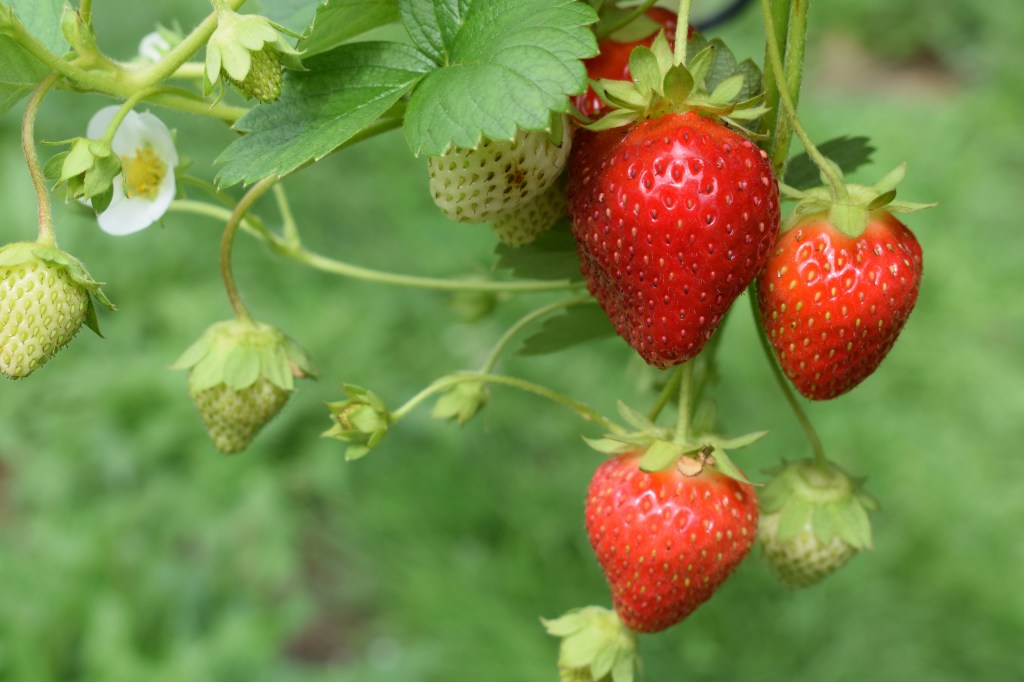
Strawberries: Photo by Justus Menke on Unsplash
Family: from Roland Meyer, a professor of Digital Cultures and Arts at the University of Zurich
Interior of a Data Center, Photo by Eric Stoynov on Unsplash
Interior of a Data Center: Photo by Winston Chen on Unsplash
Strawberry Fields Writer(s): Paul McCartney, John Lennon
Strawberry Fields Forever lyrics © Sony/atv Tunes Llc, Harrisongs Ltd, Mpl Communications Inc
Our Carnival Night In Strawberry Fields ©2026 Charles van Heck


 Charles van Heck's Woodhull Journal
Leave a comment