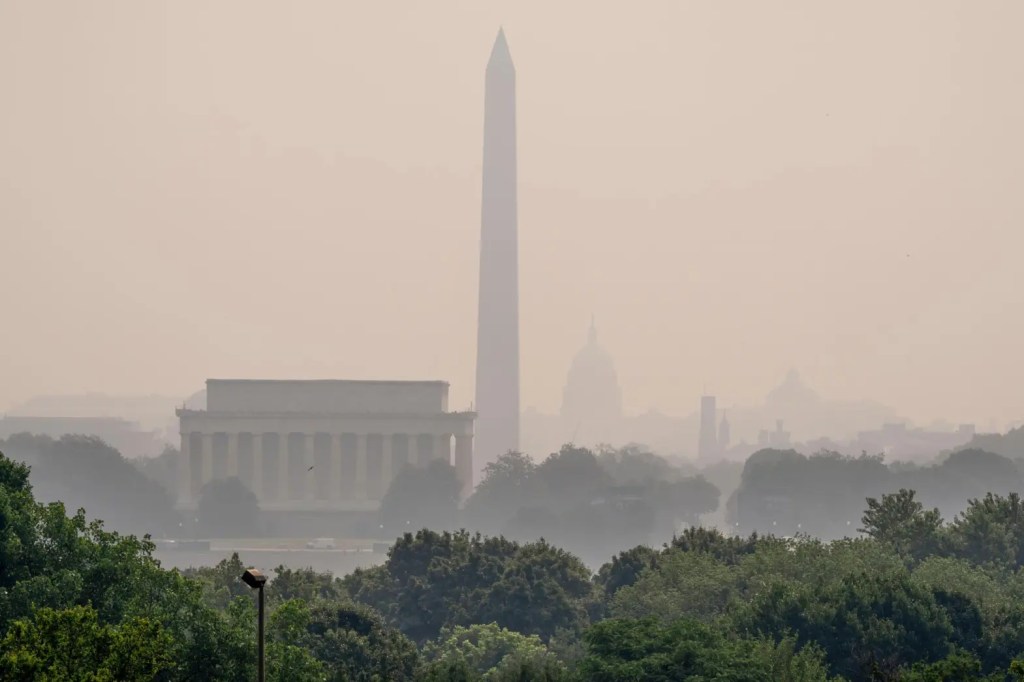
Marine One pulsed the air on the Ellipse this past Friday. The circular motion of the helicopter’s blades churned as it lifted and pitched, rising into the smoky haze obscuring Washington, D.C. Donald Trump looked out the window. Previously, he expressed his opinion on the pollution caused by wildfires.
“We are holding Canada responsible for the fact that they are not properly maintaining their Forests, and Brush therein, and the United States is being unnecessarily invaded by filthy, polluted, and unhealthy air, the quality of which is dangerous and totally unacceptable!” Trump wrote in a Truth Social post.
What is disconcerting is that most of the news media, like Trump, and many citizens, refer to the thick wildfire smoke draping the States as “smoke from Canada.” There is willful ignorance in categorizing this as a Canadian problem. They ignore the fires burning in the States. The meteorologist Armel Castellan points out, “This has been primarily a U.S.-dominated wildfire season.” Castellan is more than the person who gives us the local weather report. He is an extreme heat services technical advisor with the World Meteorological Organization (WMO).
Those who solely blame Canada also ignore the fact that Canadians are on the frontlines of the fires burning in the States.
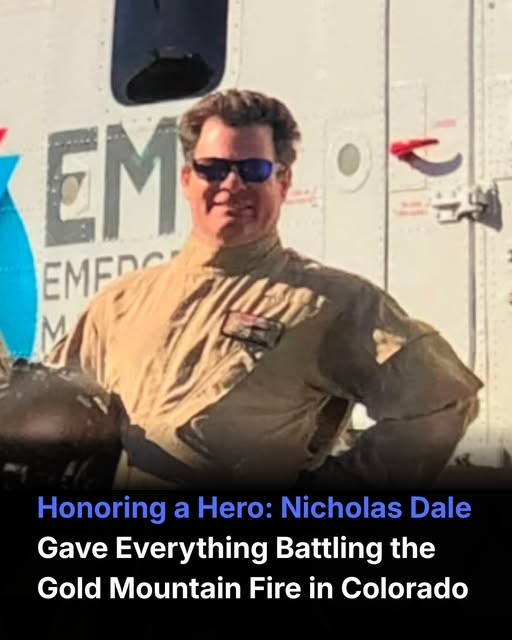
On July 13th, Nicholas Dale of Sooke, British Columbia, was piloting a K-MAX helicopter when the aircraft crashed into Silver Jack Reservoir in Colorado. A frontline fire aviation pilot, he was 56 years old, married with two children, and a Canadian serving American citizens. Currently, the Gold Mountain fire, where he was serving, now covers more than 36,000 acres and is only 11% contained in remote alpine country.
The Aspen Acres wildfire in Southern Colorado has consumed 90,000 acres of forested land, burned hundreds of structures, and forced the evacuation of entire communities. The fire is 34% contained.
According to the U. S National Interagency Fire Center, there are “73 large fires across the country, including 17 new large incidents. 17,683 firefighters and support personnel are engaged in nationwide fire activity, including 374 crews, 1,081 engines, and 139 helicopters.” The agency reports that in the States, we are “at national preparedness level 5, indicating the highest level of resource mobilization and preparedness.” This year, there have been 40,357 wildfires that have burned 3.8 million acres to date (18 July). https://www.nifc.gov/fire-information/nfn
“Because of global climate change and the warming of the planet, we’re drying out vegetation much more than we did in the past, and that makes it more susceptible to fire,” said Jonathan Overpeck, a climate scientist and dean at the University of Michigan. https://www.cbc.ca/news/science/wildfire-climate-emissions-smoke-9.7274862
Political rhetoric does a disservice to both citizens in the States and Canada. Aric Nesbitt, a Michigan state lawmaker, posted on X, “Hey Canada, “just let it burn” is not a solution. Unless you want to become the 51st state, learn to manage your forests.”
Republican Representatives John James (Mich.), Jack Bergman (Mich.), John Moolenaar (Mich.) and Lisa McClain (Mich.) wrote in a letter addressed to Prime Minister Mark Carney, “This is the third consecutive year we have had to write to Canadian officials about a crisis that Canada has the tools to prevent and has chosen not to.”
This past Thursday, U.S. Senator Bernie Moreno announced on social media, “I’ll be introducing a bill next week to sanction Canada and the responsible Canadian government officials for this atrocity.” The atrocity is the hazardous haze of “Canadian smoke” reducing air quality.
The political representatives neither offer assistance to U.S. and Canadian firefighters on the front lines nor propose legislation for U.S.-Canadian cooperation in the “proper” maintenance of “Forest, and Bush,” and measures to address climate change. Instead, they add to the toxicity of the political atmosphere as their constituents breathe in soot and dust particles. Let these politicians write letters of condolence and gratitude to Nicholas Dale’s widow and children, and the families of the other firefighters who have died. If they are truly concerned about the health of their constituents, they should propose legislation to strengthen FEMA, the Forest Service, and the EPA, among other agencies, to address the environmental crisis and provide assistance to those communities destroyed by wildfires. Instead, Trump and others speak about sanctions against Canada. Their attitude is nothing short of an abuse of political power and expresses indifference.
Pete Hoekstra, the U.S. ambassador to Canada, recently posted on social media, “This challenge knows no borders. The United States will continue to coordinate closely with Canada, just as we have for more than four decades of shared wildfire emergencies.”
Mark Carney is correct when he responded in French to Trump’s post, “La lutte contre le changement climatique relève de la responsabilité de tous les pays, y compris les États-Unis.“ (“Fighting climate change is the responsibility of all countries, including the United States.”).
Wildfires are a harbinger of political, societal, and economic instability due to climate change. Rather than repeat myself here, I would refer you to my essay titled The Environment of Dante’s Inferno. The crisis we face is a moral and ethical one that calls for international cooperation and a resolute will to develop and apply those solutions.
Images and a Note to Readers
Photograph One: The Lincoln Memorial, the Washington Monument, and the U.S. Capitol, are barely visible from an overlook in Arlington, Va., as heavy smoke from wildfires shrouds the landscape in Washington, Friday, July 17, 2026. (AP Photo/J. Scott Applewhite as found in The Greeley Tribune, https://www.greeleytribune.com/2026/07/17/climate-wildfires-smoke/)

Photograph Two: Nicholas Dale of Sooke, British Columbia

Note to Readers
Though copyrighted, I give permission to readers to share this and my essay “The Environment of Dante’s Inferno” in any manner they choose. However, this does not apply to use in an AI-generated format, and the text cannot be modified or changed in any manner without my written consent.

You will find valuable information about Canadian forests on Jean E. Pendziwol's Facebook page. Ms. Pendziwol is an award winning author.

Toxicity ©2026 Charles van Heck


 Charles van Heck's Woodhull Journal
Leave a comment