Ours is an age of envy, distrust, and the rhetoric of a revolutionary impulse that creates an abstraction of our humanity.
The Library of Congress catalog contains tens of thousands of entries related to both the Democratic and Republican parties. There are political histories, platforms, biographies, memoirs, and historical analyses. According to sources, although no comprehensive catalog exists, there are an estimated 60,000 to 100,000 books on the American Civil War. The Civil War books cover every genre of nonfiction and fiction. You could say the market is overpopulated in both areas of interest for authors and readers.
One title that stands out, at least to my mind, in the catalog is David M. Potter’s THE IMPENDING CRISIS, 1848–1861. Published in 1976, this is a single-volume survey of the political events leading to succession and the war. A future historian may want to consider using the title with a slight revision. The Impending Crisis, 1946-2028.
I am among those who think the deep political divisions in the States are leading to a crisis that neither political party is capable of averting. This, of course, is an acknowledgment of my skepticism and pessimism. My thinking is based on the perception that the leadership of both political parties has abandoned their philosophical commitments to democratic values—with humane domestic and foreign policies. The current tensions, the pitched rhetoric that denies openness to compromise, and the sectarian conflict between rival factions within the parties can only lead to more political violence. The silence and silencing of the majority of citizens is tinder for the fire.
The moral and political ordeal of the Civil War, with its tragic mythos, should serve as a warning to us. The poet and the Hickman Professor of Humanities at the College of William & Mary, Henry Hart, writes:
Although Confederates and Unionists met at veterans’ reunions after the war and worked to heal a politically divided country, from a twenty-first-century perspective, it is hard to envision the Civil War mythos as comedic rather than tragic. Wounds still persist. Having plunged into an inferno, America floundered through the purgatorio of postwar reconstruction and counter-construction. A harmonious union remained an ideal evoked in vacuous political rhetoric at odds with reality. As we look back at the Civil War, feelings associated with the “tragic sublime”—horror and awe—prevail rather than the joy elicited by comedy’s reconciliations.
Most voters testify to their need for a cathartic response to the current state of affairs. That they want to vent all their frustrations and distrust is apparent from the polls. Jonathan Chait, a staff writer at The Atlantic, provides an example of the frustration and tension he observes in voters’ responses to the Democratic Socialists of America (DSA). The DSA has become a prominent force within the Democratic Party. He writes, “Although Democratic voters approve of the DSA, voters as a whole do not. A national poll found the group’s approval at 21 percent, and 48 percent disapproved. (The same poll had 36 percent approval of the Democrats.) Its specific platform components are, if anything, less popular.” (1)
The Marquette Law School Supreme Court Poll May 20 – 26, 2026 provides insight into the current divide among voters(2).
I was intrigued by the response to two poll questions. When asked whether they trust the government, 19% responded “most of the time,” 58% “only some of the time,” and 21% “never.” Voters were then asked how much they trust other people. 52% replied that people can be trusted, while 48% expressed distrust.
As Jacob Howland noted in a recent essay, this speaks to “The dissolution of organic relationships, of shared, centuries- and millennia-old modes and practices of life in community, is both a symptom and a cause of the rapid decline of trust in our society. Public interactions have become coarser, harsher, and more aggressive in recent decades, and calculation, a busy little personal accountant, counsels that the risk of investing time and energy in them is too high, the return too low. But voluntary associations of all sorts are also dwindling. Kierkegaard attributes this decay to the predominance of reflection in our excessively abstract age. That’s because reflection ambiguates reality—or, as academics now say, ‘problematizes’ it. Kierkegaard describes that negative and critical activity as reflection’s envy.”(3)
Today, voters are presented with, on one hand, the options of the “America First” MAGA candidates, and on the other, the “Socialist progressives.” The candidates, even the most uncouth, who speak the loudest and have “charisma” draw the attention of the moderates. Our tendency is to ignore both the character and policies of those who articulate the mantra, “I’ll fight for you.” We perceive their energy and think of them as authentic and unpretentious. We fail to recognize that the two extremes divide us further, and have been historically discredited (e.g. National Socialism in Germany, and the Russian Communist Party). The loudest voices drown out reason. Their inability to listen to voices other than their own, to negotiate and compromise, undermines the democratic principles upon which the Republic rests. In the end, as history instructs, they accomplish little of substance. (4)
I think there are two questions that need to be reflected on and asked: first, what ethic will guide us away from the edge of the inferno of our discord and bring us to the “practices of life in community?” Secondly, what meaningful actions do we want the government to take, and who do we want to represent us to reasonably achieve those objectives?
Ours is a time of toxicity. What does vehement rhetoric accomplish? The answer to this question can be found in Potter’s book. Today, we can perceive it in the Trumpian and DSA “burn it all down” rhetoric. The political extremes envy the power of the other. They stroke our envy with promises to achieve their political power. What they deliver is authoritarianism.
“Every physician will admit,” Kierkegaard writes, “that by the correct diagnosis of a malady more than half the fight against it is won; also that if the correct diagnosis has not been made, all skill and all care and attention will be of little avail.” (4)
Only we the people can heal a politically divided country. The choice is ours between other/rather than.
References
- “There’s Nothing Democratic About These Socialists” by Jonathan Chait https://www.theatlantic.com/ideas/2026/07/dsa-communist-socialist-democrats/687756
2. The Marquette Law School Supreme Court Poll May 20 – 26, 2026 https://law.marquette.edu/assets/community/poll/MLSPSC32/MLSPSC32Toplines_NationalIssues.html
3. “Kierkegaard & the age”, by Jacob Howland https://newcriterion.com/article/kierkegaard-the-age
4. David Brooks provides a succinct essay on the struggle between mainstream Democrats and the extreme progressive left during the 1940s in “Democrats Became Great by Fighting the Left” https://www.theatlantic.com/ideas/2026/07/democrats-fight-left-dsa/687839/
5. Sӧren Kierkegaard, “The Present Moment,” in Selections from the Writings of Kierkegaard, translated by Lee M. Hollander, 225.
Image:
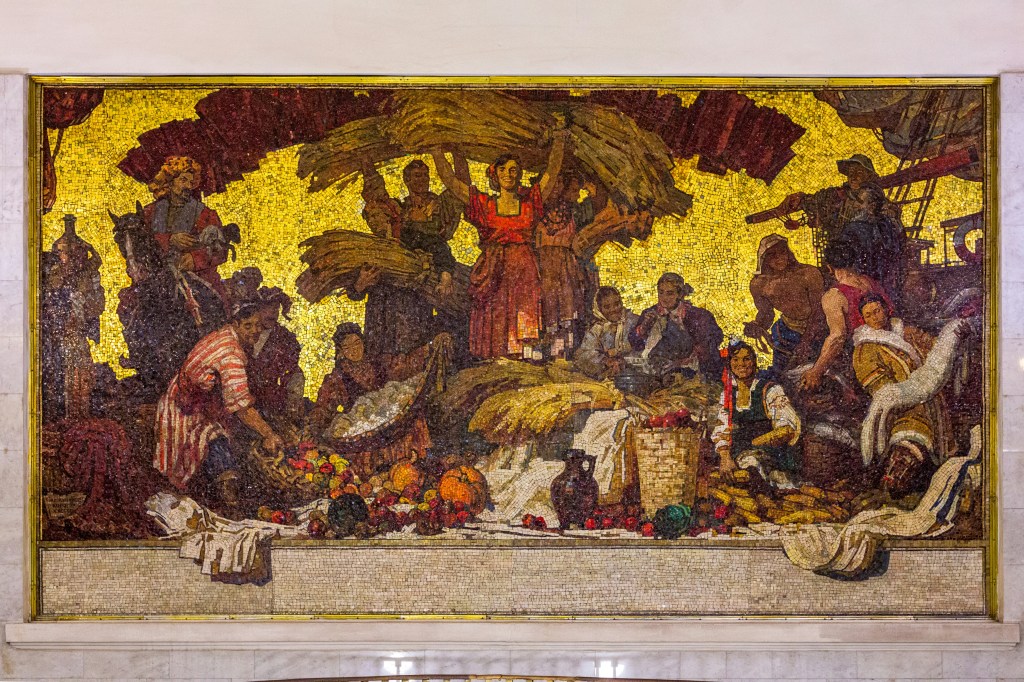
Photo by Soviet Artefacts on Unsplash
Kierkegaard, OTHER/RATHER THAN ©2026 Charles van Heck


Leave a Reply