I have been sifting through interviews of artists that I conducted for The Woodhull Arts Journal. Among those interviewed was Chrissy Mount Kapp, the Vintage Painter. Chrissy’s paintings are vintage and historical Americana themed. She is also a practical businesswoman. Our interview, conducted fourteen years ago, was wide-ranging and in-depth. Whether you are an aspiring artist, already one, or take pleasure in art, I think you will find encouragement and insight into the artistic life. My hope is that those of you with children or grandchildren will encourage their creativity after reading this. Because of the interview’s length, I have divided it into two parts. Part Two will appear later in the week.
Part One: Chrissy Mount (Kapp) in Her Own Words
CVH: You studied graphic design at the University of Wisconsin-Stout. While attending university, you were selected to study in Germany at the Fachhochschule Hildesheim/ Holzminden/Göttingen. The school is noted for its interdisciplinary program. There is also emphasis on practical application and innovation. Who are some of the people who influenced your creative development at both academic institutions?
CMK: I would say my parents were probably the most influential on my creative development while I was at college — even if it was from the shadows.
I was the first person in my family to go to college. As such, my parents were supportive of my goal to earn an education and offered to help me go to school on one condition – I had to get a “real” degree. No BFA. My dad’s reason was straightforward – artists can’t support themselves, so it would be a waste of time and money. If I wanted financial help for school, I would have to study a real program like graphic design so that I would have a career beyond college. Although my dad didn’t always understand what I was doing, he pushed me to not settle and to work towards what I wanted. I think I inherited my mom’s stubborn “going to do it my way” attitude. I simply go about meeting my goals in a quieter manner than she did. These qualities combined and resulted in me enrolling – and graduating from – the graphic design program, but taking all the life-drawing classes and every possible art elective I could squeeze into my schedule. I even took extracurricular life drawing classes. I possessed an internal drive to do what I had to do to be a painter even if I had to squeeze in twice as many classes.
I knew I was destined to be a painter but I also knew I had a lot to learn. One of the best instructors I had at Stout was Susan Hunt. She was one of the best for a variety of reasons but what sticks with me is she was the first female role model I remember that led with her intelligence as her first power. I never saw her use her charm or beauty to open doors. She showed me how a self-reliant woman acts and lives.
Mr. Todd Boppel (sadly he’s gone now) and Mr. Charles Wimmer were two of the most influential and passionate art teachers I met at Stout. They consistently showed support, concern and honest feedback for what I was doing. What I appreciate most about Mr. Wimmer is he taught me that creativity is actually a process. Creativity isn’t a lightning strike. Creativity is how you get from the lightning strike of a good idea to making the good idea happen. All too often people assume I popped out of the womb able to paint in a master’s style. Ninety-nine percent of great artists are not prodigies. They are disciplined workhorses.
Secondly, he taught me that a box should not confine me. Instead of looking to see what others are doing I am driven to create in a style that evolves on an internal linear path and not on an ad-hoc cultural trend line. This commitment has the additional benefit of resulting in paintings that are uniquely mine.
Mr. Boppel was a strong painter with 1960’s schooling. He loved teaching and it showed in his enthusiasm for every class. For example, I never signed my artwork and he would get mad and do it for me. He took a shine to my paintings and helped build my confidence as an artist. As a student from the graphic design department sometimes you were not taken seriously in the fine art classes. He recognized me as painter and encouraged me to pursue it with a passion. Now that I teach I hope to pass on some of that drive and passion to others. Of course, I only know this because I have the benefit of age and experience. At the time I thought these people were simply cool teachers.
Talking about my experience in Germany is a bit more complicated. There are a number of reasons for this. First of all, it was a tumultuous time in Germany and for me personally. During the time I was there the Wall between East and West Germany came down so many of my perceptions about life and art were formed by those magnificent experiences and the behaviors and attitudes of the Germans around me.
Secondly, when I went to Germany, I didn’t speak German and the instructors were not keen on speaking English to a sheltered and naïve American punk rocker. So I would sit in class and work independently from my German peers. Because of the language barrier I rarely took a lecture course and spent most of my time in art electives and visiting museums and galleries.
Lastly, during my time in Germany my family in Minnesota were going through a great deal of change and I was unable to be there.
CVH: How important is experimentation to your development as an artist? Who are some of the contemporary painters who have influenced you?
CMK: Experimentation was very important to me as an artist. As I mentioned, my time in Germany was not as structured as it could have been. As such, I made use of the time by working on my drawings, playing with watercolors, ink washes, pastels, markers and colored pencils. Although I took a lot of art classes in college and in high school I had only taken two painting classes in college. I couldn’t afford any more school, so I decided I would teach myself.
I did this by copying other artists from Picasso to Klimpt. I wanted to figure out how they created their works, what colors they used, how they mixed colors. In my self-taught lessons I created a series of works called “copycats”. I was not interested in being a painter “like” someone. I was more interested in the process. To make my works different I would impose a picture of a kitten or a cat in the picture to make it my own work.
As with many starting artists I had a fear of color and messing up my paintings so I decided to paint a large work in black and white to achieve the proper values. I then glazed layers of color on top of the grey scale. I found out later that this was actually a master’s technique called “grisaille.” I have created artwork using water colors, acrylics, oil crayons, mixed media and I later came back to oil paints. I have been working mainly in oils since 1995. The truth is, I enjoy all forms of art from abstract to realism but the style I like to paint looks best in oils. Some artists I have admired over the years include John Singer Sargent, Thomas Hart Benton, Frida Kahlo, Dante Gabriel Rossetti, Edward Hopper and Jean-Michael Basquiat.
CVH: William Sidney Mount (1807-1868) is your distant cousin. He was among the artists in the Hudson River School movement. You have written that Mount has exerted tremendous influence on your vision of yourself as an artist. What is that vision and how did Mount shape and influence that vision?
CMK: Have you ever sensed voices talking to you in your mind, gently guiding you and directing you down a path? I have such a voice in my head. It is easy to ignore it and put it out, but I think it is best to sit quietly and listen. My vision has been speaking to me as long as I can remember. As a young girl, I was always drawn to old black and white photos and loved hearing the stories behind the pictures. One of my first artworks was from an old black and white photo of my dad as a boy in his front yard feeding a squirrel. My grandfather would train them to do this for many years, and I, too, did it as a young girl.
It is no coincidence that during the 1990’s, while visiting the Chicago Art Institute, I would stumble upon a William Sidney Mount painting. I walked into a room and was immediately drawn to a painting. It was as if it was calling to me from across the room. The painting was a genre scene with figures in it, much like, but better than, what I was painting at the time. I thought, how could this be? I had never heard of him before. This began my journey into genealogy work. I just had to know if we were somehow related. It turns out the Mount family line is fairly easy to trace. I had my own information going back five generations, and the rest was already published on the Internet. The Mount family line came from Kent, England, and originated in the U.S. in 1660.
Finding this connection to WSM helped reconfirm my sense of purpose as a painter. Stumbling across this connection across time gave me a feeling of destiny that I was meant to be a painter. We had a lot in common, Painting in a traditional master’s way and the same sorts of themes. He was a sign maker by trade, the equivalent of a graphic designer today. Both of his brothers were also painters.
CVH: You have said that you love storytelling and history, that the American Dream fascinates you. In this sense, like William Sidney Mount, Winslow Homer, Andrew Wyeth, and Norman Rockwell, you are tapping into the deep roots of the American experience. Generally speaking, what is it about the American dream, its past history, that you want your viewers to understand and experience?
CMK: It started as a personal quest or journey. While doing my genealogy study on WSM, I learned a great deal about my own family and past. It was very humbling. My great aunt Sadie had written a true short story called “For the Land’s Sake” about the history of my family, of my great-grandparents, and their struggles in everyday life just to survive in the wild, uncharted spaces of Ladysmith, WI. It was a great true American story of survival and great accomplishments.
One of my grandfathers came to the U.S in 1906, a poor immigrant farmer with nothing but what he could carry. Through hard work and strong character, he later became a state representative for WI and was highly respected in his community. My great-grandmother was no pushover either. She worked alongside him, helping to farm the land and raise a family. Their sacrifices made me aware of how easy my life had been due to the sacrifices of earlier generations. It made me more aware of “everyday people.” The very people who made the heart of America, the people who came here with dreams and ambitions.
I hope that through my paintings, my audience will remember their own history and develop an appreciation of the sacrifices past generations have made to create the United States of America. Much of this formal and family history is not being taught or learned. As a result, much of it will be lost. My hope is that through my paintings, some people will take the time to learn and become more aware.
CVH: Your paintings also bring to mind the American realist painter and printmaker Edward Hooper. His paintings capture both the rural and urban scenes. One similarity between his work and yours is the frequent absence of action. Is there a deliberate thematic content quietly woven through your work, or is that content unintended?
CMK: My partner would probably argue that my paintings and their themes are probably a reflection of my personality more than the influence of any particular artist. He would describe me as deliberately quiet, too. However, you will find the influence of many different artists within my paintings, Edward Hopper being one of many. I think what the audience finds is more defined by their artistic literacy as opposed to my attempt to emulate an ideal. The truth is, I paint in a master’s style. As such, I am tied to certain restraints within the medium, resulting in similarities to other painters. I’m not looking to reinvent the process. I’m looking to grow my own vision.
I am not constrained by the medium but rather challenged by it. I like the challenge. It forces me to focus more deeply on the process and the development of the idea. The result of focusing on my own Vision is I often invent colors, add objects, people or places to the paintings. I will take out what I think is unimportant. My goal is to capture the moment. Some of my best paintings represent a moment between what happened last and what will happen next. So the viewer sees action, not through the painting, but rather through the act of visualization. My paintings have had that kind of impact on people. Stirring inside them some long forgotten memory from their past. There have been occasions where someone will walk into my booth and smile ear to ear, or I get the opposite, and someone will break out in tears.
CVH: Another similarity between your realist paintings and Hopper’s is the use of simplified details and shapes and the creation of mood with color. Your use of light is different from Hooper’s. Hooper’s use of light often brings out a sense of aloneness. In contrast, your use of light brings out a sense of nostalgia and intimacy. A viewer senses that you really know the people you portray. And how difficult is it to capture a person’s story, their essence, from a photograph and translate it to an oil portrait?
CMK: I like that you say my paintings bring out a sense of “intimacy.” The reality is, I paint based on impressions, and therefore, my paintings are really not about the details. For example, one of my most popular prints is based on the painting “The Sunbath.” When people look at that painting, they don’t see my cat, Lucy. They see their cat. They see their orange tabby. In reality, what they feel is the joy and love of THEIR cat. They see every moment in their life with that cat, and they remember. In that process, there is action. The details are hardly important.
When we think of people and places in our minds that we know and we have seen, we only remember them in a general way. We recall our family members and loved ones by simple gestures. However, the reason there is intimacy in my paintings is that I don’t buy old photographs from thrift stores or auctions. Nor do I go seeking them out. Most of the images I use as resource material or inspiration come to me from people I know or have met. I make a connection with them and they start sharing with me. It’s as if I know them and can see inside them without words. I have always had a strong sense of knowing people.
Without sounding too New Age-ish, when I look in their eyes and talk with them, I know them. Perhaps because I am quiet, they feel safe enough to talk about their joys and pains. We have all been trained in some way not to talk about our truths, but I have found that because of my personality and medium, people feel safe and open up to me. When a painting touches someone’s soul it can be very powerful and sometimes overwhelming.
In Albuquerque, I met a 65-year-old man, and when he looked at the painting of his grandfather on the Harley-Davidson, he cried. He cried in my booth. He cried as we loaded it into his car. He cried when he hung it on the wall at home. He kept apologizing for crying. We have been trained that tears are bad – even when they are tears of remembrance and joy. It was very powerful. I think this is one reason I have always been drawn to people and portraiture. Once I have made that connection with the person presenting that special photo or memory it feels natural and instinctual to create that oil portrait.
CVH: Staying on the subject of light, William Sidney Mount was keenly aware of the local color, light and atmosphere. You bring the same awareness. However, you are presented with the problem of time in your work. The local color is changed by photography (e.g., brown, white, black-and-white, or faded colors in photographs). How do you capture the light while maintaining the integrity of the historical period in vintage paintings?
CMK: I capture the light in my paintings by simplifying the subject matter. I try to break it down to “is it in the light or the shadow?” I will add that not all my paintings use historical or local colors. Sometimes I play with them. I love experimenting with colors and seeing how they react and vibrate with one another. When I do use historical or local, I will do some research to try to make them as accurate as possible.
CVH: Critics, scholars, and artists will often emphasize the distinction between realism and conservatism. Within the context of your artistic vision, is establishing such a distinction valid?
CMK: That’s a great question. The short answer is no. I will add, since I am an outsider when it comes to art, with no formal education, I am not limited by the rules. I don’t even know the rules. I think it is best not to pay any attention to the box people want you to live and work in. I would rather spend my time creating and letting that energy out. I’ll let someone else apply the labels.
CVH: Andrew Wyeth once remarked, “Oftentimes people will like a picture I paint because it’s maybe the sun hitting on the side of a window and they can enjoy it purely for itself. It reminds them of some afternoon. But for me, behind that picture could be a night of moonlight when I’ve been in some house in Maine, a night of some terrible tension, or I had this strange mood. Maybe it was Halloween. It’s all there, hiding behind the realistic side.” In general, how does your commission and non-coded work, influence your own interaction with viewers of your paintings?
CMK: Yes, Mr. Wyeth’s comments are true to all of my paintings. My people and subject matter are “everyone’s people”; they become everyone’s past. There is always a story behind my paintings. Sometimes I tell them, as with “Servi -Car and Billboards,” other times I sit back and let others tell me what it is, as with “The Sunbath”.
CVH: What role does humor have in your creative process?
CMK: Humor has always been very important in all aspects of my life. Growing up in a family of six we were always making light of life with laughter. I think it is very ingrained in the Midwest, I think it’s a way to deal with the cold winters here. Using humor in my creative process is a great way to reach out to people to make them feel safe and comfortable to express themselves and their own ideas about what the artwork is about.
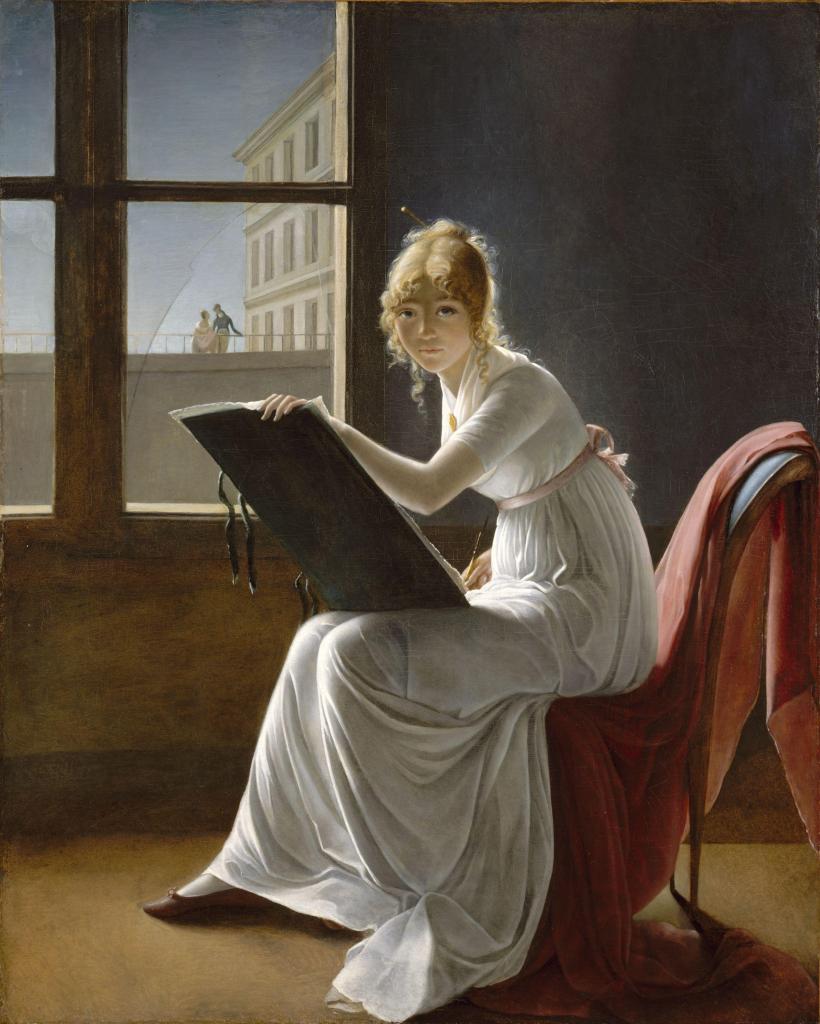
Image

Title: Marie Joséphine Charlotte du Val d'Ognes (1786–1868)
Artist: Marie Denise Villers (French, Paris 1774–1821 Paris (?))
Credit Line: The Metropolitan Museum of Art European Paintings
Mr. and Mrs. Isaac D. Fletcher Collection, Bequest of Isaac D. Fletcher, 1917
https://www.jstor.org/stable/community.16002425
ARTSTOR


 Charles van Heck's Woodhull Journal
Leave a comment