A Personal Note: This essay is dedicated to the memory of Albert Nelson Bunt of the 801st Tank Destroyers, Henry G. Flores of 755th Rwy Shop BN, and Ralph Waite of the 99th Infantry Division.
“Every gun that is made, every warship launched, every rocket fired signifies in the final sense, a theft from those who hunger and are not fed, those who are cold and are not clothed. This world in arms is not spending money alone. It is spending the sweat of its laborers, the genius of its scientists, the hopes of its children. This is not a way of life at all in any true sense. Under the clouds of war, it is humanity hanging on a cross of iron.” Dwight Eisenhower
Our parents kept the stories to themselves. There were some things they avoided discussing with us— their children. Others, mostly strangers, would speak and write about those days. We would find old photographs, love letters, medals, and their ribbons tucked away in the chest of drawers or a closet shelf. And if we looked close enough, we would see the story in their eyes—that faraway look.
Ours is a time of superficiality when vanity has run amok. Ours is a time when men of disreputable character and those wearing dubious, incendiary tattoos seek power. Ours is a time when integrity, judgment, decency, civility, empathy, and respect have waned. As The New York Times opinion editor Nadja Spiegelman writes: “The American dream is dying — or dead — and many Americans, especially young people, are struggling to imagine what comes next. Between political instability, wars, inflation and artificial intelligence disrupting the job market, there’s a lot that is uncertain about the future.”
Isolation and nihilism seep into our daily lives. This was the same atmosphere that clouded the lives of what some refer to as “the greatest generation.” They came of age in the shadow of the First World War, the Dust Bowl, the Great Depression, and the rise of fascism— totalitarianism. They were our parents (and grandparents). But what do we, those born in the years following the Second World War, remember? How have we allowed their beliefs and actions to influence our convictions and values? A generation gave a defiant “NO” to tyranny. Our response to tyranny is what? Fear? Political factionalism and paralysis? Racism? Misogyny?
At age 15, Luke Morrison is a young man who reminds us of the stories that now fade on history’s yellowing page. He reminds us that 16.4 million Americans served during World War II. Of this number, 45,418 remain living. 1.1 million Canadians and Newfoundlanders were in uniform. Today, approximately 45,418 remain. And he reminds us of those who followed in their footsteps. The story he tells is also a tribute to those who worked in the factories, raised Victory Gardens, and performed other tasks to support liberty and freedom.
He tells us the stories in an old aluminum trailer camper situated on his family’s goat farm in Danville, Vermont. Within the trailer, he has collected military artifacts of the memories of every war. He has also compiled the accounts of veterans he has met.
I ask myself, and you, what motivates a young man to do this? The answer, I think, has to do with his curiosity to understand the nature of and price of war, not its glorification. But also, and more importantly, his belief in this country, the idealism of its founding principles. There is another motivating factor. Luke Morrison wants to memorialize those who fought in wars. He has taken upon himself the responsibility of asking the questions many of us have been encouraged to both refrain from asking and the history we have been encouraged to forget.
There are, of course, other museums of various sizes that are committed to providing us the opportunity to learn the history of the Second World War. There is, for example, the ELDRED WORLD WAR II MUSEUM in Eldred, Pennsylvania. The words of Dwight Eisenhower echo in these rooms, as in Luke’s trailer camper:
“The hope of the world is that wisdom can arrest conflict between brothers. I believe that war is the deadly harvest of arrogant and unreasoning minds” {Address, National Education Association, Washington, DC, 4/4/57).
On this anniversary of the invasion of Normandy, 6 June, Luke Morrison reminds us that, in Eisenhower’s words:
This world of ours… must avoid becoming a community of dreadful fear and hate, and be, instead, a proud confederation of mutual trust and respect.
May we have the courage to raise our voices in a resounding NO to the prevalent isolation, nihilism, and tyranny. May we again find the ability to hope and work towards restoring our founding principles and a just society and world.
Images:

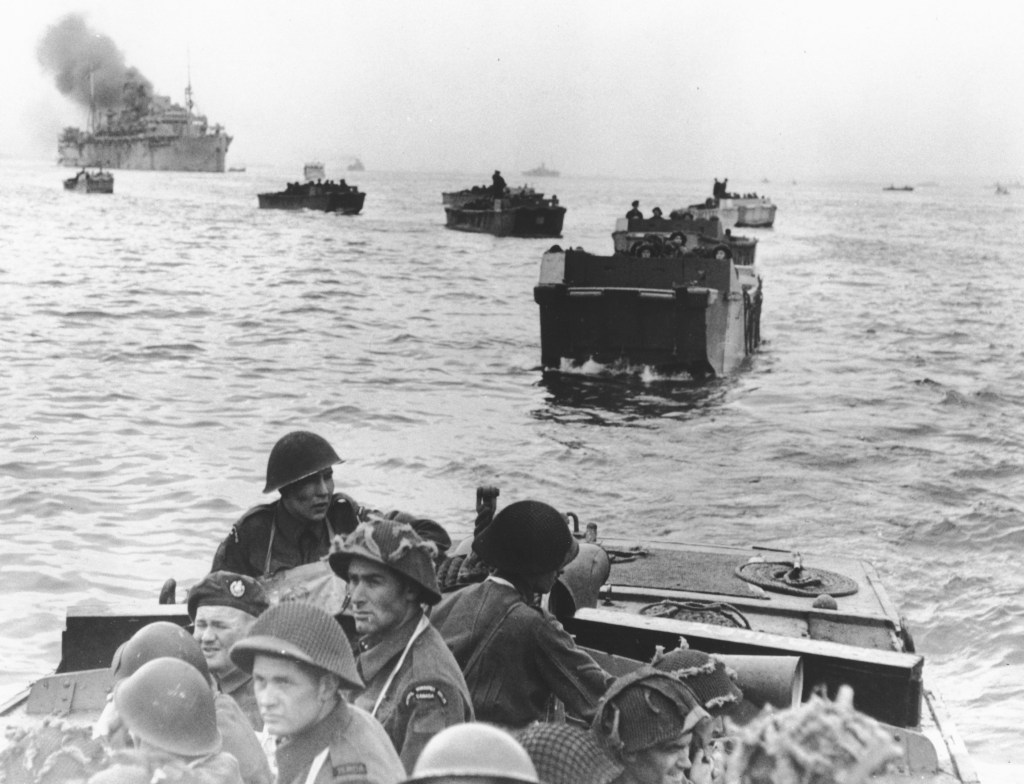
1: LCA (Landing Craft Assault) containing Winnipeg Rifles head for the Normandy Juno beach - June 6, 1944. Most are wearing Mk III helmets. (Images from Library and Archives Canada This Canadian work is in the public domain.

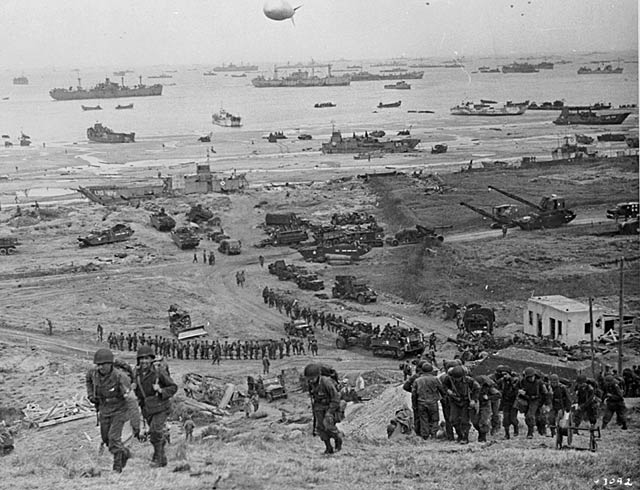
2:  The build-up of Omaha Beach. Reinforcements of men and equipment moving inland. Photo courtesy of Center of Military History.

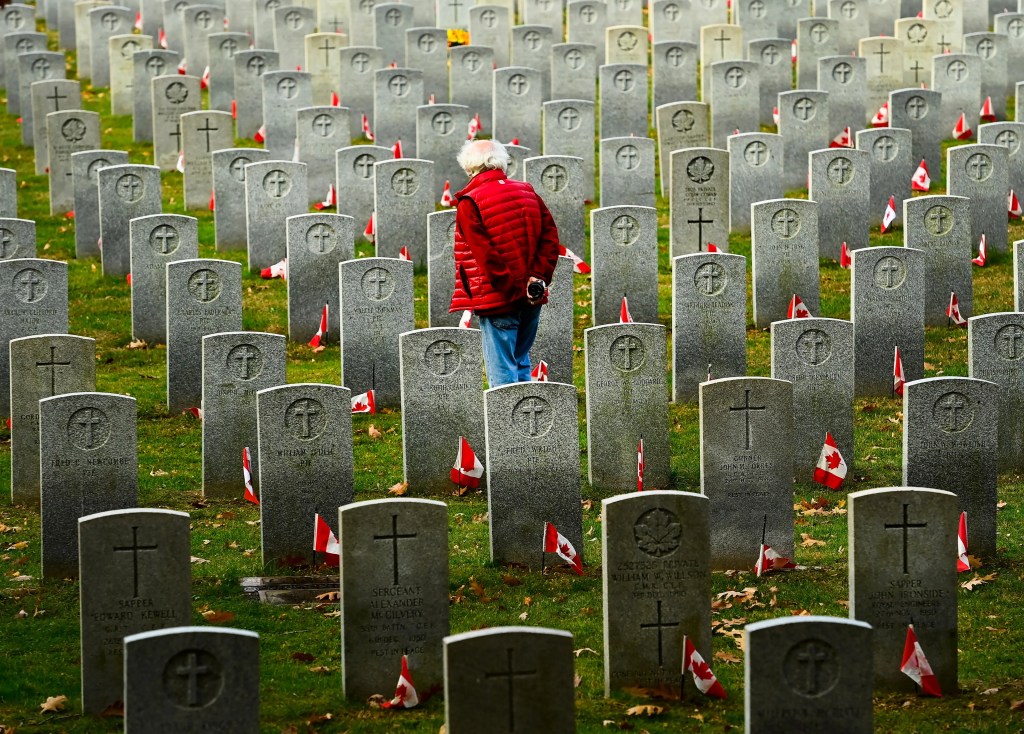
3. George McMenemy, 72, walks through the field of honour for fallen Canadian military war veterans at the Woodland Cemetery in Burlington, Ont., on Remembrance Day during the COVID-19 pandemic. (Nathan Denette/CP) AP

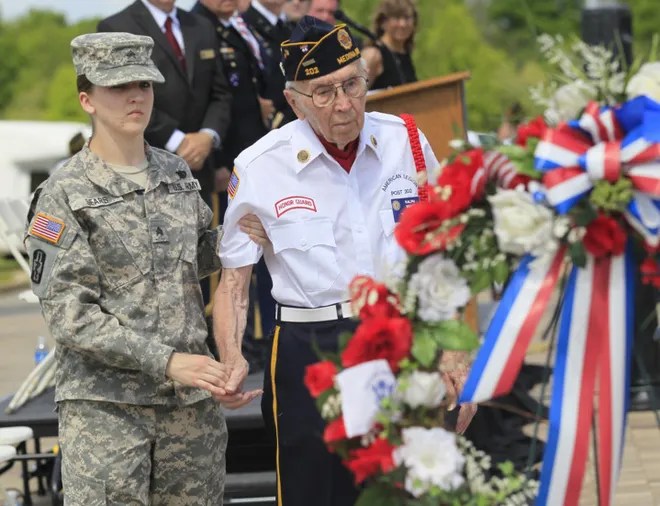
4. World War II veteran Ralph Waite, an Army combat soldier of the 99th Infantry Division who fought in the Battle of the Bulge, walked side by side along with Army Sgt. Anastasia Sears, 25, of Medina, Ohio, who returned to the United States on April 17 — the Thursday before Easter — from nine months of duty in Afghanistan with the 912th Dental Company. (Karen Schiely/Akron Beacon Journal).

My uncle Albert Bunt and the 801st were assigned to the 99th Infantry Division, in which Ralph Waite served, during the Battle of the Bulge. Henry G. Flores was also in the Ardennes.


 Charles van Heck's Woodhull Journal
Leave a comment