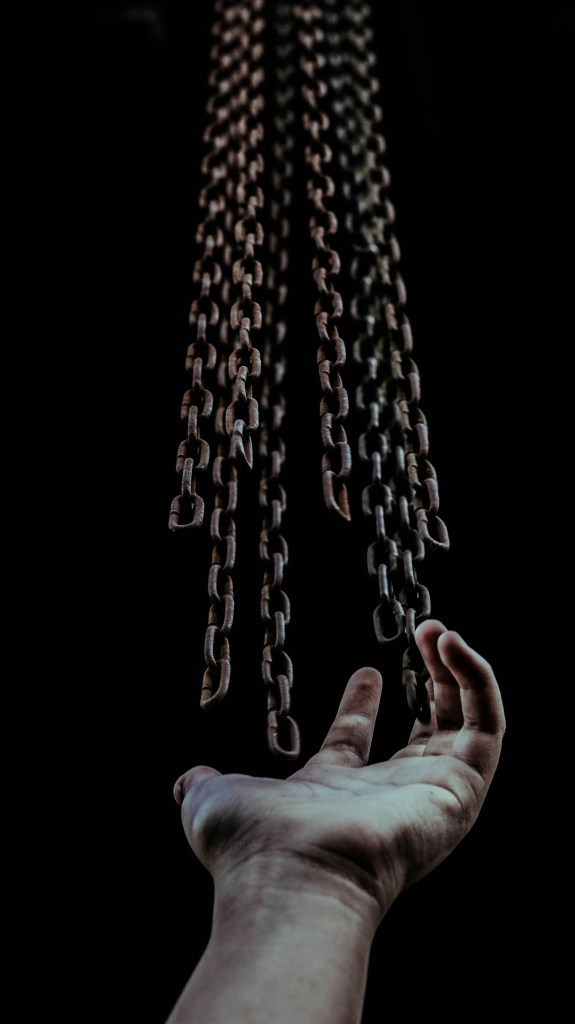
Freedom. To be free. What do we mean when we say, “I am a free woman,” or “I am a free man?” On what foundation does our freedom rest? The availability of and the choices we make when purchasing commodities? Is our freedom based on Constitutional law? Is freedom a matter of our will, our agency to act as individual persons, and as members of a larger community for the greater good? Or does freedom mean our obligation to accept, without thought, the will of an elite minority whose ethics determine the course of our lives?
In the course of my daily activity, I give little thought to the enjoyment of my freedom. I tend to take it for granted. However, I perceive a change in the atmosphere, a gathering of stygian clouds drifting over our societal relationship. The light of E Pluribus Unum (“Out of many, one”) has been underappreciated. What we had cultivated for 250 years, Novus Ordo Seclorum (“A new order of the ages”), the understanding of freedom, “that all men are created equal, that they are endowed by their Creator with certain unalienable Rights, that among these are Life, Liberty, and the pursuit of Happiness” is being obscured. Thomas Jefferson wrote in the Declaration of Independence:
That to secure these rights, Governments are instituted among Men, deriving their just powers from the consent of the governed, –That whenever any Form of Government becomes destructive of these ends, it is the Right of the People to alter or to abolish it, and to institute new Government, laying its foundation on such principles and organizing its powers in such form, as to them shall seem most likely to effect their Safety and Happiness. Prudence, indeed, will dictate that Governments long established should not be changed for light and transient causes; and accordingly all experience hath shewn, that mankind are more disposed to suffer, while evils are sufferable, than to right themselves by abolishing the forms to which they are accustomed. But when a long train of abuses and usurpations, pursuing invariably the same Object evinces a design to reduce them under absolute Despotism, it is their right, it is their duty, to throw off such Government, and to provide new Guards for their future security.
We have the right to question our government, to institute changes. Those rights belong to the people. Throughout our history, we have not altered our government “for light and transient causes.” We have reformed the government, when necessary, through the legislative and judicial processes. In this Trumpian Age, there is “a long train of abuses and usurpations” of “the Right of the People.” Both the legislative and judicial processes are failing us. Redistricting by the states by both Republican and Democrats, and the Supreme Court’s decisions of Louisiana v. Callais (2026) barring the use of a map containing a second majority-Black district, and Brnovich v. Democratic National Committee (2021) nullifying the ability to use Section 2 of the Voting Rights Act to challenge laws making it harder for minority voters to cast a ballot are two examples of the denials of our fundamental rights regardless of our race, gender, and religious affiliation. But to whom does power shift? Who defines our freedom?
In an essay titled “The Education of a Libertarian,” Peter Thiel writes, “I no longer believe that freedom and democracy are compatible.” This essay appeared in the April, 2009 issue of Cato Unbound: A Journal of Debate, published by the Cato Institute (1).
On 18 April, a summary of a book titled The Technological Republic: Hard Power, Soft Belief, and the Future of the West, by Alexander C. Karp & Nicholas W. Zamiska appeared on X (2). This abstract, comprised of 22 points, and the book are a manifesto that echoes the political theories of European fascism.
In brief, Karp and Zamiska present a fusion of the military-industrial complex and a culturally conservative critique of liberal society, centered on artificial intelligence. Céline Castets-Renard, a Professor, Civil Law Faculty; Canada Research Chair Holder International and Comparative AI Law at the University of Ottawa, correctly observes, “By posting his ‘Manifesto’—comprising twenty-two principles drawn from the book The Technological Republic (2025)—on the X platform, Palantir CEO Alex Karp reaffirms his dystopian, techno-fascist vision of the world and the role played by AI as an operational system for the U.S. military and ICE in a fusion of powers with the Trump Administration: far-right ideologies and the anti-humanist economic interests they espouse are outrageous and should spur us to resist.”
David Murakami Wood, a professor of Criminology, Faculty of Social Sciences; Canada Research Chair in Critical Surveillance and Security Studies at the University of Ottawa, warns, “My view is that the open fascism of Trump’s second term has created an environment in which the leaders of big tech firms like Palantir can openly advocate for white supremacy and what they think of as European civilizational values. It’s not just a marketing tactic; they believe in this and it is common amongst the richest men in the world (see also: Elon Musk). The problem is that Palantir is deeply embedded in many countries’ data governance infrastructures, not just in defence, but in health, welfare and energy systems. Any country which values democracy, equity, multiculturalism and a common future for humanity should reject their products and services along with their technofascism and authoritarianism.”
Personally, I find it interesting that our Canadian neighbors are attempting to direct our attention to what should be obvious, but which we in the States generally choose to ignore. We recognize the intrusion of AI in our lives, but not the transformative powers of its creators’ underlying philosophy. We accept the development of AI, but barely recognize that it is eroding our human dignity, our ability to think critically, and our freedom. We have entered an age of what the Christian author Michael A. Smith refers to as ‘synthetic truth.’ From a Jewish perspective, we have placed “idols in the temple.”
We are silent as men like Peter Thiel, Elon Musk, Alexander C. Karp and Nicholas W. Zamiska, in Smith’s words “…build the operational software platform of the federal surveillance and deportation apparatus, to bankroll a network of intellectuals openly arguing for the abolition of representative government, and to publish a corporate manifesto calling for compulsory military service, the rollback of postwar denazification, and the rejection of pluralism as a civilizational value.”
Do we allow a small elite of demagogues, whose businesses profit, at taxpayers’ expense, from their government contracts with numerous agencies, particularly defense, national security, and NASA, to abuse and usurp our government in their pursuit of profits? The necessity of the oversight of AI companies should not be minimized. Palantir, OpenAI, xAI, and other companies need better governance, auditability, and human accountability. We are at “the tyranny of the apps.” The ideology and greed behind these companies both limit and deny our Constitutional liberties. Are we willing to grasp the reality of and throw off their despotism, the technofascism and authoritarianism, in this Trumpian Age? Our freedom rests in how we answer this question.
References
1 The Education of a Libertarian Peter Thiel • April 13, 2009
https://www.cato-unbound.org/2009/04/13/peter-thiel/education-libertarian
2 The Technological Republic: Hard Power, Soft Belief, and the Future of the West, by Alexander C. Karp & Nicholas W. Zamiska https://x.com/PalantirTech/status/2045574398573453312
The book under this title is available through various outlets
The Kingmaker and the Republic: Peter Thiel, the Vice Presidency, and the Theological Architecture of an Anti-Democratic Movement, by Michael A. Smith
https://www.linkedin.com/pulse/kingmaker-republic-peter-thiel-vice-presidency-movement-smith–jybyf
Image: Man’s Hands and Chains Photograph by Zulmaury Saavedra on Unsplash


Leave a Reply