“Only Connect” is one of the most widely known epigraphs in English literature. The axiom, found in E.M. Foster’s fourth novel, Howard’s End, published in 1910, summarizes the novel’s theme. Portraying three families in a changing England, the story explores the desire and struggle to establish and protect the delicate bonds of relationships. Connecting with the outside world, be it as a nation, a community, or as an individual, is a perplexing process.
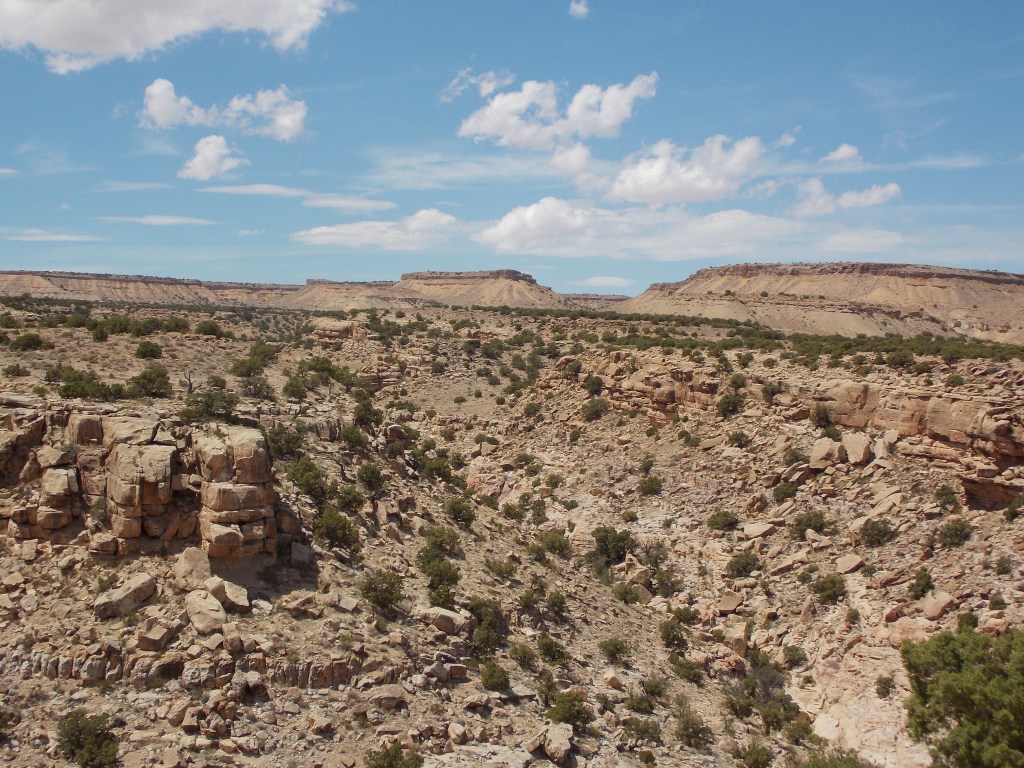
While in the Mojave Desert, I found myself thinking about Foster’s novel set in a green and wet England. The same can be said of the places I have lived. In sharp contrast, the desert is stark with its eroded volcanic deposits and lake sediments, the weathered cliff faces, multi-hued buttes, and sculptured canyons. The starkness gave a clarity to nature’s sounds. I have taken for granted my ability to hear the under breath—the still voices of woodlands and meadows. That changed through a friendship with a deaf scholar. From him, I learned to appreciate what I had taken for granted. In the desert, engulfed by quietness, I listened to the wind whispering through the open cavities of a sandstone wall, through the brush and trees. Here, there was no commotion, the symphony of sounds, the cascading tumult that assails me when I am in the urban environment.
With its coarse ground and aridity, I found myself fascinated by the desert offerings—the diversity of bird, reptile, and other animal species, as well as flora. My eyes were drawn to irregular geometric shapes in the soil where water had dried, as well as the patterns in pebbly pavement or wind-carved sand. I experienced a deep, unexpected desire to connect.
According to the Oxford English Dictionary (OED), connect is derived from the Latin coniūxī, meaning “to join” or “to unite”. Among the definitions in the OED, connect is defined as: to tie; to fasten together; to join together; to bind; to link together; to associate in occurrence or action; to be in necessary or natural association. It is this latter usage that I use the term here. To connect, to achieve connectedness, requires a quality or a state of being.
When consciously thought about, it is odd how easily the word connect is tossed around in advertisements. Connection, in the sense used by advertisers and social networks, concerns intimacy, shared aims, and relationships among people. The attempt to establish a natural association underlies the idea of bringing together people with similar interests. Underscoring the social networks and the advertisements is the idea of loneliness and isolation, our separation from one another.
Separation and detachment summarize the late 20th and early 21st century. We are separated from one another by technology, yet we have the illusion that technology brings us together. Society was once based on closely organized families and natural groups, Jacques Ellul observes in his book The Technological Society, “formed by collective interests…(that) were distinct and independent. The individual found livelihood, patronage, security, and intellectual and moral satisfaction in collectives that were strong enough to answer all his needs but limited enough not to make him feel submerged and lost.”
Walking the stony, desert landscape, I caught myself wondering if this sense of being “submerged and lost” played some part in my turning to the desert. There have been times when, after communicating on a social network or Zoom, I felt isolated. This awareness of separation extends to the loss of belonging and security. The crowded cities, the urban/suburban sprawl of tightly packed neighborhoods, the economic pressures, and insecurity—our inability to resist these conditions that have developed because of technology—contribute to our self-detachment and to our detachment from others, and the natural environment.
Detachment was a Greek ideal for the philosopher to pursue wisdom. In Irrational Man: A Study in Existential Philosophy, William Barrett writes “The word ‘theory’ derives from the Greek verb theatai, which means to behold, to see, and is the root of the word theater. At a theater, we are spectators of an action in which we ourselves are not involved. Analogously, the man of theory, the philosopher or pure scientist looks upon existence with detachment, as we behold spectacles at the theater…”
Barrett continues by making a comparison to Judaism. “The Hebraic emphasis is on commitment, the passionate involvement of man with his own mortal being (at once flesh and spirit), with his offspring, family, tribe, and God; a man abstracted from such involvement would be, to Hebraic thought, but a pale shade of the actual existing human person.”
The pursuit of intellectual knowledge and the development of reason are important and essential. Equally important is the awareness that we are flesh and blood, dust. Human life is fragile and requires nourishment that requires a connection to others, to the earth, and to ourselves.
Just as there is a clear distinction between detachment as objectivity, and detachment as disinterest, there are different types of deserts. Some deserts, of human making, are empty and barren wastelands. Other desert places are rich with life and a nurturing under breath that beckon for a commitment to “Only Connect.”
Image: When Rocks Speak ©2026 Charles van Heck

 Charles van Heck's Woodhull Journal
Leave a comment