“…we lived in the house of poetry, which was also the house of love and grief; the house of solitude and art.” Donald Hall, The Best Day the Worst Day: Life with Jane Kenyon
Dear—
This morning, in the early morning darkness, I lay in bed thinking about you. You are someone I have yet to meet, but you have entered my world. You knew something was wrong. You wished it away with an intensity seeded with hope, doubt, anxiety, denial, and apprehension. You have undergone an array of tests and scans. Distractions fill the waiting period. Then the appointment to remove doubt. A doctor sits across from you. You listen to the results. The diagnosis. Shock. Abruptly, your world changes with the impact of an earthquake.
I know what it is like to walk on the shifting ground. Before my decline in health, I would have moved forward with confidence. The diagnosis. The moment is grief. You have had a similar moment. Over the past five years, I kept grief at bay. But the truth is, I only pretended to, both to myself and others. There were moments when grief broke through, then I pushed it down and focused my attention on other things. That is a partial truth. Grief is the hand of a shadowy figure resting on the shoulder, ever present. The shadowy figure remains by your side until you turn to face it.
The other day, and again this morning, I turned to the poet Donald Hall’s memoir The Best Day the Worst Day: Life with Jane Kenyon. Hall’s book is both a celebration of their marriage and a heartbreaking account of Kenyon’s leukemia that took her life in fifteen months. Oddly, when I received my first diagnosis, and there have been too many others since then, I found comfort and strength in Hall’s and Kenyon’s story. I wrote him and received an encouraging letter back. Terri, my wife, was also a source of strength as we coped with the uncertainty.
Personally, I tend to avoid discussing my health with others. I cringe when someone asks, “How are you feeling?” A natural, easy question that I understand is raised with the expectation of an equally natural and easy, “Good.” I have found that, as you will learn, a complex response can leave the enquirer confused by their inability to find words. They will want to hurriedly move to another subject. Oftentimes, they will want to literally step away, as if you have leprosy. There are people who know about my health, though often not in full detail. Besides my wife, I have confided in two or three people. As my closest friend, a cancer survivor, has found, friends and acquaintances disappear. I find it peculiar that we speak about the disappearance of friends as our being “ghosted.” Ghosts put in appearances.
You will have much the same experience with people. A few will be present, caring and loving, compassionate and empathetic, dependable and unafraid. I say unafraid because your serious health issue is a reminder of mortality, our commonly shared physical finiteness that the majority of people neither want to think about nor face.
Pain, in various forms, and depression will accompany you on your journey. There will be days when you will feel so wretched that you will withdraw, unable to speak, and feel invisible, and practice invisibility. There will be other days when the extraordinary occurs. This happens in how a nurse, a physical therapist, or your dearest companion, looks at or touches you, or a word spoken, or something that catches your attention that opens your heart and renews you. Such moments come unexpectedly, and joy surprises you.
Time will feel distorted both after the surgery and during your recovery period. This isn’t Bill Murray’s film Groundhog Day, but a blending of days that begins with rising from bed to returning to bed at night in a speedy, blank repetition. Gradually, the fog dissipates. You will look at life differently. I found myself disinterested in things that once gave me pleasure and discovered I was unable to do many things I once enjoyed. This may be the same for you. It is important that you establish new goals. Easier said than done.
Undoubtedly, someone with good intentions will tell you there are five stages to grief. Denial. Anger. Bargaining. Depression. Acceptance. Contrary to popular thought, these stages do not follow in neat sequence. You will move in and out of them at various times until acceptance is firmly rooted in your mind and heart as you face your medical crisis. Those closest to you will also be processing their grief. Deal with grief in a healthy manner through a support group, counseling, and with honesty. Unless you do, you will remain trapped, unable to see your way out with healthy acceptance.
You will probably ask yourself, “Why did this happen to me?” If you are a person of faith, you may think God is punishing you. Be assured that this isn’t how the Divine works. Suffering and mourning are aspects of the human condition. Suffering is an aspect of our “spiritual personality” and awakens us, if we allow it, to place greater value on our worth, and that of others, and the preciousness of our existence. We are more than biological creatures. Suffering does not strip us of our human dignity unless we allow it to push us into despair.
You may think/feel God has abandoned you. This is untrue. The Divine has stepped back, waiting for you to take a step forward, to draw closer, to put aside your perplexity in faith, to be aware of and experience a deeper freedom in life in the I-God communion. This period of your suffering is one when you justify God.
The author Herman Wouk, a person of deep faith, explains this when he writes about the Book of Job, “In Job God must answer for everything, good and bad that happens. Job is the Bible’s only hero. There are fighting men, patriarchs, lawgivers, prophets, in other books. This is the one man who rises to measure the universe, to the stature of the God of Israel, while sitting on an ash heap; Job a poor skeletal beggar.”
We are like Job in our crisis of health. Neither of us know the outcome of the crisis. But we can step forward in faith, sense the Divine Presence, turn our suffering into a prayer for others. We may not understand, but we can hold on to the truth that allows us to turn to face our grief to discover an effective response, and an emotional life in its fullness of peace.
I wish and pray that you may find that peace in your suffering.
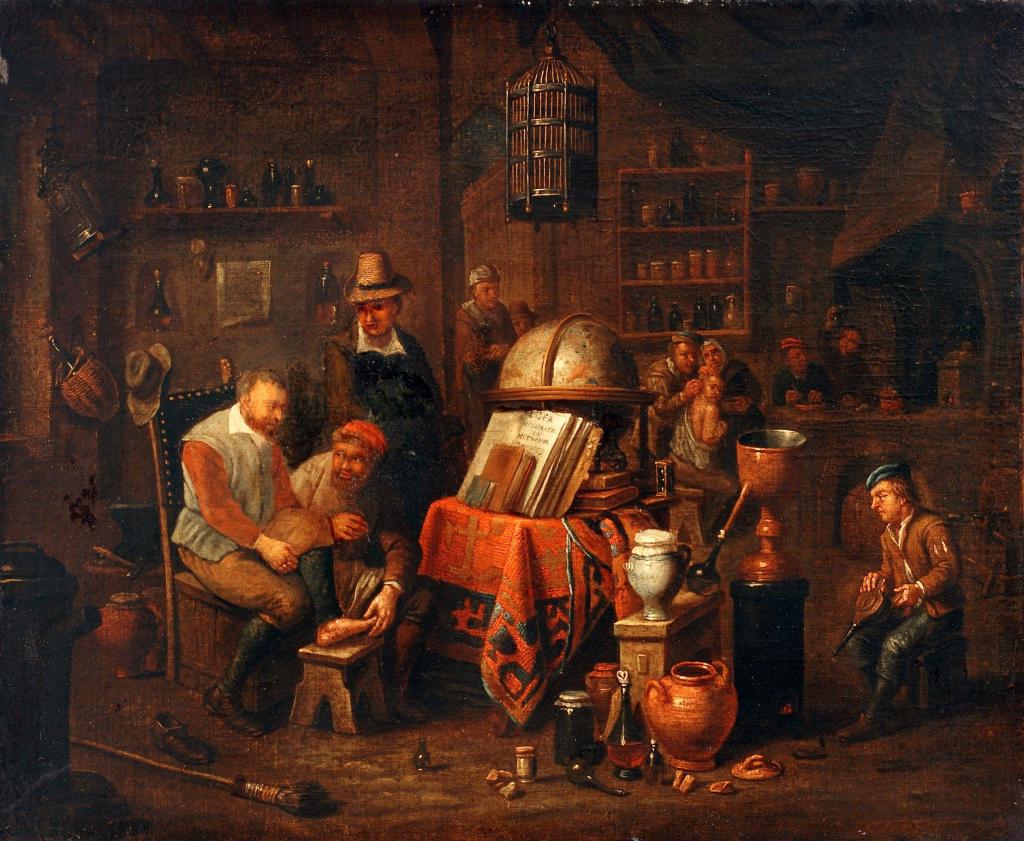
Image: A capriccio of medical scenes. Oil painting by Gerard Thomas.
Artist: Gérard Thomas, 1663-1720
Source: Repository: Wellcome Collection
JSTOR https://www.jstor.org/stable/community.24793464
ARTSTOR

 Charles van Heck's Woodhull Journal
Leave a comment