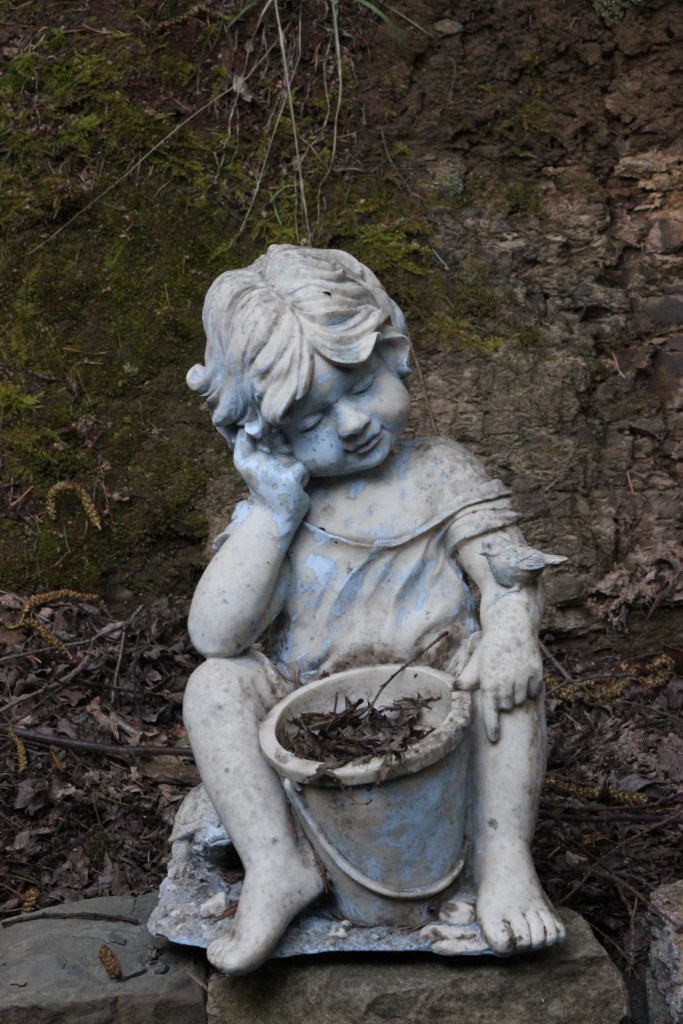
“Daydream transports the dreamer outside the immediate world to a world that bears the mark of infinity.” —Gaston Bachelard

We maneuver daily through vast spaces and past objects designed by human imagination and crafted by talented artisans. Some of these objects are as simple as a paperclip. There are crafted pieces of furniture, and towering glass-and-steel buildings lining city sidewalks. Textures and patterns surround us in fashion, appliances, and interior design among other numerous ways. In museums and art galleries, we discover paintings, exquisite glassware, pottery, and sculptures. In between and around these objects is the presence of space-time, and reflected and refracted light.

This morning, while waiting for the tea kettle to boil, the mug was the object of my attention. Its lines, circular form, the handles’ curve, and its nautical images of 18th-century ships. Faint light shone through the kitchen. The scene made me think of a still life painting. The mug was the positive space. Around the mug was negative space, being the empty space in which the mug rested on the counter. The mug’s design, its artwork, contained spaces that allowed my eye to wander the unified piece and the stories and the story it tells.

Then there was time for reading poetry. Two carefully crafted poems engaged me with the poets’ use of language and themes. The first poem was by Maureen Doallas titled “Remembering Martha.” The poem’s subject is the last known passenger pigeon named in honor of Martha Washington that lived at the Cincinnati Zoo. Dollas allows the reader to experience Martha’s life and death, and to gain insights into what inspired her to compose the poem, which can be found on her Substack page, “Writing Without Paper.”

The second poem, “From Tsukiko, While Watching the Moon,” by Michael L. Utley. This can be found in the online WordPress journal LatinoUSA. Utley’s poem is delicate, as if done in the ancient Japanese shodō (brush writing). He evokes the depths of emotion, solitude, loneliness, and spirituality blended with the natural world. The poet accomplishes this beginning with a word play in the poem’s title: Tsukiko— tsuki (moon) and ko (child).

After reading the poems, I found myself thinking about how we move “rhythmically between figurative and abstract shapes,” to borrow the words of the Canadian artist Terrill Welch. We make deliberate choices of what we observe. I have been struck by Terrill’s paintings of clam shells, pebbles, and rocks at the bottom of the coastal shoreline. There is a sense of childlike wonder, interpreted through the eyes of a skilled artist, in these paintings. When viewing these, I imagine myself barefoot, squatting down, gazing at the shells beneath the caressing sea.

What do the coffee mug, poems, and Terrill’s paintings have in common? Imagination.

The French philosopher Gaston Bachelard writes that imagination is “…the faculty of deforming images provided by perception; it is above all the faculty of liberating us from the first (here representations in perception), of changing images.”

Imagination enables us to create from the observable by adjusting reality. We find its influence in scientific theories, (e.g. Einstein’s photoelectric equation), sculpture (e.g., Michelangelo’s the Pieta, Camille Claudel’s The Waltz), painting (e.g., Pissarro, Kate Freeman Clark, Zinaida Serebriakova), poetry (e.g., Donald Hall and Jane Kenyon), dance (e.g. Martha Graham), music (e.g. Bach, Charles Ives, Dizzy Gillespie), glass works (e.g. Leopold and Rudolph Blaschka), and literature (e.g.,Arturo Pérez-Reverte , Isaac Bashevis Singer, Robertson Davies, Margaret Atwood), architecture (e.g. Frank Lloyd Wright. Gabriela Carillo). The list is endless, stretching from the earliest to the contemporary period of human history. Creativity begins with the imagination, and it is creativity that shapes our experience and knowledge of our environment.

In nature, when we pause to observe, we perceive insects in flight, or negotiating vast spaces, crawling up the stems of flowers, leaves, each slightly different than the other, dangling from branches, or delicate raindrops clinging to pine needles and cones, the diverse patterns of snowflakes, shafts of sunlight reflected and refracted off ocean waves breaking on rocks and sandy beaches, clouds, or dust particles in shafts of sunlight flowing through windows in our rooms. No two objects are alike, even when appearing similar. There are numerous patterns forming objects framed by time-space.

Within each observable object, there is an intimate space contained within an immense space. Our imagination, when we allow, invites us to daydream and experience “the space of intimacy and world-space blend….  When human solitude deepens, then the two immensities touch and become identical.”

This all seems rather academic until you think about the union of time and space in our daily lives, our ordinary experiences, which are shaped by the historical time period we live in.  Solitary moments are often difficult to come by in our contemporary life. But when we pause to reflect, we can see the interaction of space and time in nature, art, literature, architecture, and other forms of creative expression. How space-time speaks to us depends on our perspective, our willingness to observe with our senses— our commitment to understanding.

Bachelard warns us, however, that “Imagination does not seek a diagram for summarizing knowledge. Imagination searches for a pretext for multiplying images, and as it becomes interested in an image, it over rates its value.” Our imagination depends on emotional perception. Our creative interpretation and expression of the imagination depend on rational skills.

We live in a world of these two blending, a oneness and unity, that beckons us, not just as artists and writers, but as human beings, diverse as we are, to pause, to open our eyes to see— to allow ourselves child-like wonder. 

Image: The Daydreamer ©2014 Charles van Heck

Charles van Heck Avatar

Published by

5 responses to “Daydreams, Imagination, and Childlike Wonder”

  1. Mike U. Avatar

    Thank you, Charles, for your kind appraisal of my poem. Your essay resonates with me on a deep level. It’s crucial that we learn to pause and look at the world through the eyes of our inner child, for there is still much to learn and experience about life even in our latter years. Your piece inspired me to read Maureen Doallas’ poem and view many of Terrill Welch’s paintings of the seaside (those wonderful shells). Thank you for this, as it’s made my own morning more introspective and peaceful.

    Like

    1. Charles van Heck Avatar

      Your welcome. I look forward to reading more of your poems. You are a good writer. One thing I would encourage you to avoid is writing a lot of confessional poetry. Introspection is good, but too many are just writing about themselves & not observing & interpreting the world around them. Poetry is about creating characters & telling stories too. You did that in your poem. So did Maureen.

      Liked by 1 person

  2. jonicaggiano Avatar

    Thank you for discussing the poem by Michael Utley, one of my favorite poets. Like Utley, I am also a poet and, particularly in the 1950s, would have been considered a “Confessional Poet.” My work also explores nature as metaphor and distinctive views on love, paralleling Mike’s approach, though his pieces often incorporate mythology—a methodology I find quite brilliant.

    Sylvia Plath, posthumously awarded the Pulitzer Prize, exemplifies the Confessional Poet tradition that influences both my work and my appreciation for Utley. I also greatly value her poetry.

    Your writing was engaging, and I especially appreciated the paragraph about the mug, which reflects your perceptive attention to concrete details, as well as the “negative space” —a trait evident in the poets we discussed.

    However, I must express my disagreement with the idea of asking poets to limit their expression of what reflects their true feelings. What I admire in Michael Utley’s work is his vivid, descriptive style, especially his ability to convey sensory nature experiences and human resilience—qualities also seen in Confessional Poetry.

    Edgar Allan Poe, widely regarded as one of the great poets, also drew on personal struggles—a reminder of how deeply personal histories shape enduring poetic works, just as we see in Confessional and nature-inspired poetry.

    This diversity of perspectives, from Plath to Poe to Utley, enriches our world. Each of us holds deep preferences for what we value in poetry and what resonates as meaningful.

    Like

    1. Charles van Heck Avatar

      Thank you for your comment. What I am asking poets to consider is to do more than “confessional” poetry. Every poet starts with their personal experience, which shapes their worldview. What I find, however, is that many poets today don’t explore beyond that. Poetry, as I have written elsewhere here, is about capturing a moment. Sometimes the I is the self. Other times it is a character. Poetry is also storytelling with a logical progression. There is romantic, nature orientated, political, and other types of poetry. Do our feelings always come or need to come into play? To various degrees, yes. But does it always have to be about raw feelings? To my mind no. Sometimes it is about myths. narratives with literary symbolism, &c..As for Plath, I will agree that most of her poetry is autobiographical. However, highly intelligent, she could also be detached from her subject, which allowed readers a point of entry to relate. What poetry isn’t about are secret codes, as too many think, thus shying away from reading poetry. I think Utley does enrich our world. I also didn’t read his poem as a “confessional” poem. He went beyond that, but he saw it that way. My comment to him was meant to encourage him to keep pushing the boundaries, which I think he is doing. We need to be pushing boundaries in our engagement with the world. I will leave you with a question; have you read, X.J. Kennedy’s “An Introduction to Poetry”? Not everyone will agree with his approach to poetry, but it provides insight into the art of writing poetry. And I will acknowledge here that I often fail at it, as my files of unpublished poems would willingly attest.

      Liked by 1 person

  3. jonicaggiano Avatar

    Thank you for your comprehensive comment. I have not read the book you reference, but I find myself wanting to read it now. I appreciate the suggestion, and I look forward to reading more of your work.

    I certainly agree about Plath, being highly intelligent. I am a sensitive individual and find it difficult to remove myself emotionally when I write. You raised some highly interesting points in your analysis of the two poems. I wrote a poem called “Love Me Like a Luna,” and I thought about that as I read what you said. The emotion is pouring out of me about two beautiful creatures that have only a couple of days to live, yet they spend most of that time finding a mate, and they are rarely photographed, but I got lucky. The next morning, I saw the gorgeous scattered green of her large wings – yet I am sure she planted her eggs prior to her death. I guess I have a flaw: I can’t emotionally distance myself from the things I write about. I might be able to learn how to do that by reading your suggested book. I am a sensitive creature formed by my surroundings as a little girl.

    I plan to read more of your work, as I found it both different and beautiful, the way you talked about your thoughts on writing. I particularly liked the way you ended this piece, and I absolutely agree with it.

    “We live in a world of these two blending, a oneness and unity, that beckons us, not just as artists and writers, but as human beings, diverse as we are, to pause, to open our eyes to see— to allow ourselves child-like wonder.”

    Thank you again, kind sir, for your time. I would have written more, but I have an appointment this morning. You bring up some very good points, and think it might help my writing to pick up X.J. Kennedy’s book.  

    I am glad that you think Utley pushes boundaries. Some of his works bring me to tears, but I find reading him an adventure.  I feel like I am walking along beside him, and completely lose myself.

    We poets and writers, all, I believe, have piles of unpublished work, or work we are in fact just being highly critical of.  

    Like

Leave a comment