What does Trollope have to say to authors of the 21st century?
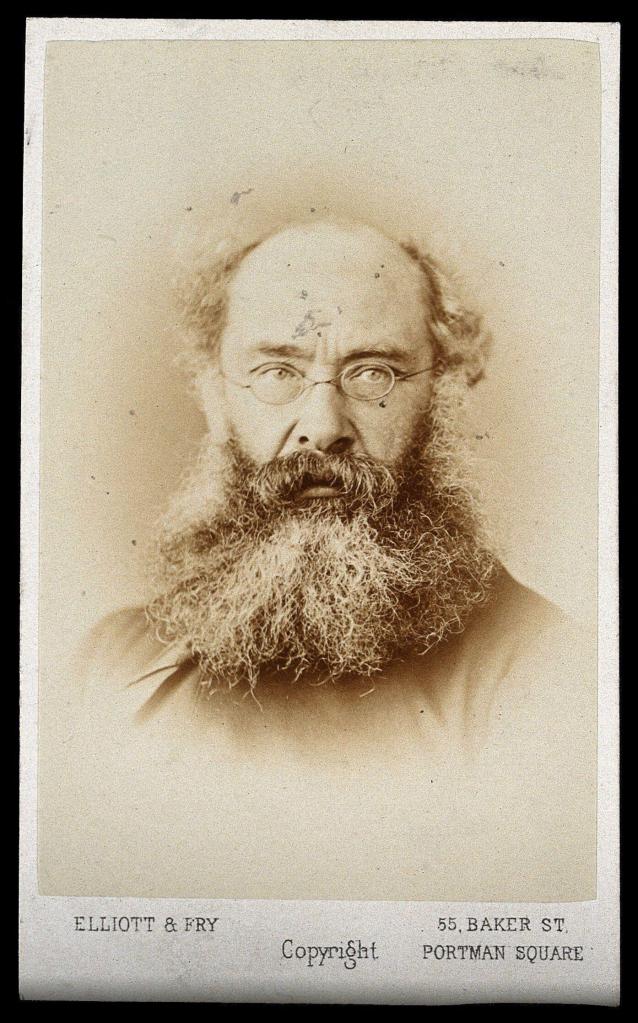
One evening, years ago, I was with Bailey White, the author and NPR All Things Considered commentator. Among the topics discussed was what to read when writing a novel and how to avoid having another author’s narrative and characters’ voices jumble ours. Bailey said she reads Anthony Trollope.
Anthony Trollope (24 April 1815 – 6 December 1882), shy and self-deprecating, continues to engage our attention. We read him for the pleasure of entering a vanished world. His stories introduce us to characters living in a society with a rigid code of conduct and limited opportunity. Politicians, clerics, and women move across the pages dealing with common issues that seem both relevant, enticingly fresh, and otherworldly. In the course of 32 years, Trollope wrote 65 books, 45 of which are novels. Of his work, Nathaniel Hawthorne wrote:
Have you ever read the novels of Anthony Trollope? They precisely suit my taste— solid and substantial… just as real as if some giant had hewn a great lump out of the earth and placed it under a glass case, with all its inhabitants going about their business, and not suspecting they were made a show of.
Hawthorne recognized the technical essence of Trollope’s work. Scholars and students have combed the stories to understand the trick of his significance. Clara Clairborne Park noted that “Trollope repeats— situations, explanations, phrasing. He irritates us with clichés, jocose Biblical language, comic names.” His style undermines what he is conveying. “Yet no novelist is more habit forming.”
Does Trollope have anything to teach 21st-century writers about their craft? To answer this question, I decided to write this piece as an interview rather than an essay. His responses are based on facts and his own words. But first, a bit of insight into his character.
James Russell Lowe, a contemporary, wrote: “Dined the other day with Anthony Trollope, a big, red-faced, rather underbred Englishman of the bald-with spectacles type. A good roaring positive fellow who deafened me… till I thought of Dante’s Cerberus.”
The poet W. H. Auden portrays Trollope as, “… a very eccentric character who might, though he would have hated to admit it, have come straight out of a novel by Dickens.”
What follows are excerpts of our conversation. I sat down with Anthony Trollope at The Lamb & Flag in Covent Garden.
CVH: You were a prolific writer. I understand you began your day at 5 a.m.
AT: Yes. I arrived at my desk at 5:30, reading the previously written material and making grammatical revisions. I averaged 250 words every 15 minutes, 2,500 before leaving for my employment at the Post Office. The writing hours at my desk were extended daily while on the train and when on those occasions of shipboard travel. I produced approximately 10,000 words weekly, occasionally 25,000.
CVH: You give the impression that creative writing is an assembly plant production.
AT: What exactly does the term “creative writing” mean? In my time, there was no idealized literary culture. There were literary endeavors. When an author is honest, they were and still are writing novels for money. I have yet to meet an author who didn’t like money. I was raised in poverty, often went penniless. To remedy my situation, I worked as a civil servant in the Post Office for 33 years. I understand its value.
CVH: But also, I think, to convey ideas and to make societal observations.
AT: I left the sermons to the ministry and the political discourse to the politicians. My characters avoid homilies. I wrote to entertain, though I have ever thought of myself as a preacher of sermons. My novels are jam and honey, making lessons on virtue palatable. The failure of my first novel, The Macdermots of Bellyclorn was instructional. People didn’t want to read about the despoliation of the land and famine. The novel ends with the heroine’s seduction and death. This lacked appeal to the rigid Victorian taste. The question I was then compelled to ask myself was how to teach lessons of morality and, at the same time, make myself delightful to my readers. I obliged my readers by engaging their attention with uncumbersome language, a compact sentence structure, and happy endings. In my second novel—
CVH: The Warden, which is the first in The Barsetshire Novels.
AT: Yes. Authors need be aware of who their audience is. They must have something to say. Then he or she must produce. An author either produces or he or she doesn’t. This is our occupation. Though I hasten to add, we must have other means of financial security.
CVH: There are those critics who argue that you emphasized quantity over quality.
AT: I never thought of myself as a genius. My novels are about the commonplace.
CVH: Writers from Homer to our contemporary authors and poets speak about the role Muses and inspiration play in writing.
AT: Inspiration? Does a shoemaker wait for inspiration? Writing is concerned with disciplined application. I believe in the transformative power of work. It’s all a matter of sheer industry, not artistic inspiration. Discipline is an essential requirement for creative endeavors. What you produce may be of a poor, good, or excellent quality. Developing the skill requires time and discipline. I hasten to add that few are excellent, such as George Eliot, the Bronte sisters, William Makepeace Thackeray, or Tolstoy. The same applies to shoemakers and other craftsmen.
CVH: And Charles Dickens.
AT: Ump. Dickens. He is simplistic in his characters. Extreme. They are either wholly virtuous or thoroughly evil. One-dimensional. Flat as a piece of paper. He failed to recognize that people are three-dimensional. Nor did Dickens allow for patterns of growth over time. Situations change them. Characters need to be depicted in the commonplace, enlivened with humor and sweetened by pathos. They must live in a state of progressive change. I will acknowledge his success. He pleased his audience.
CVH: Your characters are rigid in their observance of the limitations imposed by society’s class system.
AT: Yes, but they, particularly the women, are not passive. They observe discrete conformity. Women lacked the liberties they have in your era. I attempted to portray women as complicated individuals. An author is obligated to portray women as people.
CVH: Every novel has a framework—
AT: Tension is the framework of every novel. Characters contend with conflict. The satisfactory conclusion is that a successful adjustment must be possible. Tragedy must evaporate. Duty, affection, kindness, and decency are the solvents. These, of course, can and do fail to resolve a conflict in life, but readers desire satisfactory conclusions. Characters must be flexible when contending with complex personal or social issues. Compromises must be made.
CVH: In my era, we tend to think of compromise as abandoning one’s values.
AT: Compromise isn’t that at all. Where would my family or the government be without compromise? One must learn to take a conciliatory view. Dogmatic views lead us nowhere. The Bible counsels moderation in all things. I believe in pragmatism. In our daily lives, we make adjustments. Extremes lead to schisms. Excessive zeal undermines the social contract in both our personal lives and governance.
Image
Portrait of Anthony Trollope by cartoonist Frederick Waddy, 1872
Source: Provided by Wellcome Collection
This item is openly available as part of an Open Artstor collection.


Leave a Reply