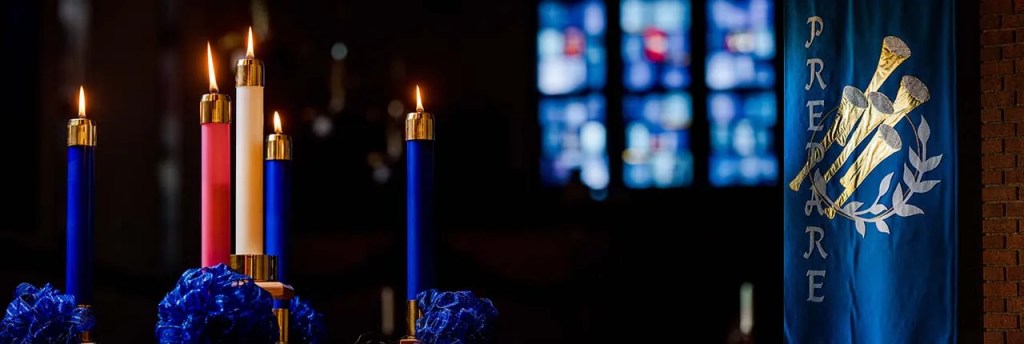
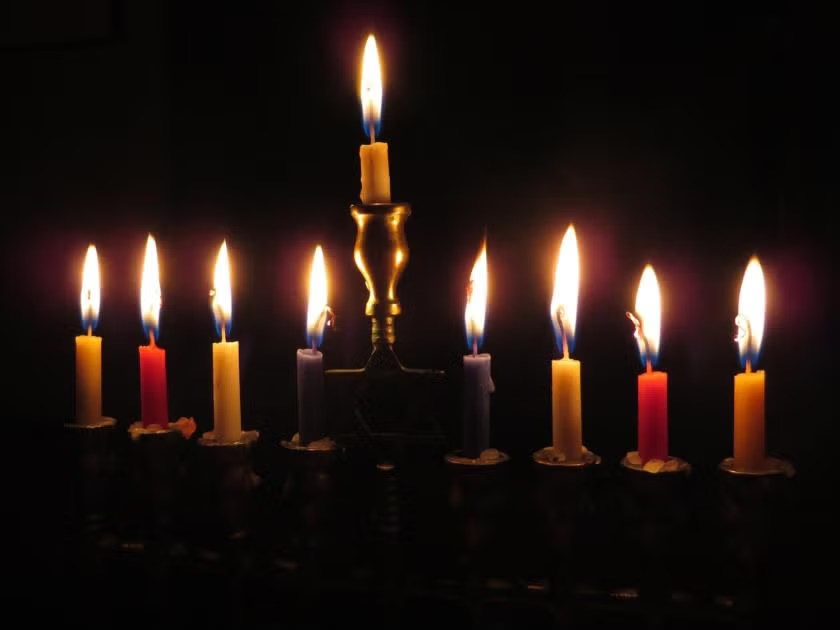
A curtain of silence drapes the late autumn and first days of winter. There is a sense of expectation. In the solitude of quiet nights, I find hope and the desire for renewal and deepening of faith in the flickering candlelight. I think of these days and nights of contemplation as an invitation to sit on Mount Horeb to hear “the small still voice” and answer the question, “What are you doing here?” (1 Kings 19:4-13).
Advent and Chanukkah are an invitation to give deeper meaning to our lives and actions― to satisfy our deepest hunger.
For the Christian, the word Advent means “coming” or “arrival.” Depending on when Advent begins on the calendar, the 13-18 days that make up the larger portion of Advent have an eschatological focus: the second coming of Christ. The last nine days, 16-24 December, turn our attention to the historical nativity of Jesus’ birth. In this context, Advent is a time of joyful hope, preparation, and conversion of the heart to deepen faith, marked by sober readiness.
For Jews, Chanukkah commemorates the rededication of the temple following the Maccabean defeat of the Syrian Greeks who had defiled the holy place. Miraculously, a cruse of oil burned for eight days. The Hasidic rabbi Yehudah Aryeh Leib Alter, the Gerre Rebbe, observed:
“The miracle of Chanukah was in the light, that one could find the illumination hidden in the darkness and the exile. And on this matter, [let us turn to] what my master, my father, my elder, my teacher of blessed memory said on the Talmudic statement [in tractate Megillah] regarding Purim, that we do not recite the Hallel then, “for we are still slaves to Achashverosh” [Babylonian Talmud, Megillah 14a]. So too regarding this miracle [of Chanukah], there was no full release or nullification of Greek sovereignty. It seems to me that on account of the miracle [the Jews] felt that they were servants of God even though they were still in exile [or, unredeemed]. And this itself was the miracle: that they could be servants of God in exile in the midst of darkness” (Sefat Emet on Chanukah, 1871).
The Gerre Rebbe (1847 – 1905) is reminding us that we are still living in exile, in a time of darkness. The Chanukkah lights are a foretaste of the Messianic redemption that is to come. A similar thought appears in the first 13-18 days of Christian liturgies.
In his book A Different Light: The Big Book of Hanukkah, the author Naom Zion reminds us that “The Rabbinic prayer for Hanukkah ignores the miracle of the oil and speaks of a general phenomenon possible in every generation whereby God helps human beings to bring about miraculous rescues from historical oppressors.”
Darkness and light. In our time, the darkness of political instability and hostility, and violence, which increasingly leans towards tyranny, descends upon us. The candles of our faith flicker in the breeze of fear and doubt. Our response needs to connect the miracle of the oil or the candles of the “coming” to a deeper, hidden Divine light. These days afford us the opportunity to find, through faith, our inner light.
What is this inner light? Joyful hope. Anticipation. Preparation. Conversion. Dedication. Education.
Why do I include education? Chanukkah literally translates to mean dedication. The first three letters are the word chanu, which means they rested. Additionally, Chanukkah has the same root as the Hebrew word for education, chinuch. A mitzvah (mitzvot plural) is a good deed done from a sense of religious duty that shapes behavior, which molds a person’s attitudes (Sefer ha-Chinuch: Mitzvah 16). We are incapable of changing our attitudes and fulfilling our obligations of faith without education to cultivate our faith and inner light. In Judaism, to study is to worship God. Rabbi Harold Kushner addresses this when he writes of a comment made by one of his professors: “When I pray, I speak to God. When I study, I keep quiet and let God speak to me.” This is no less true for Christians when they study the scriptures.
And what should be the aim of study for the conversion of our hearts to a more profound renewal of our faith in this season of darkness and light?
Two thoughts come to mind.
“ 'Love your neighbor as yourself’ (Leviticus 19:18). Rabbi Akiva said: This is the greatest principle of the Torah.
 Ben Azzai quoted the verse: ‘This is the book of the generations of Adam. In the day that God created man, in the likeness of God made He him’ (Genesis 5:1). He said, This is a principle greater than that.” (Sifra on chapter 19: verse 18).

Simeon ben Azzai reminds us that all of humanity is created in the image of God and, as such, should be treated with sensitivity and compassion.

Saint Francis of Assisi states this in his prayer:

Lord, make me an instrument of your peace:
where there is hatred, let me sow love;
where there is injury, pardon;
where there is doubt, faith;
where there is despair, hope;
where there is darkness, light;
where there is sadness, joy.
O divine Master, grant that I may not so much seek
to be consoled as to console,
to be understood as to understand,
to be loved as to love.
For it is in giving that we receive,
it is in pardoning that we are pardoned,
and it is in dying that we are born to eternal life.


© 2025 Charles van Heck


Leave a Reply