Those who know me are aware that I firmly believe in the separation of Church and State. Christian nationalists irritate me with their bending and misinterpretation of the Gospels. They misconstrue the Constitution and misconceive their liberties to fit their understanding of what it means to be an American. Those of us living in the States are a diverse people. We are all immigrants; the exception to this is the indigenous people.
My family’s roots go deep into the soil of this country, having first arrived in the 1630s. The last branch of the family arrived in 1919, following The Great War, also known as The War to End All Wars. Every generation has known combat, from the American Revolution to Vietnam, and others have served during peacetime. Some of my ancestors’ headstones are marked Daughter of the American Revolution. Other female ancestors choose not to be members.
We, as a family, are a mix of Dutch, English, German, and Spanish. And now, with the younger generation, include French Canadians, Latinos, Africans, Swedes, and a distant touch of Ojibway (Anishinaabe). In terms of religious faith, I descend from Puritans, Baptists, Roman Catholics, and Jews. Politically, we have been independent, moderate, with some leaning towards the conservative side and others towards the liberal side of the spectrum. We are not single-issue voters. Our areas of employment are diverse, including agriculture, medical careers, social work, education, manufacturing and distribution, oil fields, and small business. Volunteerism has been a part of our lives.
As a nation, we have entered a tumultuous, dark period. The tensions tearing at our national fabric bring to mind the events leading up to the War between the States, also known as the Civil War.
I spent twenty years researching and writing about the quarrels that destroyed national unity. Many of those issues have resurfaced today. In 1830, Senator Daniel Webster of Massachusetts and Senator Robert Hayne of South Carolina debated the issue of states’ rights. Webster argued that the Constitution was the supreme law of the nation. Hayne argued there was a compact, not a union between the states, thus state rights superseded the Constitution.
In 1828, Congress passed the tariff law to protect American businesses from cheap goods imported primarily from Europe. The Southern agricultural states sought lower tariff rates to access those products. The Northern manufacturers argued for protectionism. In 1832, when slavery was being debated with intensity, Andrew Jackson sent warships to Charleston, South Carolina. He was prepared to deploy 40,000 troops to uphold the tariff law. Rather than risk secession and war, Congress reduced the tariff rates.
Slavery was introduced to the colonies in 1619. Both the northern and southern agricultural-based economies were dependent on the enslaved and abused Black men, women, and children. Though freed in the northern states, deep prejudices (racial hatred) remained. Slavery was debated, and compromises were reached that still denied Black people their dignity of freedom. Tensions and violence increased over the belief that slavery must be protected. The result was Secession, the dissolution of the Union. Today, racial discrimination, targeting Black people, Latinos, and immigrants (their role in society), has replaced the slavery issue.
During the course of researching my book, Mister Lincoln’s Elephant Boys, I discovered and was surprised by the lack of consensus among the citizenry, including the Abolitionists, of what “to do” with the enslaved once they were freed. Should they be granted citizenship or sent back to Africa or to South America to establish colonies? The division of racial attitudes and prejudices penetrated every aspect of society, including the churches and the army. Motivations for enlistment varied. Many of the Northern white soldiers were indifferent to the cause, be it “Union and Constitution” or slavery. We need to bear in mind that both men and women served in the armies of the North and South. Black men and Canadians served in the Union Army.
A common complaint among the soldiers, regardless of the side they served, was that the conflict was “a rich man’s war.” Wealthy businessmen were reaping profits while farm boys were dying. Soldiers and the press referred to their respective presidents, Lincoln and Jefferson Davis, as tyrants.
States’ Rights, Constitutional law, tariffs, immigration, the abuse of presidential power, the violation of citizen rights, and the accumulation of more wealth by a small minority of business “leaders” echo those issues debated prior to and during the Civil War. And, as in that period, we witness the threat of and actualization of violence that citizens commit against those they disagree with.
Julie Ward Howe, an abolitionist, wrote “The Battle Hymn of the Republic” based on the song popular among the Union soldiers, “John Brown’s Body (Lies Mouldering in the Grave).” As one author notes, “It carries the same rah-rah sentiment as the old song, with the added weight of biblical references to Christ’s judgment of the wicked.” Ward, using biblical language, perceives the Union armies as instruments of divine judgment and retribution against those upholding the institution of slavery in the Confederate states.
Scripturally, Howe is taking her references to the second coming of Christ out of context. Her political message, wrapped in biblical language common for the period, is of justice and freedom. She assumes that God is on the North’s side, that it is God’s “swift sword,” judgment, and calls for sacrifice. In her words, “As He died to make men holy, let us die to make men free.” The song is Christian in nature, but it did not at the time, nor does it now represent the diverse faith values of all the people. For me, it is a reminder of the men and women who fought to establish and maintain our freedom. The desire for freedom is at the core of the American value system.
Howe’s song and Lincoln’s Gettysburg Address contributed to a change in the attitudes and understanding of many soldiers and civilians regarding the war’s purpose. Not all attitudes were changed. Many Union soldiers reenlisted and voted for Lincoln in 1864 because they wanted to see the war through to its conclusion. Lincoln ran on the National Union Party ticket. His opponent, former Union General George McClellan, was a peace Democrat who wanted a negotiated settlement. The Army gave Lincoln his electoral victory.
Christian Nationalists, the Trumpian “values” and “ethics” are contrary to the freedom we, the people, value. Religious freedom depends on political freedom, but the two are different in nature, as the Founding Fathers were well aware when writing the Constitution and the Bill of Rights.
We are a diverse people. Take the time to walk among the graves of any military cemetery. On the headstones, you will see crosses and Stars of David; others bear no religious designation. You will see no indication of race. You will hear the echoes of the political debates that brought them to their place of rest. And if you listen carefully enough, you will hear Abraham Lincoln say:
“Let us at all times remember that all American citizens are brothers of a common country, and should dwell together in the bonds of fraternal feeling.”
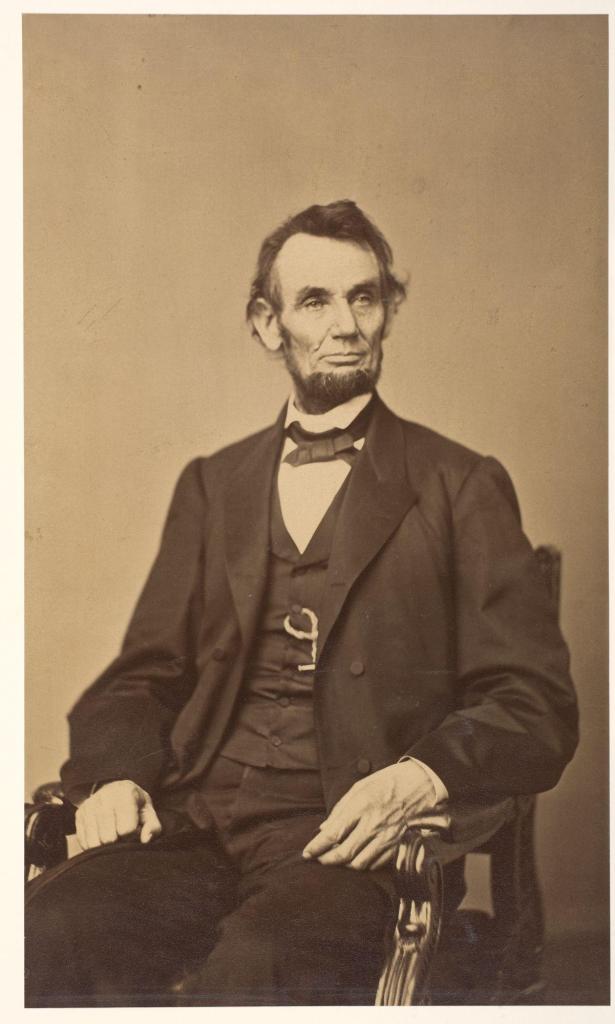
Photograph: Abraham Lincoln
Artist: Anthony Berger, Photography Studie Brady & Co.
Sources: The Metropolitan Museum of Art
Gilman Collection, Purchase, The Horace W. Goldsmith Foundation Gift, through Joyce and Robert Menschel, 2005
2005.100.1116


Leave a Reply