The name David Suzuki is unknown to most people residing in the States. Canadians know him as the host and narrator of the CBC science program The Nature of Things from 1979 until his retirement in 2002. Suzuki taught genetics at the University of British Columbia. He is an environmental activist.
Another person relatively unknown in the States is Murray Brewster. He is the senior defense (spelled defence in Canada) reporter for the CBC. He covers Parliament Hill on matters related to the military and foreign policy.
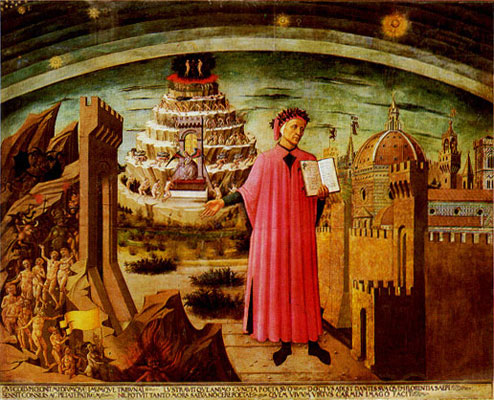
Dante Alighieri is a more familiar name recognizable for his poetic and allegorical masterpiece The Divine Comedy. Most students and readers are familiar with the first volume, Inferno, which is where most leave off rather than progress through the remaining two books, the Purgatorio and Paradiso. A student once told me that Hell (the Inferno) is a more entertaining and enticing place. He decided to avoid progressing further.
Dante permeates his Comedy with the symbolism of direction from the opening stanza of the Inferno to the concluding stanza of the Paradiso. Circular movement, the descending, spiraled structure of Hell’s landscape, is an inversion of geography and geometry. Readers, like the souls in this environment, are left wondering what direction they are moving in. Hell is a place of confusion, anguish, pain, and despair.
You may be asking yourself, what is the connection between Suzuki, Brewster, and Dante’s Inferno? If you have read the Inferno, you probably don’t recall encountering Suzuki or Brewster there. Trust me, and I am confident both will be relieved to know, neither Dante nor I saw either of them among the ruinous cliffs or channeled walls. Should I ever be tempted to rewrite Dante’s Divine Comedy, I would have them appear on some other hierarchical level. I digress. The environment is the connection.
In keeping with the structure of the Inferno, let’s begin with Dante. The poet is concerned with the moral condition of humanity, the decisions that we make, and our behavior based on those choices. We have free will to decide what is right and wrong as rational creatures. Those principles and values govern our lives. Our ethics are shaped by family, society, and reflection based on experience, knowledge (including self-knowledge), reasoning and reflection. We have two innate inclinations— the inclination to do good, the other towards evil.
Dante recognizes sin (the evil inclination acted upn) to be the antithesis of virtue (the good inclination). His understanding of what is good and what is evil is derived from Aristotle, the Patristic writers (Church Fathers), and Thomas Aquinas. Two examples illustrate the workings of the inclinations.
Gluttony, the unconstrained craving for food and luxuries, and greed, an excessive desire for property and wealth are both countered by the virtues of self-restraint, moderation, and generosity. Think about these two “sins” in the context of Canto Eleven of the Inferno where Dante writes:
“One can use force against the Deity, / cursing it, or denying it in one’s heart, / or scorning Nature and her generous goods;” (lines 46-48).
Have we politically and economically pursued moral goodness in our relationship to Nature, or have we been “scorning” and abusing earth’s resources? And if we are not stewards of the natural environment, are we capable of pursuing peace, justice, and harmonious living, acting out of moral goodness with one another? Dante’s answer, based on his theological perspective, would be no, we can’t. We open ourselves to the other categories of “sin” he catalogues in the poem.
This brings me to Murray Brewster’s report on a recent journalism conference held in Seoul, South Korea. Journalists from 50 countries discussed the ramifications of climate change and its implications “on both the literal and political landscape.” He writes: “The consensus, albeit a rough one, was that the public — from Azerbaijan to Zimbabwe — was exhausted by the issue. It was tough to get their attention and people increasingly tuned out, even though in some cases their homes had literally been blown away.”
Governments, including the Trump Administration, are concerned about immigration. Disaster-driven climate events are contributing factors in population migration. The Obama Administration offered this dire warning in 2015: “Climate change is an urgent and growing threat to our national security, contributing to increased natural disasters, refugee flows and conflicts over basic resources like food and water.… The present day effects of climate change are being felt from the Arctic to the Midwest. Increased sea levels and storm surges threaten coastal regions, infrastructure and property.” Canadian governments, among other nations, have issued similar reports.
Brewster writes, “Buried deep within a recent wildfire briefing, there was a particularly stark admission from a senior federal official who suggested the ability of the government to respond is close to the breaking point. What we’re seeing today with these disaster-driven events, they’re increasingly outpacing the capacity of the Canadian emergency management system,” said Matt Godsoe, the director of the Emergency Management Strategy Implementation Office. “A key example is the increasing reliance on the Canadian Armed Forces for disaster response and support. Which long term is unsustainable, and it can hinder the Canadian forces’ ability to respond to other threats, both at home and abroad.”
Authoritarian governments, poverty, drought, famine, and disease are not the only mitigating factors for population shifts. Climate change contributes to geopolitical instability. A 2024 report issued by the Council on Foreign Relations found, “… that a rise in average temperatures by 1.8°F is linked to a 4.5 per cent increase in the incidence of civil war that year. Climate is also linked to making such wars last longer.”
“Scorning” nature, our neglect of our fragile relationship with the earth due to our gluttony and greed for its resources, brings me to a question David Suzuki raises, “Is it too late to escape climate catastrophe?”
Suzuki notes that we have “surpassed seven of the nine planetary boundaries that define the constraints under which human and other life exists. These relate to climate change, novel entities, stratospheric ozone depletion (the only one somewhat resolved, thanks to an international agreement), atmospheric aerosol loading (the only other boundary yet to be transgressed), ocean acidification, modification of biogeochemical flows, freshwater change, land system change and biosphere integrity.”
According to Suzuki, it is too late to prevent the earth from heating up. “But solutions are here. We just need to shift our priorities, hunker down and actualize them. We must all get involved.” Our survival requires moral improvement as individuals and collectively in a time that UN Secretary General António Guterres has called “moral and economic madness.”
The blame for the environmental crisis is easily cast upon our political and corporate leaders. But Dante would, without hesitation, remind us that free will carries with it both freedom and responsibility. We are no better than those characters he encountered in the Inferno. We, like they, have made our choices. The difference is we are the ones creating our own Inferno.
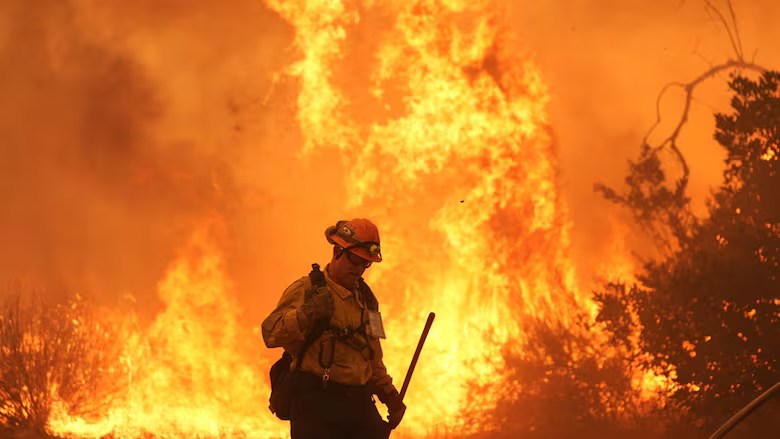
A firefighter battles the Canyon Fire in Halsey Canyon, Calif., on Thursday. (Marcio Jose Sanchez/The Associated Press)
References:
Planetary Boundries
https://www.stockholmresilience.org/research/planetary-boundaries.html
David Suzuki Foundation
https://davidsuzuki.org/story/is-it-too-late-to-escape-climate-catastrophe/


Leave a Reply