On April 14th, Bob Confer wrote an article for The Wellsville Sun titled “The Deadly Stress of Farming: New York farmers are committing suicide at alarming rates, help is available.” His piece has haunted me since reading it.
I am a descendant of farmers in rural New York state. My mother’s father and her grandfather farmed in Allentown. My father was a pasteurizer for a dairy in New Jersey. When I was raised in Secaucus, there were still pig farms, and towns like Franklin Lakes, Mahwah, and Wyckoff had surrounding orchards and farms. My father and Cy Sommer (Uncle Cy), his best friend, purchased farmland near Delhi, NY. Our neighbors were dairy farmers. I should add that my father was very much a “city boy,” a first-generation American born in Brooklyn. Despite his employment and rural friendships, he was always eager to return to the city. I grew up with one foot in the urban environment and the other in the rural. These are contradictory worlds that are part of my contradictory nature. I take pleasure in the city’s cultural offerings (though uncomfortable with the congestion), but I prefer farm country with its small towns and villages.
Agriculture is taken for granted. The average person thinks little about where food comes from and the intense labor of raising crops and cattle. I did migrant work and milked cows, besides having what we called “kitchen gardens,” which were no small plots. There is a difference between a warm, freshly laid egg and those purchased in the grocery market. Hens glare and squawk a warning when you reach into their nest. A Holstein cow is no fun to mount and attempt to ride⸺ neither you nor the cow will enjoy it. Nothing tastes better than freshly picked berries, tomatoes, lettuce, corn, green beans, and other crops.
The issues family farmers contend with are too numerous and diverse to list, due to the variable types of farming. Regardless of the type of farm, a farm’s health depends on the soil’s health and finding good solutions to problems. Wendell Berry observes, “A good solution will satisfy a whole range of criteria; it will be good in all respects. A farm that has found correct agricultural solutions to its problems will be fertile, productive, healthful, conservative, beautiful, pleasant to live on.” A farm is a home, a place of residence, not just a business. There is one aspect of farming that needs a good solution. Mental health.
Bob Confer writes: “The rate of suicide for those who put food on our tables is 44 per every 100,000. For comparison, the rate for the general population is around 14.”* The figure for veterans taking their lives is 34 per every 100,000.** A Canadian study showed that “Approximately 57% and 33% of participants were classified as possible and probable cases for anxiety, respectively; the respective proportions for depression were 34% and 15%.” Additionally, the findings showed that “Roughly 45% of farmer respondents had high stress, and 58% and 35% met the classifications for anxiety and depression.”***
Statistical data doesn’t put a face on those struggling with mental health issues. Unless you are on the staff of a VA Hospital or working with veterans and their families struggling with psychological challenges in some capacity, the reality of the mental health crisis is glanced over in a news report. Regretfully, many in Washington and Ottawa and urban dwellers give little thought to the crisis in the farm states and provinces.
Farmers contend with multiple stressors that include the impact of tariffs, climate change, animal diseases, invasive insects and creatures, and the costs of crop seed, animal feed, fertilizer, and machinery. Business cycles of when and what to plant and when to harvest depend on the weather and demand. Farmers receive pennies on the dollar of what we pay at the grocery market. Middlemen reap higher profits from the intense, back-breaking labor of agriculture workers. Physical injuries such as back and other injuries are common. To continue their work, lifting seed and feed sacks, bales of hay, and picking vegetables, dependence on prescription painkillers and other drugs can lead to addiction. Family relationships, as anyone with a family knows, are stressful for men and women who are always together in a livelihood in which there is no separation of family and business. Isolation, the distance between neighbors, and burnout contribute to emotional difficulties.
I have observed dramatic changes in rural communities due to the mechanization of agricultural (agri-business) operations and their impact on families. We need to maintain rural hospitals that can provide for the physical and mental health of farm families and their communities.
Mental Health issues are neither a matter of rural v. urban, Republican v. Democrat, nor limited to one Canadian party or other. We all need to follow the example of the citizens of Wellsville, New York, just as other communities and organizations that have taken steps to raise mental health awareness. Most importantly, we must provide the services and support for those with mental health issues regardless of where they live and their occupation.
When you shop for groceries, prepare and sit down for your meals, I hope you will take a moment to think about those who labor on the good land to make your meal possible.
RESOURCES for HELP
If you, a family member, or someone you know is considering suicide, help is available at the 988 Suicide & Crisis Life Line.
NY FarmNet is a free and confidential consulting service available to any farm located in New York State to discuss financial and health issues. Their hotline is 1.800.547.3276.
For Canadians, the Provinces have information at:
https://www.canada.ca/en/public-health/services/mental-health-services/mental-health-get-help.html
Au Coeur des Familles Agricoles – Milk Run Program (French only)
A Quebec not-for-profit organization offering free support services for farmers, including checking in to assess their mental health, offering respite from the farm when needed, and intervening with farmers in distress
Farmer Wellness Initiative https://www.ontario.ca/page/mental-health-resources-for-farmers
Access to free, professional mental health counselling support by calling the toll-free number 1-866-267-6255.
Designed to help connect Ontario farmers and their families with tailored mental health support offered by licensed professionals, the Farmer Wellness Initiative is available 24 hours a day, seven days a week, 365 days a year. Available in English, French and Spanish.
North Central Farm and Ranch Stress Assistance Center
National Suicide Prevention Lifeline: 1-800-273-8755
Crisis Text Line: Text “HOME” to 741741
Iowa Concern Hotline: 1-800-447-1985. Available in the 12-state north central region, including Illinois, Iowa, Indiana, Kansas, Michigan, Minnesota, Missouri, North Dakota, Nebraska, Ohio, South Dakota, Wisconsin. Serving the farm community, Iowa Concern has access to an attorney for legal education, stress counselors, and information and referral services for a wide variety of topics.
Bob Confer, “The Deadly Stress of Farming’. https://wellsvillesun.com/blog/2025/04/14/column-the-deadly-stress-of-farming/
Jones-Bitton, A., Best, C., MacTavish, J. et al. Stress, anxiety, depression, and resilience in Canadian farmers. Soc Psychiatry Psychiatr Epidemiol 55, 229–236 (2020). https://doi.org/10.1007/s00127-019-01738-2
REFERENCES
*Bob Confer, “The Deadly Stress of Farming’. https://wellsvillesun.com/blog/2025/04/14/column-the-deadly-stress-of-farming/
**The CDC reports that in rural communities, “the suicide rate is between 18.3 and 20.5 per 100,000 residents, compared to large urban communities where the rate is between 10.9 and 12.5 per 100,000.”
***Jones-Bitton, A., Best, C., MacTavish, J. et al. Stress, anxiety, depression, and resilience in Canadian farmers. Soc Psychiatry Psychiatr Epidemiol 55, 229–236 (2020). https://doi.org/10.1007/s00127-019-01738-2
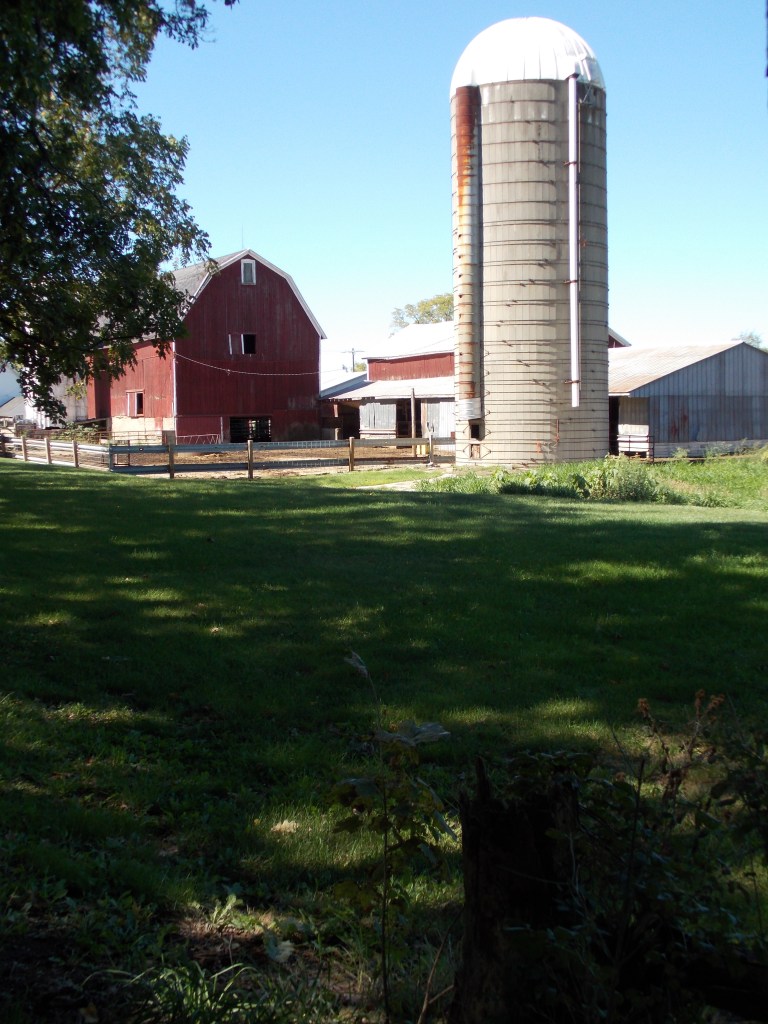
Image: Barn Yard Photographer: Charles van Heck


 Charles van Heck's Woodhull Journal
Leave a reply to automaticdaeb44aad7 Cancel reply