A mutual acquaintance arranged our clandestine meeting. We left the lecture hall and entered the fluorescent hallway that appeared shadowy that night. He hesitated, glancing around. Then he motioned me to follow him. We came to a narrow, corner space where we had a clear view of the hallway and he could slip into the shadows. “They have eyes and ears everywhere,” he said in a low, heavily Russian accented whisper. I reminded him he was granted political asylum. “This does not matter. The KGB still watches me. I am not safe even here.”
The man I met with that evening in 1982 was a Russian dissident; a defector from the Soviet Union. Many others were less fortunate. They were arrested and vanished in labor camps scattered around Russia, I had questions, many of which I assumed he already responded to during his debriefings with the FBI, CIA and State Department. Our discussion would cover the fate of other Russian dissidents, the Soviet economy, and briefly military strength.
I read an article about Senator Lisa Murkowski in The New York Times this morning. I was startled by her comment “We are all afraid.” Then I watched the video of her town meeting. The expression on the Senator’s face, her body language, the tone of her voice, her admission of fear brought back the memory of that night of nervous glances, low voices, and a hallway discussion in the shadows. Cautious paranoia? Perhaps. To be candid, I have been feeling fear lately. So have others who are more visible. Please take a few minutes to read the Times’ opinion piece The Trump Administration Is Disappearing People Like the Soviet Union: The courts can only do so much to protect us. Will more people be doomed to the fate of Kilmar Abrego Garcia? (18 April).
The Soviet government imprisoned 6,000 individuals between 1958 to 1986. They were arrested, tried and sent to the gulag for their disagreements with the official political, religious, and socio-economic policies under the Soviet Criminal Code. They were “non-conformists.” The number of 6,000 is an estimate. There were more.
Dissidents were arrested for such crimes as reading and circulating samvydav (samizdat, self-published) materials; conducting anti-Soviet conversations at the workplace; becoming active in a “non-approved” religious group; meeting with foreigners in an unauthorized context. The list goes on.
An estimated half-a-million citizens were invited to have a “friendly” conversation with KGB officers. These “chats” were to remind the citizens of the proper behavior and the correct thoughts of a “good Soviet citizen.” They were cautioned to avoid deviating from what was deemed acceptable.
Russian friends and others I met expressed their apprehension about speaking to strangers and acquaintances because they feared being reported. Others told me of hearing the knocks on neighbors doors. Their neighbor never being seen again. They talked about turning on their kitchen radios, going into bathrooms, and running water to have conversations for fear of their homes being “bugged,” or their neighbors overhearing their discussions. Poetry and statements were mimeographed for circulation. Crowds listening to “unacceptable” music, poetry readings were broken up by the KGB. Authors, such as Boris Pasternak and Alexander Solzhenitsyn arranged to have their manuscripts smuggled out of the country for publication. Pasternak got off easy during the Stalin years because the dictator liked his poetry for some peculiar reason. The poet Yevgney Yevtushenko found his audience and was able to travel abroad, much to the resentment of other dissidents, because of the more “liberal” policies of the Khrushchev period. Two dissidents, among many others you probably haven’t heard about are Tatiana Osipova and Vasly Stus. Strus was nominated for a Nobel Prize in Literature in 1985. He died at the camp Perm-35. Those released from the camps were often re-arrested on new charges or sent into internal exile. Others were exiled out of Russia.
I witnessed and heard similar accounts from Chinese acquaintances and friends while living in university housing. Officers of the Ministry of State Security (MSS), the primary Chinese civilian spy agency were and still are assigned to university campuses. An agent lived with a family next door to us in campus housing. My son babysat for the family, who was from mainland China. The MSS agent’s duties included observing Chinese students to report their activities and any deviant behavior or speech. This agent sat gloomily through a party for my son at which friends from the Mainland, Taiwan, Korea, and the States attended. He made no secret of following me around on occasion. How did I know this man was an agent? My neighbor made no secret of it.
We should, like Senator Lisa Murkowski, take seriously the Trumpian threats. But like her, Bernie Sanders, Cory Booker, Alexandria Ocasio-Cortez, and others, we cannot be shackled by our fear. The Russian dissidents provide us with examples of courageous actions.
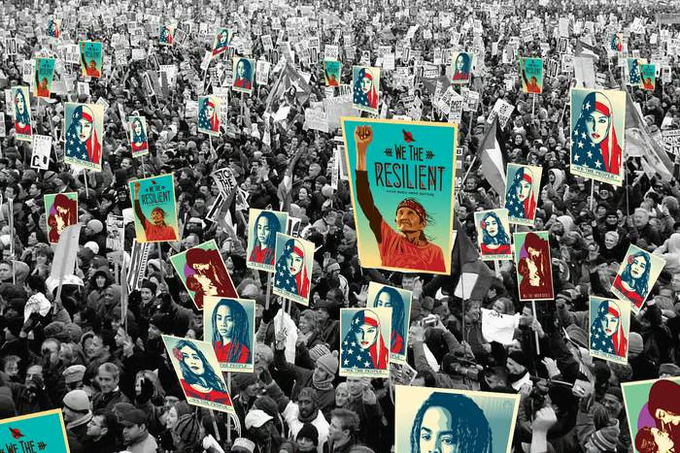
David Brooks surprised me with statements in his editorial What’s Happening Is Not Normal. America Needs an Uprising That Is Not Normal (The New York Times 17 April). He writes:
“It’s time for a comprehensive national civic uprising. It’s time for Americans in universities, law, business, nonprofits and the scientific community, and civil servants and beyond to form one coordinated mass movement. Trump is about power. The only way he’s going to be stopped is if he’s confronted by some movement that possesses rival power.”
“I’m really not a movement guy. I don’t naturally march in demonstrations or attend rallies that I’m not covering as a journalist. But this is what America needs right now. Trump is shackling the greatest institutions in American life. We have nothing to lose but our chains.”

A poster from the Polish Solidarity Movement


Leave a Reply