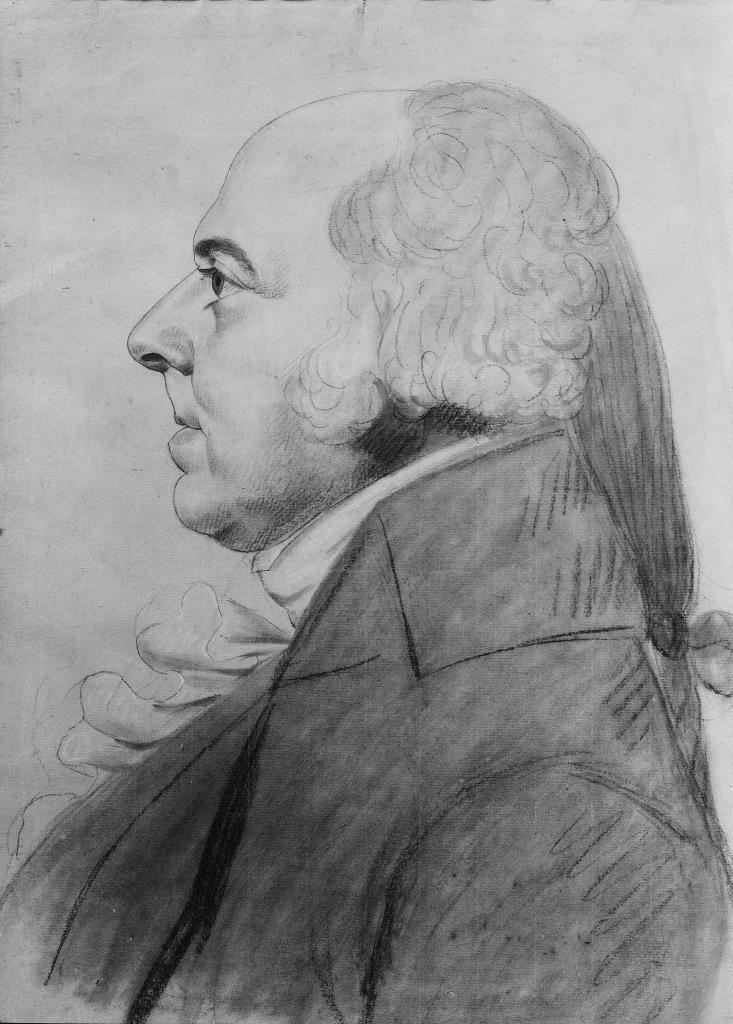
John Adams wants a word with you about ambition
One of the privileges of being a former president of the United States is recognition. Historians combing through your life and policy decisions is a disadvantage. For John Adams, the disadvantage of the latter is increased by having served in office between George Washington and Thomas Jefferson. His personality contributes to the derision and being largely ignored. David McCullough's biography John Adams and the television miniseries introduced Adams to a 21st-century audience.

I was first introduced to John Adams as a youth. A neighbor, who taught history, was moving. He arrived one evening at our home and presented me with a volume on American history. I was hooked. And, like McCullough, I found Adams more interesting than Jefferson. As we approach the 250th anniversary of the Declaration of Independence, I decided to interview Adams. The interview was conducted in the library at the Adams’ historic home in Quincy, Massachusetts.  What follows is an edited transcript of our conversation.

CVH:      The historian John Ferling has described you as a “one-dimensional man.” Unlike others of your generation, you had no interest in scientific inquiry, the arts, music, the theater…
JA:          I take it that you have been speaking with Franklin and Jefferson. The value of art lies in providing moral instruction. Explain to me what you mean by “one-dimensional man.”
CVH:      He writes that you were, “… a restricted human being whose goal was the solitary pursuit of self-fulfillment, a fulfillment that could only be realized through a popular recognition that John Adams was indeed a great man.”
JA:          I was compelled by ambition. There is no denying that. The study of law, politics, and war was of the utmost importance. I did that, as I expressed to others, so that my sons may have the liberty to study mathematics and philosophy. My sons ought to study geography, natural history, naval architecture, navigation, commerce, and agriculture, in order to give their children a right to study painting, poetry, architecture, statuary, tapestry, and porcelain.
CVH:      But ambition… how do you define it?
JA:          Most people are motivated by the desire for wealth and other means of accomplishment that bring them esteem and attention for their gratification. Those in political leadership love fame. They speak of their legacies. Are their actions productive for the public good, or are they productive for the honors and admiration of those they represent? What is their aim? The Revolutionary Generation sought the greater good. Our ambition aimed higher than personal wealth, but nonetheless sought recognition. Ambition is, in and of itself, not evil. The evil of ambition is in the absence of virtue.
CVH:      Then you differentiated between the various forms of self-seeking ambition?
JA:          Puritan introspection and study of political motives allowed for a discernment of passions, prejudices, habits, hopes, fears, wishes, and designs. For myself, I adhered to disinterestedness.
CVH:      What do you mean by disinterestedness?
JA:          A commitment to public service and the public good at the sacrifice of personal interests. This is the virtue upon which rests the Republic. There are few politicians who are disinterested in power for its own sake, let alone motivated by civic virtue. I would argue this is particularly true of the executive branch. The balance of power among the executive, congressional, and judicial branches checks self-serving passions in favor of the common good. Wisdom instructs us that ambition and avarice are incapable of virtue.
CVH:      You have to acknowledge that your understanding of disinterestedness is out of sync with how most citizens understand the Constitutional arrangement.
JA:          Democracy is never simple. Neither is human nature.  My convictions were derived from the classical commitment that the social order and the institutions of government needed to be balanced, and the necessity of an equilibrium between the social elite and democracy. This is neither involuntary nor instinctive. We achieve this politically. I would add that, as Washington said, “To form a new government requires infinite care.” The same holds true in maintaining it.
CVH:      You once wrote: “Democracy will soon degenerate into an anarchy, such an anarchy that every man will do what is right in his own eyes and no man's life or property or reputation or liberty will be secure, and every one of these will soon mould itself into a system of subordination of all the moral virtues and intellectual abilities, all the powers of wealth, beauty, wit and science, to the wanton pleasures, the capricious will, and the execrable cruelty of one or a very few.”
JA:         This remains true. I believe you are experiencing this in your own age. A small elite, and a president who, lacking the ability for introspection and reasoned thought, acts on instinct. He prioritizes his self-interest. The state of affairs is worsened by sycophants motivated by their own self-serving passions. This is the danger of unlimited executive authority. Balance is the basis for constitutional wisdom.
CVH:      Human nature being what it is, do you think citizens understand and appreciate the necessity of balance? Grasp the necessity for constitutional balance?
JA:          I am more sympathetic towards the citizenry than my critics allow. Yet people tend to move towards extremes. History provides numerous examples of this. In your current state of affairs, you are contending with a demagogue. People who support him are motivated by fear and envy of others. These are dangerous emotions in politics. Citizens need to understand who their true friends are, rather than be misled and deceived. We need to be ever mindful that the same laws that govern citizens are applicable to those who govern.
CVH:      Despite your interest and the positions you held, you never wrote a book on political theory. Why was that?
JA:          There were a few attempts. Discourse on Davilla is one example. There were two problems I had to contend with. The first was my writing style lacked fluency— rambling and disjointed. This can be attributed to my conviction that political theories can either be too comprehensive or too rational to explain the reality of the world. Human beings are complex, often irrational. The majority of political writers are expressing ideology rather than theory. The other difficulty is the limitation of language. Language is never neat.
CVH:      Your critics would add that your temperament, priggish, adversarial, and contrarian, contributed to logical inconsistencies.
JA:          Do you expect a response to that?
CVH:      There is much more for us to discuss, but is there anything you would like to add before we conclude?
JA:          My counsel is to be wary of political movements and social trends. They are vanities and addictions. I say this as one who has struggled with my own vanities and ambitions, which I have often sought to take both preventive and corrective measures. We, like any government, contain within ourselves the seeds of our own destruction, as Joseph Ellis noted in his biography of me.
Image:
Title: John Adams
Date: 1800–1801
Artist: Charles Balthazar Julien Févret de Saint-Mémin (1770–1852)
Source: The Metropolitan Museum of Art, The American Wing, Gift of William H. Huntington, 1883
https://www.jstor.org/stable/community.18571896
Artstor

 Charles van Heck's Woodhull Journal
Leave a comment