Do you eat with intent?
In my parents’ house, our evening meals were served precisely at 5 o’clock. We gathered at the table, recited a blessing, then dined together as a family.
There was an understanding that my father’s employment as a dairy pasteurizer provided the income to purchase groceries for our nourishment. His work, our friendships with farmers, the kitchen garden, and the fact that my mother’s parents farmed allowed us to appreciate food as more than what came from the A&P store. For my mother, cooking was an act of love, though on occasion she slipped us frozen prepared meals (vintage late 1950s, early 1960s). Our appetites told us of our need for nourishment, the need to care for our bodies.
There was a spiritual/liturgical approach to dining. We recited in unison the blessing (berakhot), with its intent of raising awareness that God had provided for us; the dietary law (kashrut), though not strictly followed, and the celebration and pleasure of food (seudah). Though more Christian in his thinking than Jewish, my father, who was raised Roman Catholic (my mother a Baptist) believed that our shared meals were part of our spiritual formation.
As a child, I either failed to understand or appreciate the lesson my father was imparting. This would come with maturity, though I often fail to adhere to the intentions of purposeful eating.
Purposeful eating is about more than satisfying one’s appetite. The Hebrew word kavanah refers to intention, direction, and purpose in the performance of our religious acts. In other words, it is the intent and direction of our heart and mind to avoid an act being mechanical. When done by rote, distractions undermine and diminish the purpose of our action, which is to fulfill a mitzvah (commandment of God). When we perform a mitzvah (plural: mitzvot) we are seeking to elevate our consciousness to connect (or d’vekut) with God. We typically associate kavanah with prayer, but in actuality, it is associated with our daily actions.
The Baal Shem Tov provides insight to the relationship between food and kavanah. He observes:
When you take a fruit or any other food in your hand and recite the blessing “Praised are You, O God” with intention, your mentioning the holy name awakens the spark of divine life by which the fruit was originally created. Everything was created by the power of the holy name. Since an element is awakened when it comes in contact with a similar element, the blessing awakens the element of divine life in the fruit, the element that is food of the soul. (Keter Shem Tov, 43).
Elsewhere he taught:
The will of the Creator, then, is to “enliven every living thing” by means of eating. So I have to eat in holiness and purity, for I am doing God’s will by eating. And when you think this way, then you can accomplish the spiritual purpose of eating by lifting up the holy sparks to their source…. And you should realize that it is God who has brought you to this hunger and thirst. For the hunger is from God. (Mazkeret Shem ha-Gedolim, 79). 1
In the coming days, Passover (Pesach) begins. The commemoration of the Exodus is the beginning of the covenant between the Divine and the Jewish people. The covenant is founded on God taking the people out of Egypt. All aspects of the Jewish faith rest upon this moment in time. When considered in context, the Gospels establish that the Christian faith also flows from that night and the departure from enslavement.
Despite obvious differences in understanding Passover, the Church’s (regardless of denomination) liturgy, with its eucharistic moment, was shaped by the Passover Seder, from the Last Supper to the gatherings for meals shared in the homes of Jewish-Christian believers in the Apostolic Church, through to the contemporary Church. In the earliest history, the Jewish and Christian communities remained socially connected. By the fourth century, there was an irrevocable split that spilled into anti-Semitism, anti-Judaism.
For Jews, the observance of Passover is a remembrance, a reappropriation of a story that is not merely ancient but of our own personal experience of a journey to freedom—the struggle against enslavement and oppression, and our movement towards a time of peace. That desire for peace has been relevant throughout our history. Today, the news accounts remind all people, Jews, Christians, Muslims, and non-believers of our longing, our deepest desire for peace, the abolishment of the hate and violence that enslave us.
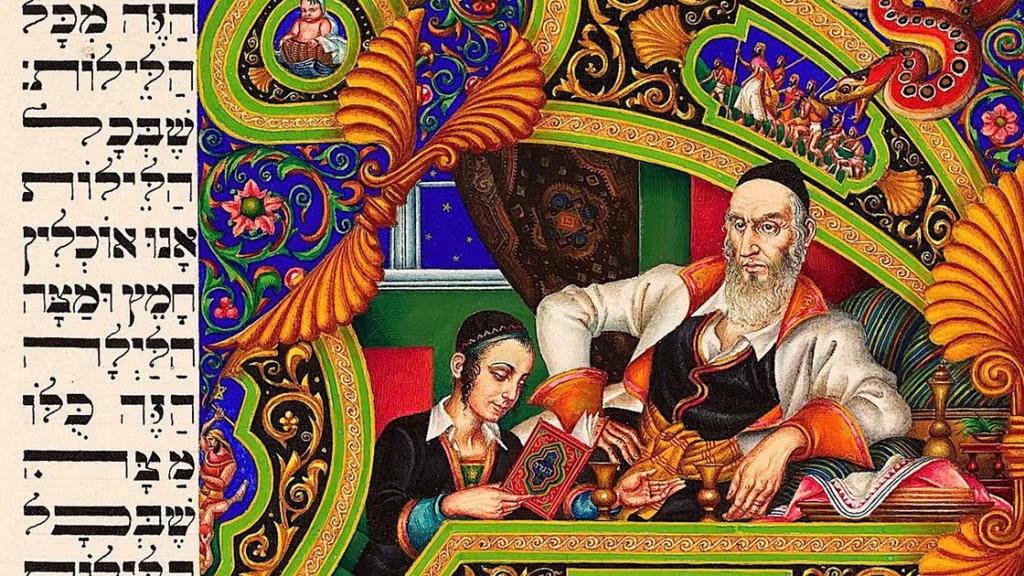
The reading of the Haggadah, which translates as “telling” and food are central to Passover. In the pages of the Haggadah, there are prayers, blessings, tales, songs, and instructions on how to conduct the seder. Our Passover meal is a reminder of purposeful eating. The food is symbolic to allow us to experience the bitterness of slavery and the joy of liberation. We are challenged to remember our priorities, to appreciate what we have in our lives, and our responsibilities towards others who are enslaved, searching for liberation.
In her Davar Torah, given 6 April 2018 to the Kol HaNeshamah community in Seattle, Rabbi Zari Weiss said:
“And you shall remember that you were a slave” [in Egypt], we read in Deuteronomy 16:12, part of the special reading for Passover. Commenting on this verse, Rashi said, “Only on this condition did I deliver you from Egypt: that you keep and do these laws.” In other words, Rashi says, only on the condition that you remember that you were slaves did I bring you out of Egypt, did I free you. Remembering this experience is the central reason we do everything we do as part of our observance of Passover.
If we truly remember what it is like to be a slave, to not be masters over our own lives, to not feel safe, to not live freely, then we cannot help but feel the pain of those who find themselves in similar circumstances today. We feel and understand that pain with such an intensity that it is our pain as well. Except that we are now free, and they are not.
With every breath (Kol HaNeshamah) and with every bite of food (ביס של אוכל) let us be mindful of before Whom we stand and of one another. Let it not be just on this night that is different from every other night, but on all nights.
1 Briefly, there are various ways to understand “the holy sparks.” One interpretation is they are the “fuel of creation” through which all things both exist and function. Another way to think of them is that everything in existence has a spark of holiness because it was created by the Divine.
Image Source: The Four Questions page from the Arthur Szyk’s 1935 Haggadah. (Wikimedia Commons)

 Charles van Heck's Woodhull Journal
Leave a comment