March is a transformative month, though I doubt anyone can say with certainty what the month is transforming into. In the course of a few days, Winter and Spring have seemed to be like unsynchronized and unintentional ballroom dancers stepping on one another’s toes. Summer appears to be intent on interrupting the dance partners. I suspect that Summer will do a freestyle dance. Will it be a crowd pleaser?
I am one of those people who prefer Autumn and Winter. I tend to be most creatively productive from mid-August, when the first cool breath of Autumn is felt, and the crop harvest is underway, through late April when the yard chores begin to beckon. Autumn and winter, with their cooler days and denser, flattened clouds filtering the sunlight, direct my attention to the changing landscape of colors. The way shadows drift across the pasture and sunlight weaves between the branches, casting blueish-gray shadows across the pearl snow, bringing out faint shades of purple and pink. Sweater weather gives me a sense of comfort. Mornings until early afternoon are the creative hours. Evenings are spent with either a good book or a good costume (period) drama.
Most of what is passed off as entertainment in film and streaming shows today is poorly written, humorless, or absurdly over-the-top, and overly violent, as if to push the boundaries of shock value. I find it rather peculiar that Hollywood, for all its “liberalism,” offers guns and superhero resolutions to their characters’ problems. We devour the stale popcorn of their offerings.
Mysteries are transparent from the outset. Terri gives me a stern look when we sit down to watch a mystery. “Don’t tell me,” she warns, knowing I will figure out who the murderer is and who the victims will be within the first few minutes. I write victims because the writers, seldom content with one homicide, stack up the bodies. If the show is a series, I am left wondering how anyone survives in a given village or county with so many serial killers lurking about.
I will confess to watching and enjoying “Vienna Blood,” “Dark Winds,” and “Magpie Murders,” and its sequel “Moonflower Mysteries.” I did watch “The Night Agent,” but found the writers got so much wrong that I was unable to suspend my disbelief to be entertained.
We tend to think that research is unnecessary in fiction writing. Fiction is fiction. However, if you are going to write about the White House, for example, you need to understand the function of the various staff positions, the internal power plays, and the interaction between agencies, and those agencies’ procedures. Also, your characters need a touch of humor, be it dry or sarcastic. Too many shows and movies have characters strolling around with faces carved in stone. The same can be said of police procedures. Watch Michael Kitchen in “Foyle’s War.” Kitchen insisted the writers delete his lines from their script. He conveyed more with his facial expressions than with the spoken word. Besides this, the writers provided him with humorous, dry quips. Good writing requires three dimensional characters. Readers and viewers need characters they can relate to. Despicable characters are fine, but even the most disreputable characters require a trait we can empathize with.
There is an emotional component to writing. Susanne Knaller, a professor of cultural studies and general and comparative literature, observes:
The arts are instances of observing paradigm scenarios, while they, in turn, also depend on the condition of their own observation. In this respect, we are not only concerned with emotions from real-life and cultural paradigm scenarios, but also with aesthetic paradigms. Furthermore, the arts are not merely concerned with emotions as physical or cognitive experiences and assessments, or with self- and referential reactions. Aesthetic emotions are also bound to take a specific form, appear in a specific mode, and place themselves in a relationship to existing and possible aesthetic paradigms (of emotions).
A writer, and I think this applies to artists in general, deals with aesthetic emotions during the creative process, as they react to and assess the scene they are observing, either physically or mentally visualizing, that they wish to convey. Writers deliberately evoke their characters’ emotions, as well as the emotional atmosphere of the material the characters move through and react to. Aesthetic emotions are shaped by their cultural and historical context. The reader or viewer of a work also experiences emotions in their response to the work being communicated. In our daily lives, our emotional responses are more layered, complex, and reflection is needed to achieve understanding.
The other day I attended a meeting of the Authors Guild on marketing a book. The speaker was Andréa Guevara. While listening to her and later going through the workbook she provided and my notes, I found myself questioning whether I had adequately prepared my novel, Mister Lincoln’s Elephant Boys, for an audience. Self-doubt is part of the writing process, just as hope that the material will resonate with readers. There is no room for arrogance. Few writers become masters of the art. We strive on the learning curve. However, regardless of how good or excellent we become, writing is a bit like standing on a ledge of Niagara Falls and dropping a pebble, then waiting to hear the plop. The same is true of whatever one writes. One neither knows whether there will be readers nor how the readers will respond. Some, if not most, writers have a niche. They know their audience. Their audience knows them. There is nothing wrong with that. Others, like myself, lack a niche. They, and here I include myself, are generalists due to their diversified interests. Regardless of what they compose, all writers wait for the plop sound.
In the meantime, Winter and Spring continue their awkward dance. Summer has already risen in the ballroom’s western wing, stretching his limbs and ready to perform.
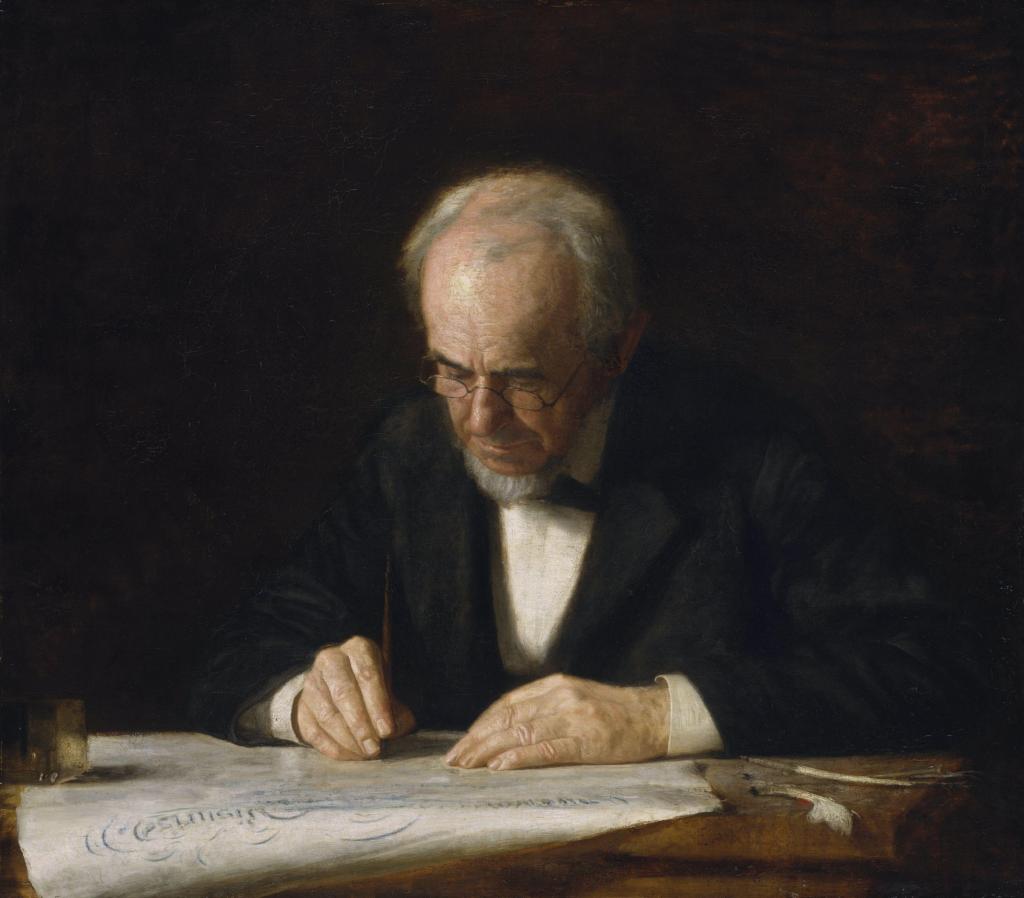
Image: The Writing Master
Artist: Thomas Eakins (American, Philadelphia, Pennsylvania 1844–1916 Philadelphia, Pennsylvania)
Credit Line: The Metropolitan Museum of Art, The American Wing, John Stewart Kennedy Fund, 1917
https://www.jstor.org/stable/community.15995198
Artstor

 Charles van Heck's Woodhull Journal
Leave a comment