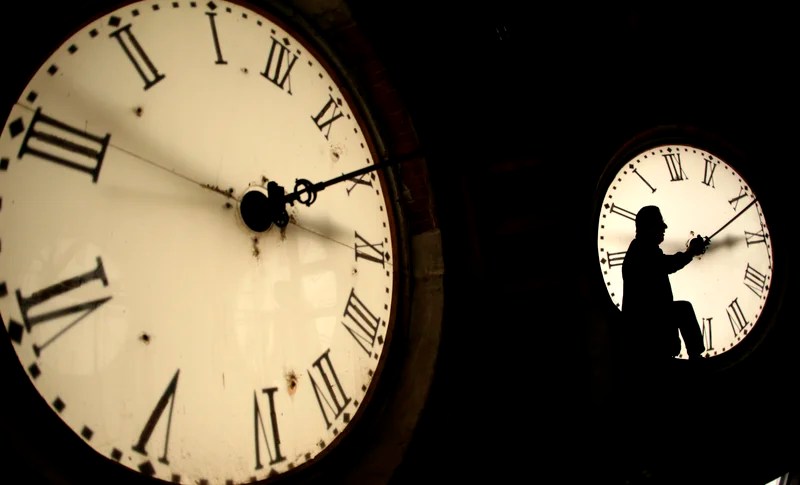
This is the time of year when the majority of us, 54%, dread moving forward. Why? On Saturday evening, we will dutifully change our clocks to Daylight Saving Time (DST).
The ritual of shifting clocks back and forth an hour to observe daylight and standard time appeals to me even less than being summoned for jury duty. Both are intolerable rites. One is necessary, the other is not.
The time change has a terrible effect on me. For months, I am left feeling miserable, fatigued, and slightly disoriented as my body’s clock fails to be in sync with the house clocks. As a parent, I kept trying to convince my young children that, despite the profuse sunlight, it was time for bed. As for me, I have difficulty convincing myself I can sleep despite Apolo (a.k.a. Helios ) peering around the edges of cellular blinds. I came to appreciate the late Roman period Latin term Sol Invictus (“Unconquered Sun”).
Terri is puzzled by my counter ritual. In previous years, I would rise on Saturday morning to promptly adjust all the clocks. This provided for a minor relief from the inevitable change. During the summer months, I moved into our basement apartment. We refer to the larger bedroom as “the bunker.” There are no windows, which makes it a relatively safe haven in the event of a tornado. Here, I shelter from the unblinking god.
Over the past few years, my ritual has failed to lift the mental fog. Terri was bewildered when I changed the clocks two days earlier last year. “Why?” she asked. “Maybe this will help me to adjust,” I mused. Sunlit rooms weren’t deceived.
The farmers I know have yet to find the benefit of changing the clocks. They find it disruptive to their schedules. Complaints are expressed by the business community, store managers, workers, medical professionals, clergy, and educators who contend with the sleep-deprived. The medical community finds no advantage to the change. The sleep medicine physician, Dr. Karin Johnson, says, “When we ‘spring forward’ for daylight saving time, we disrupt our body’s natural rhythm, damaging our sleep quality, mental health, and overall well-being. Our internal clocks are extremely sensitive to natural light and environmental shifts. Even a one-hour change can have serious consequences for health and safety. We need to end the practice of seasonal time changes and stick with standard time.” Other medical experts concur.
What are the risks? An increase in the risk of strokes, cardiovascular events, mood disturbances, mental health issues, production of inflammatory markers in response to stress, medical errors, and motor vehicle accidents, all can be a result of the time change.
The first proposal for DST was made by Benjamin Franklin, who ascertained that he was wasting his mornings by loitering in bed. In 1915, the Canadian government implemented Standard Time to reduce coal consumption and to extend the daylight hours for workers. The States followed in 1918 when President Woodrow Wilson signed the Standard Time Act to conserve energy during the First World War. Presidents Richard Nixon and George W. Bush have also tampered with clocks. Legislation has stalled in the Senate; the latest effort to abolish DST was in 2025. During his campaign, Donald Trump articulated support for eliminating DST, then hesitated. In March of 2025, he announced that this was a “50-50 issue.”
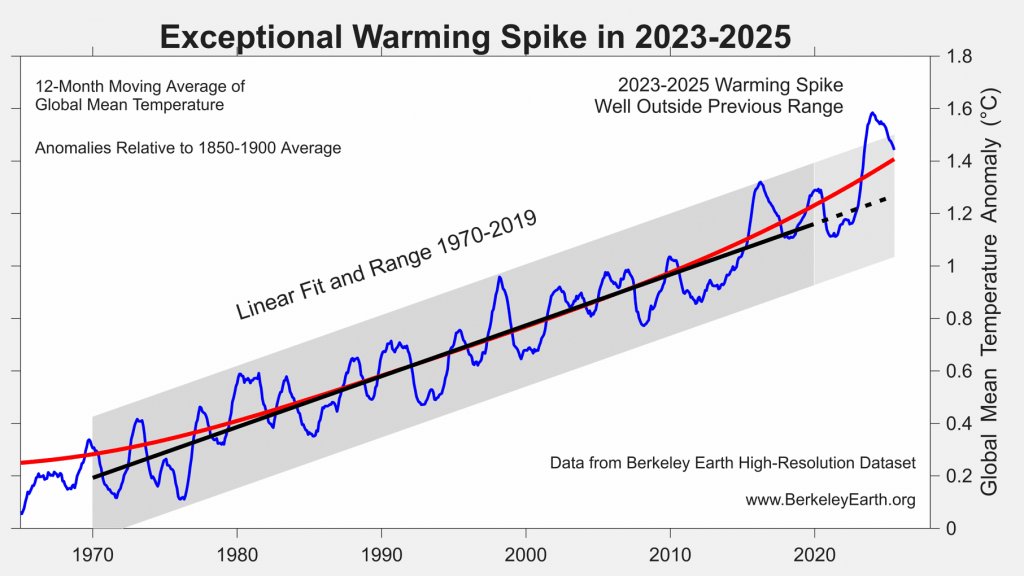
But does daylight saving time conserve energy? Actually, no. DST increases our energy consumption for air conditioning and carbon emissions. According to a report issued by Berkley Earth, “2025 was the third warmest year on Earth since 1850.” The report notes, “2023 to 2025 has been extreme and suggests an acceleration in the rate of Earth’s warming.” The analysis estimated as “1.44 ± 0.09 °C (2.60 ± 0.17 °F) above the average during the period 1850 to 1900, which is traditionally used as a reference for the pre-industrial period.” This represents a modest cooling.
Having lived in the South with high heat and humidity, I can appreciate the desire to remain on Standard Time. I can also understand the New England argument that summer daylight would begin at 4:10 a.m. and it would be dark at 7:30 p.m. rather than 8:30 p.m. When I lived in Tennessee, the time zone line between EST and CT ran through our home. Where we currently reside, the time zone has us on the edge of the EST Time zone, but leaves us with the CT effect. Time zones influence how DST and ST affect you.
A solution to the DST v. ST problem would be for states to follow the example of Hawaii, most of Arizona, Puerto Rico, American Samoa, Guam, the United States Virgin Islands, and the Canadian province of British Columbia by scrapping daylight saving time. Russia, China, and India do not apply DST. The Japanese use UTC+9.
UTC (Coordinated Universal Time). This is the worldwide 24-hour standard for time and, combined with the Earth’s rotation, is maintained using precise atomic clocks.
This DST debate has gone on long enough. Benjamin Franklin’s whimsical idea should be abandoned for the sake of our environment and health. If the Federal government won’t act, then the states should.
Things you can do to adjust to the time change are suggested at https://www.npr.org/sections/health-shots/2023/03/09/1161733459/these-6-tips-can-help-you-skip-the-daylight-saving-time-hangover
Information about health risks can be found at https://med.stanford.edu/news/all-news/2025/09/daylight-saving-time.html
Images:
Image 1 Credit: Charlie Riedel/AP
2) Chart Credit: https://berkeleyearth.org/

 Charles van Heck's Woodhull Journal
Leave a comment