There is a story told about Lyndon Johnson. In the telling, the President was playing poker in the White House family quarters with a few of the congressional leaders. During the game, he became melancholic, brooding. The assumption was that Vietnam was on his mind, a subject they wanted to avoid raising with him. If Johnson wanted to discuss the war, he would. Johnson looked at his guests and somberly said, “This house is wired for death.”
I have forgotten the source of this story. A reporter? An account in a memoir by an advisor? Is it an apocryphal legend that often follows a president? Those who knew Johnson say that he often referred to the Vietnam War as a “plane without a parachute.”
Donald Trump, Pete Hegseth, and Israeli Prime Minister Benjamin Netanyahu are flying a plane without a parachute.
What exactly are the strategic priorities of the Trump and Netanyahu governments? Is it to eliminate Iran’s ability to develop nuclear weapons? Or is it regime change? There is a vast difference between these two objectives.
Omani Foreign Minister Badr Albusaidi, who mediated the talks between the U.S and Iran, said on Thursday (26 February) that “significant progress” was being made in the negotiations on the nuclear issue. Both sides were to meet on Monday, 2 March. Albusaidi stated that a “peace deal was within reach.” He flew to Washington in an effort to avert war and to brief Vice President J.D. Vance.
Ironically, the deal Trump’s envoys were attempting to negotiate was addressed in the Joint Comprehensive Plan of Action (JCPOA) in 2015. This treaty, signed by Iran, imposed limits and prohibitions, allowed for inspections, and barred the production of weapons-grade enriched uranium. China, France, Russia, the United Kingdom, and Germany participated in the negotiations. Netanyahu opposed the agreement as too lenient. Trump unilaterally abandoned that deal in 2018.
The cloud over these discussions had been Trump’s rhetoric, his shifting positions between diplomacy, national security, and human rights, and his pledge to support Iranian demonstrators “to take their government,” a brutal, repressive, violent regime that supports terrorism.
There is another perspective. Both Trump and Netanyahu are unpopular. Netanyahu is on trial for corruption— charges of bribery, fraud, and breach of trust. According to The Economist, polls show Trump’s standings with Americans is 39% approve, 56% disapprove, and 5% are uncertain. Presidents have historically turned their attention to foreign policy to boost their poll numbers. Richard Nixon is a prime example of this during the Watergate scandal.
A foreign crisis enables a president to have a rally around the flag moment to divert attention from failed domestic policies. Patriotism or Nationalism? Again, there is a difference between the two. Trump and Netanyahu know how to play the nationalist card game. As for patriotism, both men wear the flag for their self-interest. If this were a patriotic moment, the president and prime minister would have laid out the clear and present danger to their citizens. Iran posed no immediate threat to either nation. Daryl G. Kimbel, the executive director of the Arms Control Association recently wrote:
Renewed U.S. military strikes on Iran would be counterproductive, reckless, and unjustified on nonproliferation grounds. Such a war of choice against Iran, without congressional approval, would violate the Constitution and the 1973 War Powers Act. It would also violate Article 2(4) of the UN Charter, which prohibits the threat or use of force in international relations.
Trump has not yet explained his case for war. He may believe the threat of strikes or “limited” attacks can force Iranian leaders to capitulate. That is highly unlikely. He has reportedly told advisers that if diplomacy or a targeted attack does not lead Iran to give in to his demands, he will consider a much bigger attack that is intended to drive the state’s leaders from power.
In brief, Kimball writes, “There is no imminent threat. Iran is not close to ‘weaponizing’ its nuclear material so as to justify another U.S. attack.”
Admiral William J. “Fox” Fallon (Ret.), who commanded both the U.S. Pacific Command (PACOM) and U.S. Central Command (CENTCOM), issued a strategic warning that members of Congress and the Israeli Parliament need to heed. We cannot sacrifice long-term stability for short-term political wins. In his memoir, Decisions, Discord & Diplomacy: From Cairo to Kabul, he writes, “Since the end of the Cold War, the U.S. has been too quick to use the military in response to global challenges. We seem to have forgotten about the other instruments of statecraft.”
Trump, Hegseth, and Netanyahu are ignoring the history of the wars in the region. They are ignoring that history has taught us that regime change, the belief that factions will not engage in a bloody internal conflict for power, is a fantasy. Success in war requires a strategy, competence, patience, and a solid grasp of history. Failure to understand this is to invite disaster, as we have witnessed in Afghanistan, Iraq, and Vietnam. Israel’s war in Gaza is a reminder of this, as well. Military leaders understand that, in Fallon’s words, “the chances of something being a one-and-done are low,” and that “strategic success requires thinking beyond the next election cycle or news cycle.” Diplomacy requires patience, competence, and an understanding of your opponent’s cultural and national interests and the deep societal divisions.
Billionaire “diplomats” playing let’s-make-a-deal are not competent State Department negotiators, despite their business acumen. Their failures are readily apparent in the discussion to settle the Russian-Ukrainian War, their inability to see through Putin’s misleading, deceptive, and duplicitous negotiations.
How long can the U.S. sustain this war? What will its effect be on other long-term strategic interests, particularly in Asia? The military has depleted munition supplies in Tomahawk missiles and several types of interceptors. What will be the cost in human life, both civilian and military? Morale is already low among Navy personnel due to prolonged deployments. How will that affect both re-enlistment and recruitment? The Administration is degrading our military capacity. What price in personnel and materiel are Americans willing to pay for Trump’s war? How many civilian casualties, the collateral damage of war, can Americans tolerate or justify? And who will emerge to control the Iranian government with the death of Ali Khamenei, the supreme leader, and other leaders of Iran? The door is open for the Revolutionary Guard Corps to assume power. They will prove even more oppressive of the Iranian people and difficult to negotiate with. As of Sunday (1 March), an interim theocratic leadership council will govern Iran.
U.N. Secretary General Antonio Guterres is correct when he observes, “Military action carries the risk of igniting a chain of events that no one can control in the most volatile region of the world.”
“The stability of the region is of the utmost importance: The only lasting solution is a diplomatic one,” Ursula von der Leyen, the president of the European Union’s executive arms has correctly stated.
In their arrogance of power, Trump, Hegseth, and Netanyahu are flying a plane without a parachute. They are flying without strategy, prudence, and legality. And for Trump, he is flying without Congressional approval. In doing so, he weakens our constitutional structure.
Image
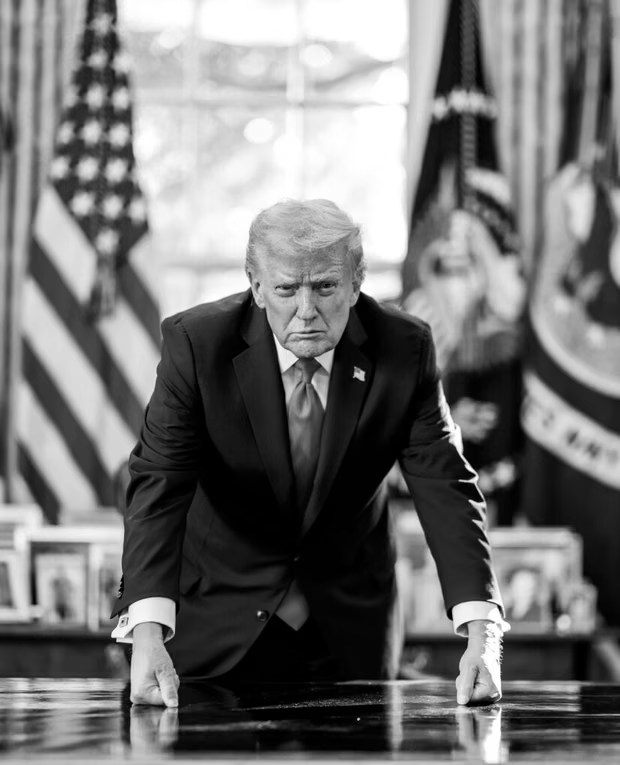
Portrait of Donald Trump. Photograph: Official White House photo by Daniel Torok
 Charles van Heck's Woodhull Journal
Leave a comment