In my hometown of Oakland, New Jersey, there are two lakes: Mirror Lake and Crystal Lake. My family home was on Mirror Lake, which was commonly known as “Little Lake.” I recall the summer days when we neighborhood children gathered to swim and the winter afternoons when we skated. Occasionally, I would take my bamboo fishing pole to the water’s edge, usually catching a sunfish, but more typically, I would catch a few idle hours away from chores.
“We call that a pond,” my wife laughed when she saw the lake. There is, of course, no comparison to be made with our “Little Lake” to the Great Lakes bordering Michigan, where my wife was raised. Jersey pride compelled me to retort, rather defensively, that we had the Atlantic Ocean. Jersey pride.
A friend, Diane, lived across the lake from our home. Despite the 596 miles (959 kilometers) that now lie between our homes, Diane sends a card once a month. Her cards are friendly, uplifting reminders to grasp the positive. My wife, a cheerful optimist who shares much in common with Diane, would be the first to tell you I need these healthy reminders.
I am one of those people who, by nature, anticipate and brace for the worst and have deep gratitude when things work out for the best. Does this make me a pessimist? A few people would think so. However, the pessimist is often led to despair. Their worldview is such that they perceive calamity but have diminished hope of a resolution.
In rabbinic literature, I find a middle way between optimism and pessimism. The Rabbis revered life. They were, as the Jewish theologian C.G. Montefiore states, “resilient optimists” with their unwavering faith in God. Their love for God and for life was greater than their fear. This isn’t to say they weren’t perplexed by the evil of their times and the difficulties they and the people around them faced. They understood that anything can happen.
In difficult, bad times, those times when we feel as beleaguered as Job, we are inclined to blame God. We ask, why? Regardless of our faith tradition, and I suspect even for the rabbis, we have moments of doubt. To be a “resilient optimist” requires a different perspective. As Rabbi Samuel S. Cohon writes:
Instead of conceiving of God as remote and inapproachable, Judaism learned to view Him as both high, mysterious and holy and also as near to the lowliest of men (Isaiah 57:.5; Psalm 113.5). He is also near to all who call upon Him in truth (Psalm 145.18). In the words of the rabbis: “He is near in all kinds of nearness” (Yerushalmi Berakot 9.1). Note: this last reference is to the Jerusalem Talmud.
Faith sustains us in our daily lives. This is true whether we are Jewish, Christian, of other traditions, or humanistic rationalists. In our world, anything can happen. The rise of MAGA, this Trumpian age, is a harsh reminder that the bad can occur on a national scale. My faith in God remains intact, but my faith in this country is strained to the breaking point.
The Trumpian Age is one of vanity, greed, corruption, racism, and both moral and Constitutional degradation. We are in a period of “a betrayal of the highest order.” We are witnesses to the disloyalty to our founding principles. Our silence makes us complicit in the Trumpian crimes. Those who are silent are guilty bystanders.
There are numerous words, memes, and actions that capture this moment in U.S. history. However, none capture it better than a 15-foot-tall, gold-leafed statue of President Trump, which will be mounted on its 7,000-pound pedestal at his Florida golf course. The statue, paid for by cryptocurrency investors, will, as reported by David Yaffe-Bellany of the New Times, be the height of a two-story building. An idol in the temple of U.S. Democracy.
This statue, Trump’s meandering address of 5 February at the National Prayer Breakfast, the renaming of the Kennedy Center, and his desire to stamp his name on Dulles Airport, Penn Station, and on bitcoins, among other things, speak to his vanity. But it also speaks to his weakness.
The crisis we face today is that of one man’s weak ego, his and white nationalists’ inability to believe in the nation’s creed. Listen or read his meandering address of 5 February at the National Prayer Breakfast. Watch him closely, and you will see a weak, scared man.
Lately, Trump’s words and actions make me think he is facing his own mortality. What matters to him is his legacy. I am reminded of the triumphs awarded to the victorious generals who had defeated Rome’s enemy. A slave, riding in the chariot with the conqueror through the streets lined with cheering crowds, whispered in his ear, “Memento mori.” Memento mori, is translated as either “remember that you are mortal,” or “remember you will die.” All glory is fleeting. I suspect Trump is hearing those whispered words.
Trump is now a backward-looking man. Jamelle Bouie, a New York Times Opinion columnist, made a comment in a podcast with Michelle Cottle and David French, broadcast on 7 February, which I agree with.
He (Trump) is preoccupied with his loss in 2020 and losing the popular vote in 2016. Sending the F.B.I. to Georgia, to take materials from the 2020 elections, to me, suggests that all of this is less about subverting the elections that are actually going to happen and more about finding material for Trump to be able to say, “No, I actually won.”
David French is also correct when he observes that the “MAGA apparatus” is forward-looking. The Trumpians are looking beyond Trump. We, too, need to look beyond him to understand how radicalized the Trumpians are by misinformation and disinformation. Power for the sake of self-serving power.
Our resistance must grow stronger. We need to be more attentive, more willing to stand up as the citizens of Minneapolis have, and to say, with Dr. Martin Luther King, “Let Freedom ring.” There is a price to pay, as those who marched for Civil Rights, as the protestors in Minneapolis and elsewhere know. How willing are we to pay that price to restore our institutions and limit presidential power?
We need to be “resilient optimists” to believe that we can succeed against the Trumpians by becoming more vigilant, better organized in peaceful protests and boycotts, and more motivated to vote for women and men who will uphold the Constitution, and support poll workers. We cannot allow disinformation to mislead, and fear to paralyze us.
Am I pessimistic? Strained as my faith in the States is, I believe that the damage Trump has done to the nation is affording us an opportunity to improve our institutions for the benefit of all the people. We are approaching a new beginning if we have faith.
The examples of our forefathers and mothers, those who believed in the nation’s principles and values, regardless of their race and creed, teach us that to have faith in a time of political oppression is to act with courage. To have courage is to brace for the worst and to work for the greater good.
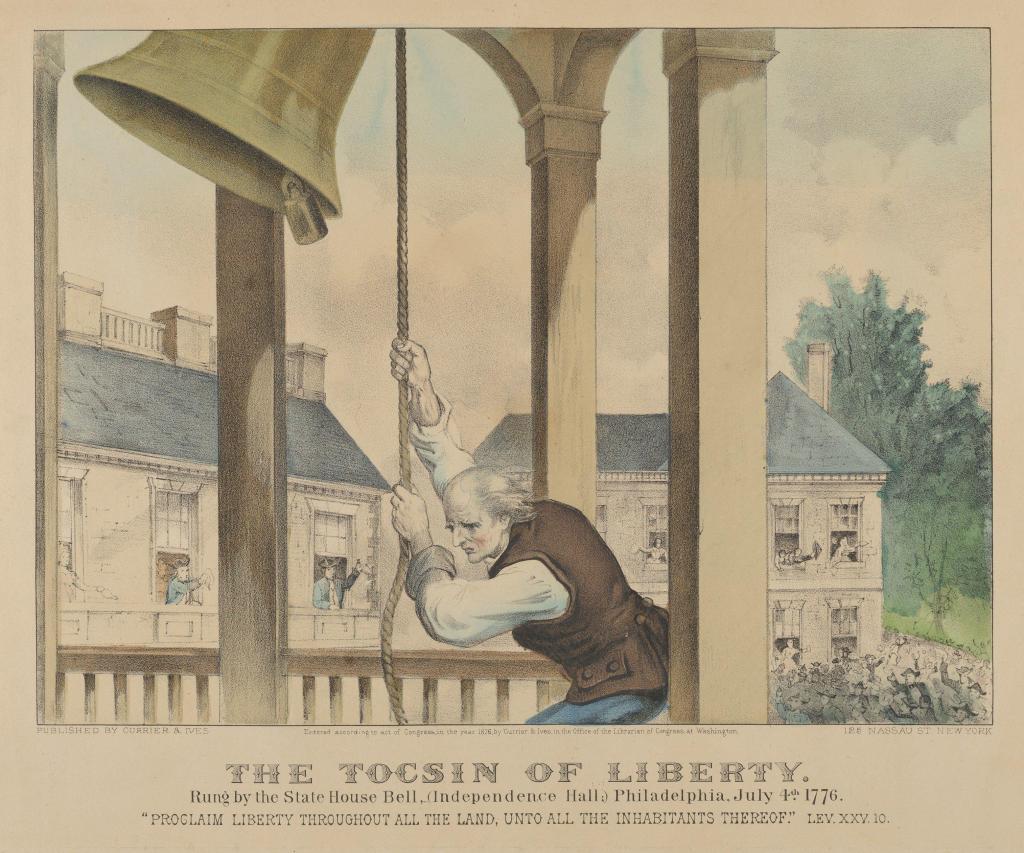
Image
Title: The Tocsin of Liberty–Rung by the State House Bell, (Independence Hall) Philadelphia, July 4th, 1776, “Proclaim liberty throughout all the land, unto all the inhabitants thereof” LEV.XXV.10.
Creator: Publisher: Currier & Ives (American, active New York, 1857–1907)
Credit Line: The Metropolitan Museum of Art, Drawings and Prints, Bequest of Adele S. Colgate, 1962

 Charles van Heck's Woodhull Journal
Leave a comment