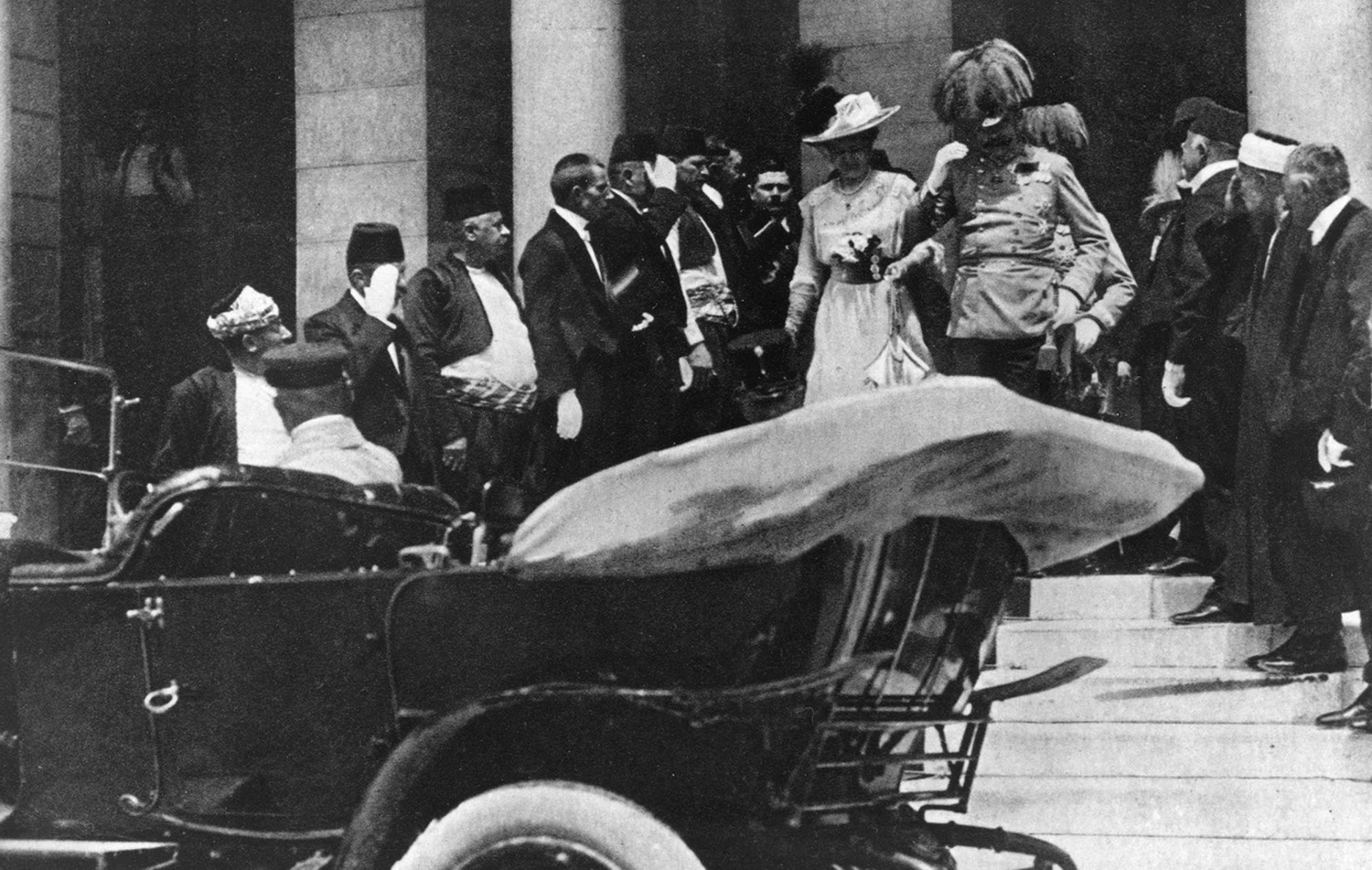
“’Some damned foolish thing in the Balkans,” Bismarck predicted would ignite the next war. The assassination of the Austrian heir apparent, Archduke Franz Ferdinand, by Serbian nationalists on June 28, 1914, satisfied his condition.’” So wrote Barbara W. Tuchman in her book The Guns of August.
On 28 July, one month later, Austria-Hungry declared war on Serbia. The First World War began. Between 2-7 August, Germany followed suit by invading France and Belgium. France responded by invading Alsace, and British forces arrived in France. These are simply the names of nations and dates. By themselves, the dates are meaningless, and the countries are places to visit or read about.
The faces of those who fought stare back at us from old photographs. Lost over time are their names and stories. Travel along the Western Front, and you will discover the scars of the trenches they dug, the craters of their artillery bombardments, and their graves.

The Robert Schuman European Center reported in 2011 that an estimated 9.7 million military personnel and 6.8 million civilians died during the course of the war. The civilian causes of death included genocide and starvation.
Barbara Tuchman writes:
“Men could not sustain a war of such magnitude and pain without hope― the hope that it’s very enormity would ensure that it could never happen again and the hope that when somehow it had been fought through to resolution, the foundation of a better-ordered world would have been laid. Like the shimmering vision of Paris… the mirage of a better world glimmered beyond the shell-pitted wastes and leafless stumps that had once been green fields and wavering poplars. Nothing less could give dignity to the monstrous offenses in which thousands and hundreds of thousands were killed to gain ten yards and exchange one wet-bottomed trench for another. When every autumn people said it could not last through the winter, and when every spring there was still no end in sight, only the hope that out of it all some good would accrue to mankind kept men and nations fighting.”
The memory of the War to End All Wars has faded. The sheets of pages of the peace agreements have been catalogued and filed. Occasionally, a scholar will request to see the yellowing documents. The disillusionment of a generation persisted, entangling subsequent generations in the all-too-familiar patterns of conflict.
Nationalism, military competition, imperial ambitions, alliances with incompatible interests, and competition for natural resources were the primary causes for the First World War. The political leaders were waiting for the “necessity” of a “favorable moment” to act offensively, to begin a conflict.
Today, 107 years after the guns fell silent, we face the same issues. A would-be king, an emperor, a would-be czar, and petty tyrants rattle their sabers. The names and faces have changed, but not the motives. We are in a period of severely deteriorating geopolitics. The scene today, as in 1914, is endemic of socio-economic and political divisions. The question that needs to be asked is how the Trump Administration will respond when a foreign adversary decides they have found a “favorable moment.”
The scene at Marine Corps Base Quantico, Virginia, on 30 September, when Trump and Hegseth addressed the U.S. senior military leadership, is a cautionary tale relevant to both domestic and foreign policy. Hegseth and Trump revealed their ineptness and incompetence, as well as their ability to miscalculate. Both would and do use violence for their own self-interest. The generals and flag officers in that room are professionals with 30 to 45 years of experience. They view both the purpose of the military and war realistically. They understand the danger of the incompetent and the undisciplined, who hide behind a machismo persona and induce others to do their fighting. They know that “War,” as Barbara Tuchman observes, “is the unfolding of miscalculations.”
The gunshot of 28 June, 1914 continues to reverberate as we wait for “Some damned foolish thing…”

Photographs:
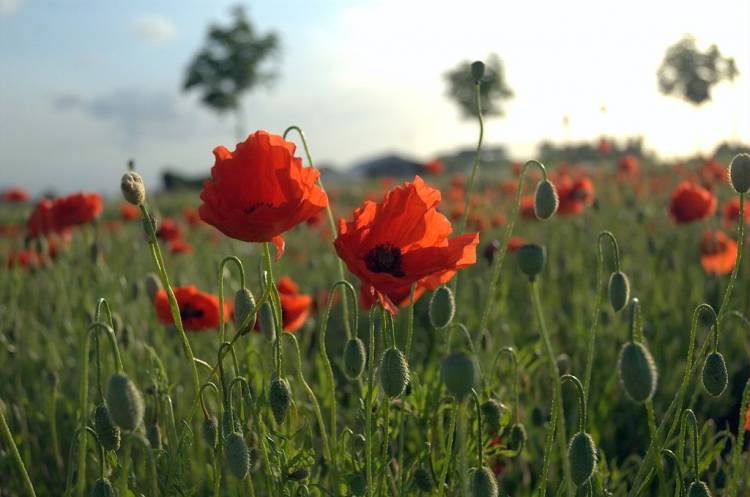
1 Memorable Imagery of War: Poppies growing in Flanders Field, Belgium.
2 Archduke Franz Ferdinand and his wife, Czech Countess Sophie Chotek, in Sarajevo on 28 June 1914. They were assassinated by a Serbian nationalist moments after leaving a City Hall reception. Source: The Atlantic
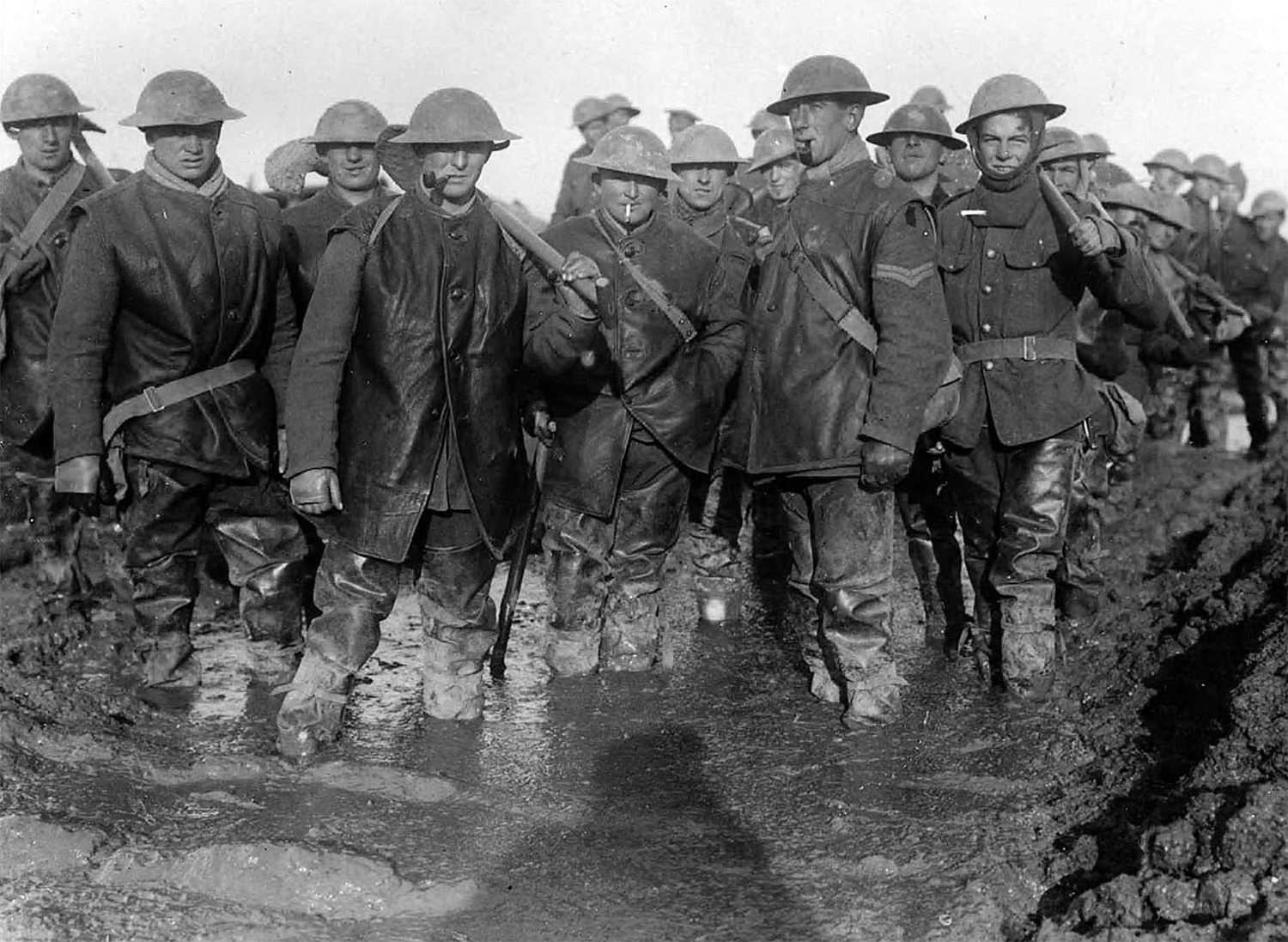
3 British soldiers standing in mud on the French front lines, ca. 1917. Source: The Atlantic and National Library of Scotland
4 A Verdun battlefield that still bears the scars of shell impact craters, photographed in 2005. Source: The Atlantic
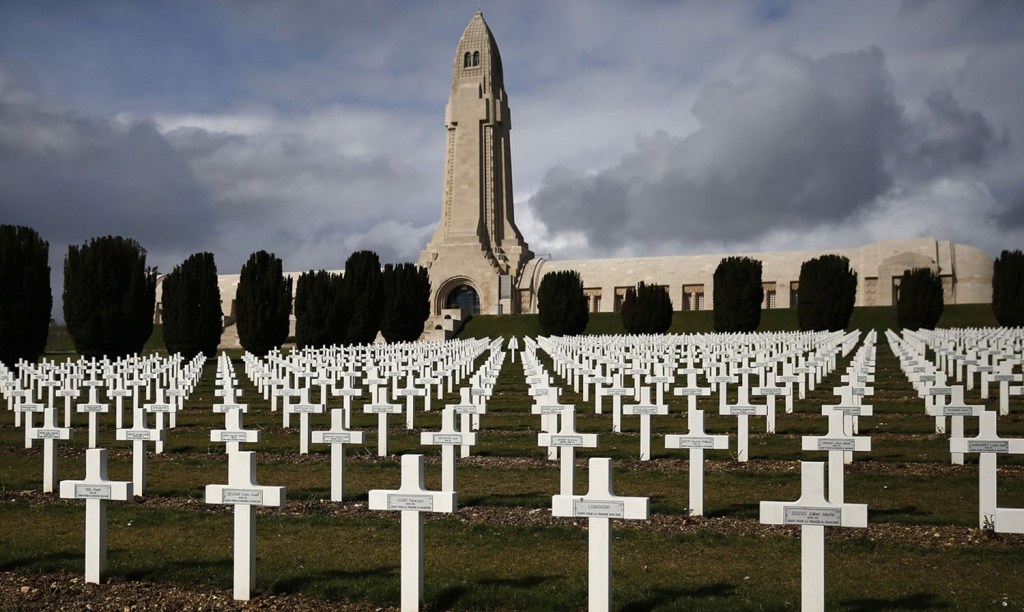
5 Crosses stand at the WWI Douaumont ossuary near Verdun, France, on March 4, 2014 Source: The Atlantic. Photogrpher: Reuters / Vincent Kessler,
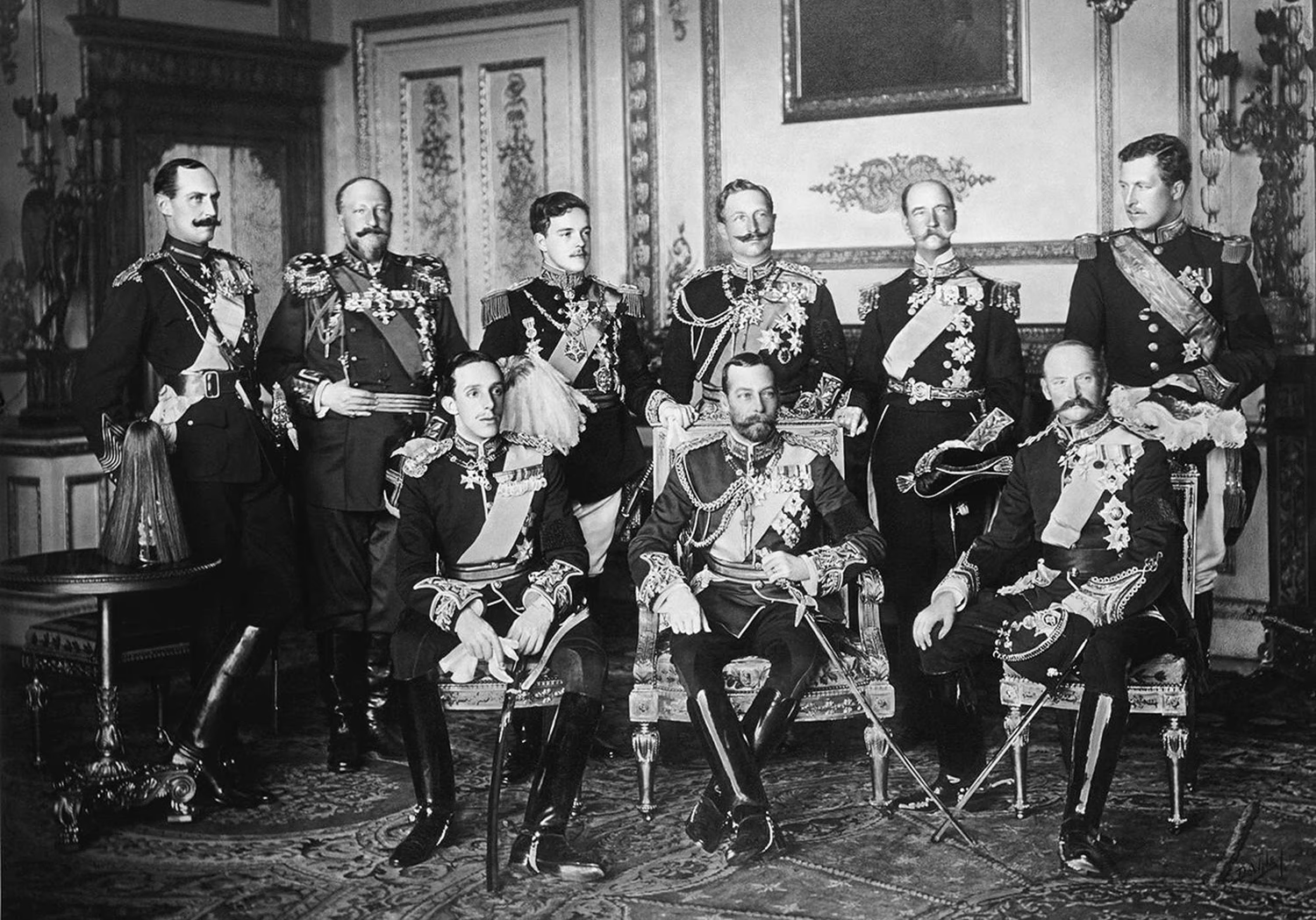
6 Nine European Sovereigns at Windsor for the funeral of King Edward VII in May of 1910, four years before the war began. Standing, from left to right: King Haakon VII of Norway, Tsar Ferdinand of Bulgaria, King Manuel II of Portugal, Kaiser Wilhelm II of the German Empire, King George I of Greece and King Albert I of Belgium. Seated, from left to right: King Alfonso XIII of Spain, King-Emperor George V of the United Kingdom and King Frederick VIII of Denmark. Within the next decade, Kaiser Wilhelm II and Tsar Ferdinand’s empires would engage in bloody warfare with the nations led by King Albert I and King George V. The war was also a family affair, as Kaiser Wilhelm II was a first cousin to King George V, and an uncle to King Albert I. Of the remaining monarchs pictured, over the next decade one would be assassinated (Greece), three would keep their nations neutral (Norway, Spain, and Denmark), and two would be forced out of power by revolutions. Source: The Atlantic, W. & D. Downey.
7 Soldiers at the Battle of the Somme, 1916. Via Wikimedia Commons.

 Charles van Heck's Woodhull Journal
Leave a comment