This past Friday morning, Verdict: Legal Analysis and Commentary From Justia arrived in my mailbox. I subscribe to it for insights into the workings of the judiciary. The article I delved into was by Marci A. Hamilton titled “Déjà, the Supreme Court’s Cabal, and the Trump Administration’s Secret Maneuvers.” She is currently a Professor of Practice in Political Science at the University of Pennsylvania.
I find pleasure in reading the law, particularly constitutional law, and scholarly articles on the subject. While a grad student, and though it wasn’t my field, the stacks and alcoves of the law library were my habitat. Hours were spent pursuing cases and legal arguments through numerous volumes.
Law is something either taken for granted or ignored until we find ourselves personally in dire straits. We are fixated on criminal cases, more for the actual homicide and the courtroom drama than for how the law actually works. The backroom conferences, the research required to develop the arguments that will be presented, and the decisions, both by the lawyers and judges, that will be made, can be tedious. Still, these reveal more of how the law functions. Personalities, race, socio-economic status, and gender also influence the judicial process.
Ms. Hamilton clerked for Sandra Day O’Connor during the 1989 Term of the Supreme Court. During that Term, three cases were brought to abrogate Roe v Wade. O’Connor assigned Ms. Hamilton to oversee these cases. The conservative clerks befriended her to assess if O’Connor would change her mind. She writes, “That meant I became a favorite of the Federalist Society Supreme Court cabal even before I knew there was a cabal.” The Justice remained firm in her support for Roe despite pressure from Justice Antonin Scalia.
A cabal is a small group of individuals planning and operating covertly to take, usually, political action. Ms. Hamilton’s experience in dealing with a cabal within the Supreme Court needs to be told in her own words.
“They were meeting behind closed doors to design their right-leaning campaigns (to invalidate Roe). They never bothered to tell me that they were on a mission to invalidate Roe, not simply engaging in friendly clerk conversation. Looking back, though, I can see their work. At the time, there were odd, unexpected surprises. Early in the Term, one of my favorite majority opinions that I had worked on for Judge Edward Becker in the U.S. Court of Appeals for the Third Circuit was summarily reversed out of the blue. No fellow clerk working on the case had come to me to ask about it, even though we all knew who had clerked for whom below. Two of my three co-clerks were conservative, and when I asked generally what happened, I remember one shrugged apologetically. He knew what had happened, obviously. All of a sudden, I knew there was some kind of game being played I couldn’t win. Forget winning; I couldn’t even play.
The cabal was a bunch of white guys (Ms. Hamilton is also white). There was a female clerk who was also an ardent Federalist Society member, but she was rarely included in their meetings. That was consistent with Federalist Society culture. I attended a “Fed Soc” meeting once, shortly after I had won a major federalism case at the Supreme Court, Boerne v. Flores, and was struck by the extraordinary uniformity of the members. Almost all were white males sitting in a sea of dark, largely identical suits. They were discussing my case, and a mistake was made, so I raised my hand. Even though I was not dressed in a dark suit and couldn’t be missed, they refused to call on me. Not long after that, a leader reached out to me to ask me why women didn’t flock to them.”
I have dealt with my own share of cabals in business, academia, and religious institutions. In this, I am not alone. I have yet to meet a politician, clergy person, or educator who hasn’t contended with those who operate sub rosa to undermine a leader, a colleague, or a policy.
Cabals are comprised of those who typically think/feel themselves outside of the power base. They want to consolidate power to orchestrate their influence on policies. This is particularly true of those responsible for drafting Project 2025, the “conservative” agenda privately discussed and drafted, unexplained, and imposed without public discussion.
The Trumpian cabal was and is incapable of laying out a philosophy of government. They understood their actions were unconstitutional, illegal, and immoral. They knew and know that the majority, 60%, of citizens reject their positions, which they were and remain incapable of defending. As Ms. Hamilton states, “They failed to persuade the people on these issues, so now they want a government that will impose their beliefs on everyone else. They cry that the criticism of those positions as ‘religious discrimination’ rather than what it is: other people’s opinions.”
I often question if Trump can, or is even capable of seeing beyond his own insecurity to grasp that a cabal of arrogant and self-serving individuals is manipulating him. They wear smug, self-satisfied expressions when around him. They pretend to bow to the throne while playing a Machiavellian game. Then there are others. They project uncertainty, aware of the tenuous hold on power. This latter group attempts to project confidence, but more often stands offstage or shouts in congressional hearings, hoping to win favor with their boss. Trump appears bored in their presence, except when they are fawning over him. The stage and spotlights belong to those who carry an air of “we know better than you.” The “you” is their opposition.
Robert Redford cautioned about this type of elite twenty-two years ago. “Current political trends are toward power being in the hands of a very few people for the benefit of a very few people, and I see the threat of restrictions on all sorts of things, of the unraveling of constitutional rights, being able to be slid through under a lot of patriotic slogans.”
The terminations of Stephen Colbert and Jimmy Kimmel underscore the insecurity and superficiality of the cabal that has taken power. They are vulgar and grasping, focused on their personal financial gain. They believe citizens are easy pushovers. As Ms. Hamilton writes, “The surprise attack is part of how cabals and the Trump administration operate. They don’t care what you think of what they are doing…until you disagree. Then they want you to be quiet. Don’t be.”
Image
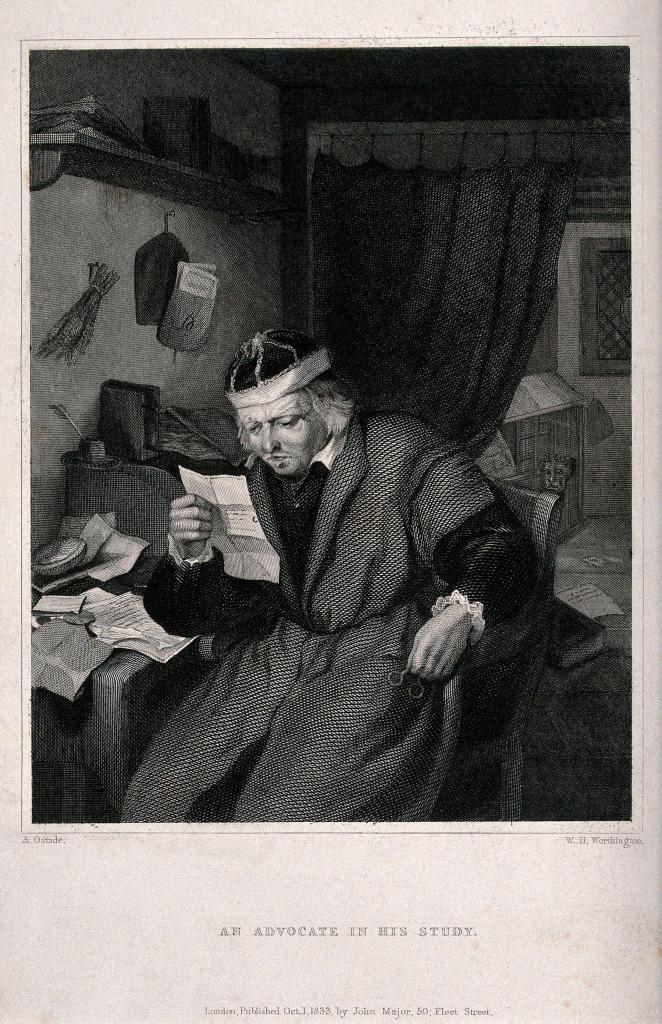
Title: A lawyer in his study. Engraving by W.H. Worthington after A. Ostade.
Artists: Adriaen van Ostade (1610-1685) and William Henry Worthington 1795-1839
Source: Wellcome Collection, part of an Open Artstor collection

 Charles van Heck's Woodhull Journal
Leave a comment