One of my pleasures on Fridays is reading Chuck Wiser’s column, “Wiser’s Wramblings” in The Wellsville Sun. Chuck summarizes his column, “I write the words to share what my eyes see and my heart feels.” Chuck’s column is a reminder to “open your eyes and see,” which is something I often say. My now adult children frequently heard this while growing up. When we open our eyes, we connect and can feel with our hearts. Occasionally, my wife will quote this back to me.
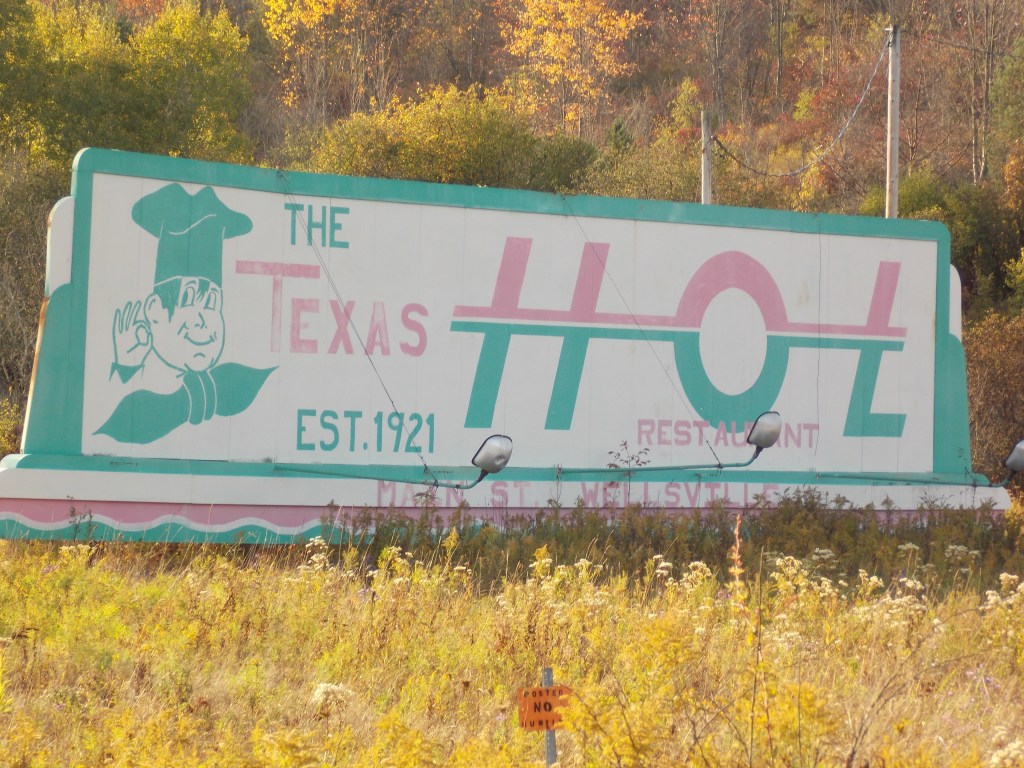
Chuck and I exchanged correspondence a few weeks ago. We share similar backgrounds and, as he noted, we “are almost images, even if mirrorlike reversed on somethings.” I found myself wondering if we had passed one another on the streets of Wellsville, New York, or dined at different booths in the Texas Hot. For those unfamiliar with the Texas Hot they have been serving their famous hot dogs, pies and other foods since 1921. I also wondered if we drove past one another on State Rt, 275 where it enters the hamlet of Nile. This is where the road becomes a two-lane residential street named Pennsylvania Avenue. In the center of the community, the route meets the east end of Fifth Avenue. 275 bends back to the north, crossing through rural sections of the town of Friendship. I was either driving a ’65 Chevy Nova or my grandparent’s Plymouth.
My grandparents lived in Richburg on 275. If you blink you would miss the hamlet that was once a booming oil town which the Rochester Democrat & Chronicle headlined in 1897 “From a Sleepy Village It Became as Lively and Wicked as Mining Camp When Oil Was Struck.” The first well test was on the farm of Jeremiah K. Reading on Richburg Hill Road not far from our family farm. The well produced 70 barrels of oil on its first day. The surrounding hills, farms, and even the lots in town sprouted derricks. By 1882, the oil fields in Pennsylvania began to change Richburg’s fortune. The hamlet today is a shadow of its former self before 1881, and even as I remember it.
No boom lasts forever whether in oil, stocks, or bitcoins, contrary to inflated expectations. Historically, the American economy slips into a recession every seven years. This is an adjustment period, difficult to get through financially, but survivable.
Can we apply the seven-year cycle to the changes in our bodies? We each have memories of ourselves in former years. We used to think that the cells of our bodies change every seven years. The reality is more complex. What is our real age? At the end of this piece is a link for a short, enjoyable video that answers the question.
Last week I met with my primary doctor for my annual physical. A few minor concerns. This Wednesday I met with the surgeon who performed the operation to resolve a problem following prostate cancer surgery. I had a Gleason score of 9, which is comparable to getting a hole in one in golf, or winning the lottery, but you don’t feel the urge to celebrate. What was celebrated is that the surgeon and I agreed that this surgery was a success. I have had to make concessions to spinal stenosis, polymyalgia rheumatica and giant cell arteritis. The pacemaker and all the metal in my body from the surgeries these past six years allow me to call myself Iron Man. This isn’t to complain. I am, like Richburg, unlike my former self, but still standing.
I have been standing at a fork in the road these past months since the cancer surgery. What to do after so many things that gave me pleasure were abruptly removed (and not just the prostate). I am referring to limitations in performing numerous activities. How do I rebuild my life? Starting over, relearning how to walk, exploring new interests, and refining old skills is a gift that others gave me. The giant cell would have left me blind but for Dr. Christine A. Persson, and Terri, my wife’s medical experience in eyecare, a team of specialists in her field, and rheumatologists. Our spirits are uplifted and renewed by others. Chuck Wiser observes this in his column in regard to the nurses and staff at Jones Memorial Hospital in Wellsville, New York. As the song goes, “People who need people are the luckiest people in the world…”
Who am I (or you) without others? This is a question we need to ask ourselves daily. Regretfully, it is a question we are losing sight of in this tumultuous period.
The German theologian Dorothe Soelle raises this from the perspective of human suffering. She writes, “… the most important question we can ask about suffering is whom it serves. Does our suffering serve God or the devil, the cause of becoming alive or being morally paralyzed?”
What matters in life is our willingness to open our eyes to see, to “share what my (our) eyes see and my (our) heart feels.”
Your Body’s Real Age | NPR’s SKUNK BEAR
Photograph: Copyright © 2025 Charles van Heck

 Charles van Heck's Woodhull Journal
Leave a comment