As with most summer days, the sun beat down on the tree-lined street. People were gathered on the sidewalk, some brought lawn chairs. Children raced playfully across shaded lawns. Buntings and a flag decorated the viewing stand. A cluster of politicians stood behind the grand marshal. The Marine Corps Band from Cherry Point, North Caroline stood rigidly in their dress blues. Sweat dotted their brows, ran down their necks into collars. Holding a gold-plated mace, the stone-faced Drum Major Master Gunnery Sgt. Wayne Bunt looked straight ahead. The grand marshal was Cousin Brucie, also known as Cousin Bruce Morrow, a disc jockey for WABC radio in New York City.
Bruce Morrow had a lot to say that sweltering summer day. He often did. I never met Morrow, seldom listened to him on the radio. I did know Wayne. He was my cousin, and more of an older brother. While living with Wayne’s parents in California, I stayed for a few weeks with Wayne, his wife Kitty and their daughters in the Naval Housing district in San Diego. In the early mornings, 4 a.m., Wayne and I left for Marine Corps Recruit Depot in San Diego. At the time, Wayne played trumpet in the band. Over the course of our weeks together, there were rehearsals, concerts, and hanging out with the band members (stories for another time, uh maybe).
Morrow kept speaking. The Marine band, at the head of the parade, kept sweating. Behind them other marchers wilted. Wayne turned his head slightly towards the sidewalk where I stood. “Gwaad,” he mouthed. I knew he had had enough. The mace was raised. The guys stood a bit taller as they raised their instruments. The downbeat was given. Music blared. They marched. Morrow’s face tightened mid-sentence. His displeasure for being interrupted was apparent. Then he introduced the Marines.
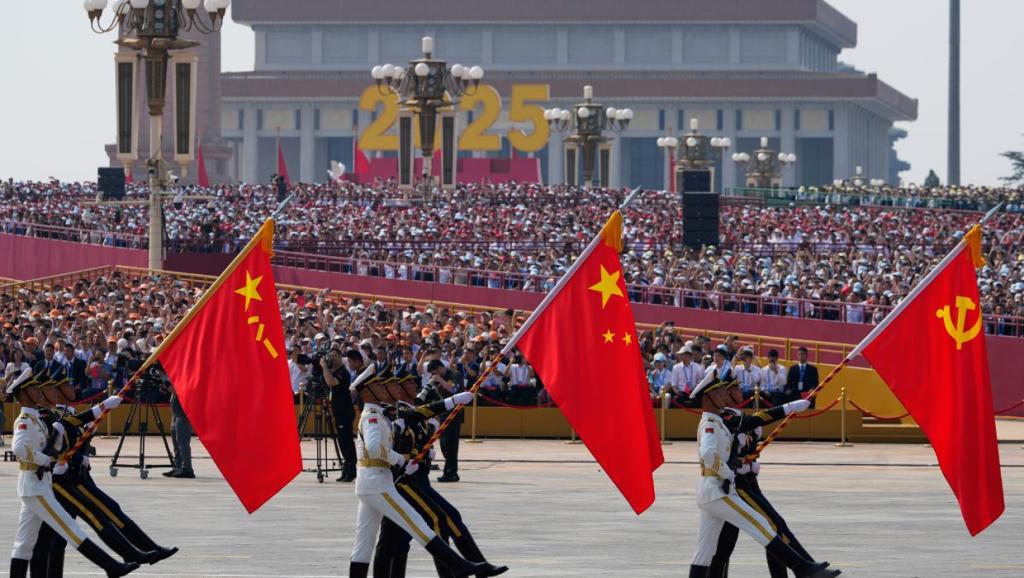
On 3 September I watched the 2025 China Victory Day Parade. I found the official name rather ironic, Conference to Commemorate the 80th Anniversary of the Victory of the Chinese People’s War of Resistance Against Japanese Aggression and the World Anti-Fascist War. The irony was apparent on different levels
The prelude music was impressive, rousing. Along the Songhua River, On the Taihang Mount, Yellow River Cantata, Without the Communist Party, There Would Be No New China. You don’t have to hold to the communist ideology, or any ideology, to appreciate talented musicians. Also impressive was the discipline of the approximately 12,000 military personnel. What intrigued me were the weapons for naval combat. This provided insight into the Chinese thinking of the type of warfare they anticipate in its early stages.
Jennifer Parker, adjunct fellow in naval studies at UNSW Canberra, noted the importance of separating China’s information warfare campaign. “Associated with parades or exercises or demonstrations is always a huge degree of deception,” she said. “But I don’t think we should underestimate China’s capabilities – they are a very capable military, and I think we should be quite concerned.”
The irony of the morning came in layers.
There were 50,000 people, excluding the general public, lining Beijing’s Chang’an Avenue. Those whose homes overlooked the parade route were told to stay away from their windows. They were to watch the television broadcast. Offices, shops, and subways were closed within a six square mile radius of Tiananmen Square. The area was heavily patrolled.
I watched President Xi Jinping and his wife, Peng Liyuan greet the world leaders. The majority of these leaders are authoritarian. They have no regard for the principles of democratic liberalism. Among the most prominent, and receiving the warmest welcome, were Russian president Vladimir Putin and North Korean leader Kim Jong Un. As they walked to the reviewing podium, Xi and Putin were overheard discussing organ transplants that could potentially help human beings live to 150 years of age.
Wen-ti Sung, a fellow at the Atlantic Council’s Global China Hub, observes, “China is unafraid to stand by its friends and be their literal fellow traveler, even and perhaps especially when they are pariahs in the court of international public opinion.” That is made clear in the reception Putin and Kim Jong Un received.
Prior to and as the parade occurred, the Russian military fired 500 drones and two dozen missiles at Ukraine. Putin has expressed his intent to carry out the war with Ukraine, meeting his objective, with Chinese and North Korean aid. He disregards Trump’s efforts for a peaceful settlement.
“The Chinese people won the great victory through their united efforts with the antifascist Allied forces and the people around the world,” Xi said, extending the gratitude of the Chinese government and people, to foreign governments and international friends who had supported and assisted the Chinese people in resisting aggression.
Xi’s speech rewrites the narrative of the Second World War from a Western-centric account towards an Asian one with emphasis on China’s role in the shaping of the post-international order. History disallows us to deny the role China played in defeating Japan. 14 million Chinese died and up to 100 million became refugees during the eight years of the conflict with Japan from 1937 to 1945. Xi’s speech lacked an explicit mention of financial and material support, and the allies’ loss of human life in supporting China.
The military parade was a carefully choreographed show. As Joseph Torigian, an associate professor at American University, observes, “For both Xi and Putin, victory was costly, but incomplete. They believe that ‘hegemonic forces’ still want to impose a foreign model upon them and block their rightful place in the world. Now, they want to use the memory of the war to inoculate future generations against Western values and legitimate the global order they envision.”
On a sweltering day in Beijing, the memory of war laid bare the case of China’s resentment towards the U.S. and the West, and its intent to change the geopolitics in Asia while telling its people to stay behind closed windows and off the streets.
Image: Military personnel take part in a military parade to commemorate the 80th anniversary of Japan’s World War II surrender held in front of Tiananmen Gate in Beijing.
Ng Han Guan / AP
Source: Stuff (New Zealand)

 Charles van Heck's Woodhull Journal
Leave a comment