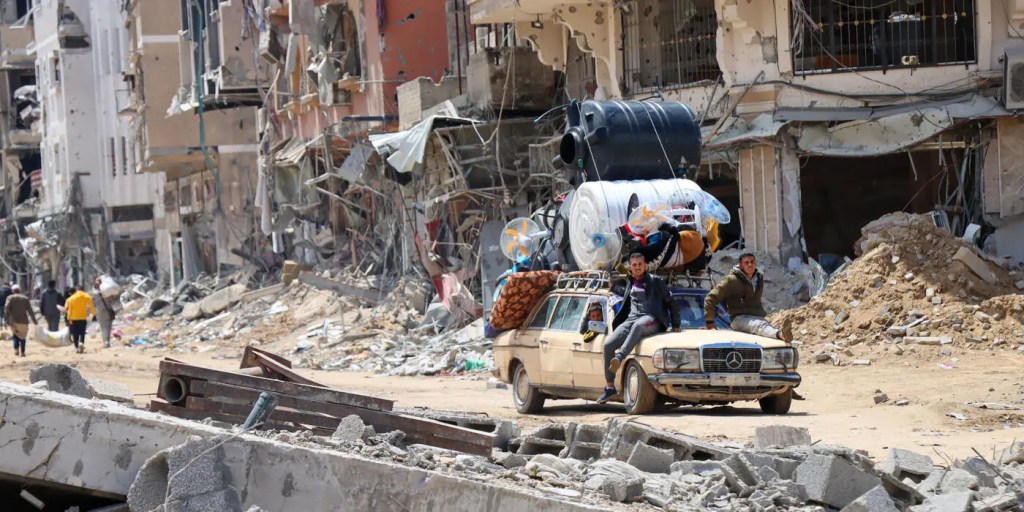
When does war become an act of vengeance? The question pricks at the conscience in times of war, political instability, and humanitarian crisis. We again find ourselves in such a period. The question demands a response.
Gaza.
Palestinians: 59,219 fatalities: 26,655 men, 9,417 women, 17,921 children,4,307 elderly, 143,045 injured, 1.9 million people have been displaced.
Israelis: Over 1,200 fatalities: 5,431 reported injuries. IDF (Israel Defense Force) list 454 dead and 6,153 wounded.
The Jerusalem Post reports that 20 living hostages, and 30 dead remain in captivity.
These statistics are from OCHA (United Nations Office for the Coordination of Humanitarian Affairs) issued on 25 July and by the IDF (Israel Defense Force) on 27 July.
Statistics fail to put into context the horror and images of human suffering. Be they Jew or Palestinian, these are human beings. We cannot shrug off the civilians as “collateral damage,” and the soldiers as “performing their duty.” The statistic fails to express the psychological and emotional pain of the hostages and their families, as well as the grief and suffering of the IDF families who have lost loved ones, and the wounded.
The political decisions by Prime Minister Benjamin Netanyahu in pursuing the war in Gaza have resulted in a moral crisis for Jews both in Israel and the Diaspora. How do we justify the mass killings of civilians when the very core of Torah values is the sanctity of human life? A few examples illustrate the fact that neqamah (vengeance) is contrary to Jewish ethics.
“You shall not take vengeance or bear a grudge against your kinsfolk, but you shall love your neighbor as yourself: I am the LORD” (Leviticus 19:18). This verse establishes a precedent to avoid neqamah (vengeance).
The Covenant code states: “If you meet your enemy’s ox or ass going astray, you shall bring it back to him. If you see the ass of one who hates you lying under a load, you shall refrain from leaving it there; be sure to help him with it” (Exodus 23: 4-5).
“You shall not abhor an Edomite, for he is your kinsman. You shall not abhor an Egyptian, for you were a stranger in the land. Children born to them may be admitted into the congregation of the Lord in the third generation” (Deuteronomy 23:8-9). The medieval commentator Rashi qualifies this, though one can hear the strain, when he writes, “You shall not loathe the Edomite entirely; and even though you are entitled to loathe him who came out with the sword to greet you: you shall not loathe the Egyptian— utterly; even though they threw your male offspring into the Nile. What is the reason? They were your hosts during time of need!”
“If I have rejoiced at my enemy’s ruin/ or exalted when trouble overtook him/ I have not allowed my mouth to sin/ by asking for his life with a curse” (Job 31: 29-30).
There are other scriptural examples that provide models of ethical conduct to avoid vengeance. This isn’t to say that neqamah lacks roots in the TaNakh (Old Testament). Vindictiveness and malice are found, for example in Psalm 137: 7-9). However, the majority of the references to neqamah are connected to the concept of justice (e,g. Isaiah 59:15b-18). The New Testament is not exempt from the harsh language of neqamah, but, as in the TaNakh, retributive language is countered to emphasize love and compassion.
Jewish ethics rest upon the pillars of mishpat (justice), tzedakah (righteousness), chesed (kindness), and rachamim (compassion). “Simon the Just said, ‘The world stands on three things: Torah, avodah (divine service), and acts of lovingkindness’” (Avot 1:2). Hillel taught, “What is hateful to yourself do not do to your fellow-man. This is the entire Torah, the rest is commentary. Go and study” (Babylonian Talmud, Shabbat 31a).
In Jewish law, the primary justification for war is when fighting a defensive war, “to save Israel from an enemy that is attacking it” (Maimonides, Mishneh Torah, Hilkhot Melakhim 5:1.). Israel’s response to the Hamas attack of 7 October is and was justified. I condemn Hamas both for its attack on Israel, holding of Jewish hostages, and its repression of the Palestinian people, their leadership’s game playing to avoid a negotiated settlement, and its theft and withholding of international aid. Hamas is a terrorist organization. However, my voice is also raised against the Netanyahu government that uses starvation and the dislocation of Palestinians from Gaza as an weapons of war. Additionally, I speak against those who look at the Gaza Strip as a potential real estate deal once the current population has been relocated. The war in Gaza at this stage is one of revenge, not one of justice.
(One who takes revenge or bears a grudge is as) “one who in cutting meat sticks the knife in his hand and now goes ahead and sticks the knife in the other hand” (Yerushalmi Nedarian 9:15 in a comment on Leviticus 19:18).
Our ethics should compel us to ask, “Do we live by the code of neqamah, or do we raise our voices to say olam hesed yibbaneh (the world is built on steadfast love), then conduct ourselves in a manner that reflects those words?
Photograph
A family drives through rubble in Khan Younis after Israeli troops withdrew. Widespread destruction and explosive remnants remain, posing severe risks. A UN team reported critical shortages of food, water and healthcare. April 2024. Photo: OCHA/Themba Linden

 Charles van Heck's Woodhull Journal
Leave a comment