What does it mean when someone asks you to pray for them? What does the request say about them and you?
Prayer is a topic that we relate to public worship, a liturgy. Our engagement in private and personal prayer is typically an undiscussed topic because it is just that― private. Emotional public appeals for prayers following a school shooting, or a natural disaster are pleas for relief from the deepest agony when a person’s world is falling apart. Those who scoff at these cries for spiritual assistance are partially correct when they respond, “We need to act, not pray for them.” However, derision of the appeal for prayers is a misunderstanding of the aims and purposes that prayer serves.
When a person asks us to pray for them, they are revealing their vulnerability― a wound, or sorrow, doubt or fear― and asking us to touch and enter into that weakness to give them strength. When we pray, our response is not one of callousness and indifference to action for justice, mercy, and kindness. Instead, it is the complete opposite. Prayer for those in need is an act of empathy, a commitment to service, and an opening of the conscience to others and to God.
Judaism is an action oriented religion. It places on us obligations, mitzvot (commandments) towards community (e.g. feeding the poor). Mitzvot is too often thought of as “ways to be good.” The commandments are a way to live moral and ethical lives. In themselves, they lead to rational and logical actions. The commandments improve us as human beings, and bring healing to the fabric of the world while maintaining the covenant between God and the Jewish people.
Despite the numerous and vast differences between Judaism and Christianity, Christianity is also directed inward towards personal holiness, and outward towards service to others to be instruments of the Divine in compassionate acts, to seek justice for the poor and dispossessed, and for peace.
Prayer is concerned with the multi-complexity of human existence for both faiths. Whether prayer is personal, spontaneous from the heart and depths of the soul, or communal within the formal liturgical structures of public worship, it is not divorced from our daily lives. Prayer is an act of worship, regardless of its context, that opens us to the sensibilities of the mysteries surrounding us. Prayer opens our eyes to see our relation to time and space, to others, and to address the fundamental problems of the human condition as we give voice to the issues of human affairs. Rabbi Abraham Joshua Heschel writes:
“Prayer is a confrontation with Him who demands justice and compassion, with Him who despises flattery and abhors iniquity. Prayer calls for self-reflection, for contrition and repentance, examining and readjusting deeds and motivations, for recanting the ugly compulsions we follow, the tyranny of acquisitiveness, hatred and envy. We face not only things― continents, oceans, planets. We also face a claim, an expectation.
God reaches us as a claim. Religious responsibility is responsiveness to the claim. He brought us into being; He brought us out of slavery. And He demands.”
I was once asked to substitute teach a class. After being told the topic, I began composing my lecture notes. Then the instructor changed his mind on what I would teach. I started over. At the last minute, he changed his mind again. He asked me to speak on prayer. This left me scrambling to put together notes. At one point, I stated, “God doesn’t always answer our prayers.” Before I could continue, one of the students exploded in a rage. You would have thought I had lit a short fuse to a bomb. His rant was violent, personal and abusive. In his opinion I was denying God’s authority and the power of prayer as he experienced it.
The point I was attempting to make, and still maintain, is that though God demands of us, we cannot demand of God. The response we receive will not always be to our personal satisfaction. We stand before Sinai, not atop of it. Christians stand before Golgotha. These are not barriers between us and the Divine. Our responsibility is to make a commitment that comes from the soul, the core of our existence, to climb the mount.
Though we often feel we are making that ascent alone in a world darkened by misery and suffering and often do not sense the Divine Presence, the reality of faith is that the darkness is neither final nor complete. We are personally and as a people vulnerable to life’s tragedies and the resulting suffering that too easily allows us to become callous to the Mystery of before Whom we stand. Prayer is an expression of our openness to God, a verification of the overwhelming awareness of our solidarity with the Divine, our fellow human beings and the eternity that flows daily into our lives.
Prayer is the expression of praise, thanksgiving, gratitude, petition, hope, trust and love. Prayer is an action that should lead us to other actions as we go about our daily lives.
“Rabbi Johanan said: What is the service of God? Prayer” (Midrash Psalms on LXVI, 1).
(see Deuteronomy 11.13)
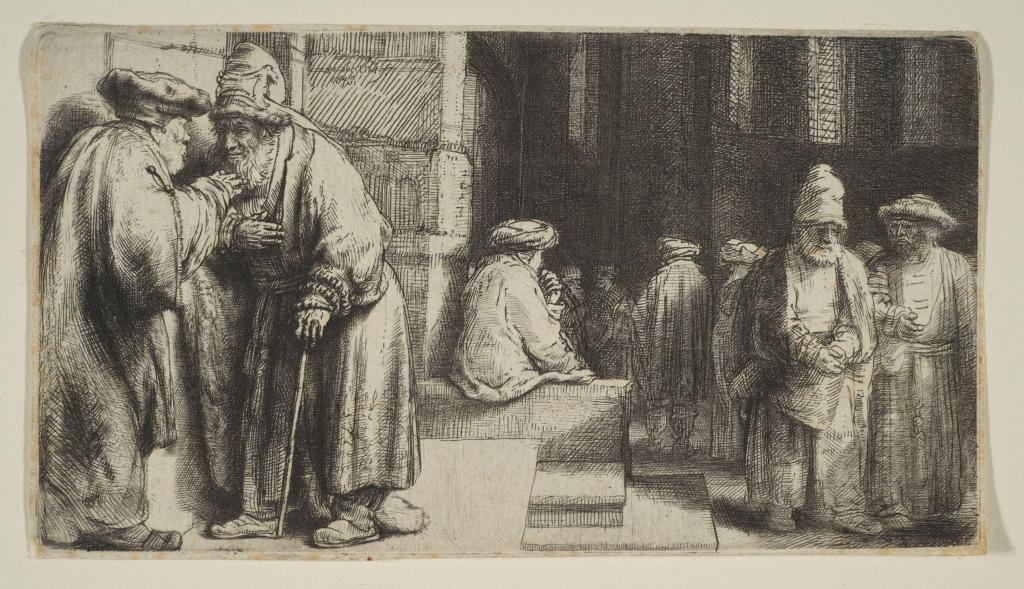
Image: The Synagogue
Creator/Artist: Rembrandt (Rembrandt van Rijn) (Dutch, Leiden 1606–1669 Amsterdam)
Source: The Metropolitan Museum of Art


 Charles van Heck's Woodhull Journal
Leave a comment