by Carl ten Hoopen
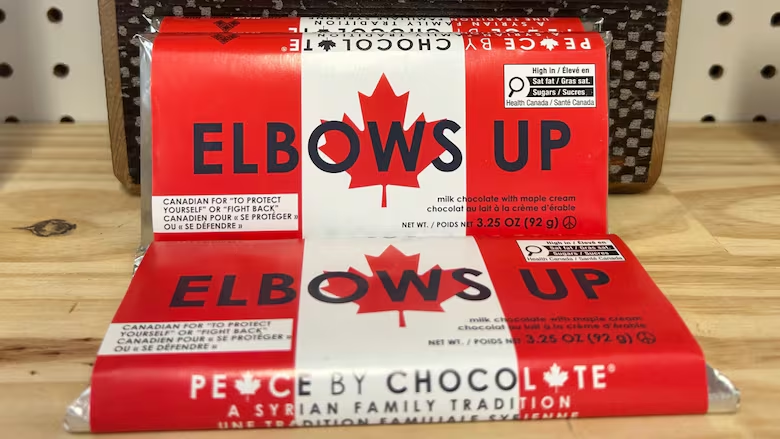
Chocolate and beer slip uneasily into essays. They are topics that glide easily to our attention when pushing a cart down the grocery aisle, attending a hockey game, or dining at the Queen & Beaver Public House in Toronto. My thoughts have unraveled on beer. Chocolate, as beloved as it is, fails to qualify as a vital category of food products. Of course, we can find chocolate everywhere. This lures us into thinking it is high on the food chain. Unlike beer, I don’t know anyone who has been pulled over by a police officer for swerving, or drifting between the center line and shoulder while under the influence of a candy bar. Americans and Canadians have taken both of these staples of daily life for granted until Donald Trump developed a fixation on tariffs.
Canadians are rightly outraged by the Trumpian attitude towards their nation. His lust for their natural resources is like grocery shopping with a three-year-old in the candy aisle. You would be hard pressed to find “sweet treats”, as my wife Éva refers to chocolate candy, made by the American corporate giants. Canadians are taking their boycott seriously. Enter Loblaws on Carlton Street in Toronto or the Real Canadian Superstore in North York and you will discover the absence of American products.
Among the top selling candies that you can’t find in the States are Wunderbar, Coffee Crisps, Crunchie, and Crispy Crunch. Peace by Chocolate, a Canadian chocolate company based in Nova Scotia is marketing a silky milk chocolate bar filled with maple syrup. The bars are wrapped in a truly Canadian symbol. The name, “Elbows Up,” is an appropriate response to the tariffs and the Administration’s condescending attitude to a friendly country that has been a good neighbor.
Tariffs have affected the sale of Labatt and Molson which are owned by multinationals, and both are essentially American brands. I have an obligation to beer drinkers to offer a few suggestions, and to tell Americans what they are missing.
Unibroue (pronounced “uni-brew”), a Quebec brewery (now unfortunately owned by a Japanese company), makes a white beer refermented in the Belgian tradition. Central City Brewers, located in Surrey, British Columbia, is considered to be “Canada’s leading craft brewery and distillery.” Of course, tastes vary, but I am told The Red Racer IPA is their best. Kid Rock and Ted Nugent may want to collect their decorative cans (put down the fully automatic MP5 and nine-millimeter, boys and pull up a chair). Also in Montreal, the McAuslan Brewery (McAuslan – Brasserie & Distillerie). Their St-Ambroise line is popular with Influencers. There are other craft breweries to explore while Canadians vacation in Canada rather than go on holiday in the States.
The tariff negotiations between the two nations have been conducted in a collegial atmosphere on a daily basis. Prime Minister Mark Carney and Donald Trump have a good chemistry. Canadian Ambassador Kirsten Hillman has stated that the Canadian government’s goal is to return to the provisions established in the free-trade agreement and remove all tariffs. I, and no doubt members in the Canadian government are left wondering, what does Donald Trump want after expressing his intent to impose a 35% tarrif on August 1st? A 51st State? All the natural resources? The Administration says it wants Canada to crackdown on the fentanyl drug trade. The data collected by the U.S government shows that little of the dangerous drug, 26 kilograms, crosses the northern border. Carney has said, “Canada has made vital progress to stop the scourge of fentanyl in North America.” Canada’s Fentanyl Czar Kevin Brosseau is pressing ahead with a $1.3 billion border security plan.
How do you negotiate with someone who lacks consistency in his demands? Businesses on both sides of the border are dealing with uncertainty. “For the business community in Canada, the uncertainty, this constant changing of the goalposts, the unknowns around what will this be, what will it apply to, is quite toxic. It really neutralizes decision-making. It takes away capital investment. It really affects everything,” said Matthew Holmes, executive vice-president and chief of public policy at the Canadian Chamber of Commerce, in a CBC interview.
Ambassador Carla A. Hills, who served as U.S. trade representative from 1989 to 1993, and negotiated the NAFTA trade agreement, sums it up when she said in a CBC interview that the U.S. tariffs on Canada are, “like shooting your sibling in the heart.”
CHARLIE ANGUS – THIS IS MORE THAN A TARIFF WAR

 Charles van Heck's Woodhull Journal
Leave a comment