Censors sneak up right before your eyes in broad daylight. They aren’t figures lurking in a dark alley on a rainy night waiting to mug you as you make your way from a subway entrance. The censors wear tailored suits. They act quickly. A few people look up at the glass and steel towers housing the newsrooms and notice something different. Otherwise, nothing. And what was good becomes just another thing for you to think is unimportant as you rush to the nearest café for your morning coffee and a scroll through the apps on your phone.
Journalism was once an honored profession. This isn’t to say there wasn’t yellow journalism with its gossip and twisted tales of the macabre. This dark under-belly still exists, and appears to be more popular with “True Crime” apps, podcasts, streaming services, and broadcast news. This isn’t to say all journalism is of poor quality. Good news coverage is still around. In the current political environment, though, journalists are viewed with skepticism and cynicism by both elected officials and the general public. The intactness of their reporting is questioned. Politicians disparage their motives and objectives. Owners and the corporate executives of news organizations are anxious to settle frivolous lawsuits for favors and personal financial gain. Cross the boss and your salary vanishes along with your rides on Air Force One.
Spin is a tool politicians employ on a regular basis to promote ideas, influence policy and protect their reputations. News reporters have the responsibility to both present what is said, and to sift through the spin for the real story. Ann Peters, one of my high school English teachers, instructed her students to learn how to read between the lines. What was really being said was there if you paid attention. Today this is a requirement. We need to understand that spin is a form of propaganda. Twist the truth of the real story into a pretzel and feed it to the reporters. If questioned why he or she should eat it, you tell them they’re a lousy and mean person with a bias. Give the pretzel to a friendly reporter, he or she will eat it without second thought.
Spin can be subtle or overt. The nuance and framing of information is important in managing and manipulating public opinion. Spinning the outcome of a presidential debate, an election, or a national security issue is a way to drown out or counter an opposing point of view.
We have two feel good slogans that buoy our attitudes towards information. A “marketplace of ideas” applies to the social networks most people receive their news from and where citizens exchange personal contacts. In this understanding, we like to think that information just wants to be free. We accept the notion that information technology facilitates personal expression, economic, social, and political freedom. The danger is the control of access by an aggressive government, and a small class of providers, who control internet content and divide, shape, and. “disseminate information for the maintenance and propagation of its image and power among its population”, as Chistopher Ford of the Council of Foreign Relations observes. In other words, censorship doesn’t always require direct blocking techniques to distort media coverage.
Bloggers, myself included, podcasters, and other writers on social media depend on professional news reporters for our information. Only a few of us have the opportunity to attend White House, and other agency briefings. The same applies to state and local officials, though on the local level there are town hall meetings open to the public.
Jimmy Breslin once remarked, “But working for a newspaper can get to be a way of life more than a job…” The same can be said for working for a television network. It isn’t always about getting the big scoop, and investigative reporting. On a local level news reporting is simply keeping a community informed and maintaining a sense of belonging. This is how I think of papers like The Wellsville Sun.
The first edition of The Wellsville Sun was published on February 28, 2021 several years after the closure of the Wellsville Daily Reporter. I remember walking with my grandmother to the Richburg Post Office in the late afternoon on summer days to pick-up the Daily. This, and WLSV AM, the Wellsville radio station, were the sources of our local news. Her cookbook contains the recipes she cut out and pasted into a school notebook along with her handwritten recipes. I have her book, and still use it.
When Andrew Harris and John Anderson began the online paper with assistance from Michael T. Baldwin, the ethos was simply to advocate for Wellsville and the surrounding communities in Allegany County, New York. At the same time, they wanted to increase the regional news reporting. Other outlets exist for the national and international news. What was important then, and remains true today for them, is integrity. No spin. This applies to every columnist.
Integrity matters in the news business. Rural areas, small cities and towns need papers like The Wellsville Sun to uplift local businesses, to bring people together, to celebrate what they have in common, and to assist one another in improving their communities even when they disagree on how to go about that development. And yes, to report the darker behavior of human conduct without sensationalism.
Maintaining an ethos of integrity, regardless of their size and their medium, is essential to a free press. A free press is necessary for an informed citizenry to maintain our democracy. The Wellsville Sun has been successful at this. Let us hope others will follow their example despite the political pressures in the current climate.
Photograph
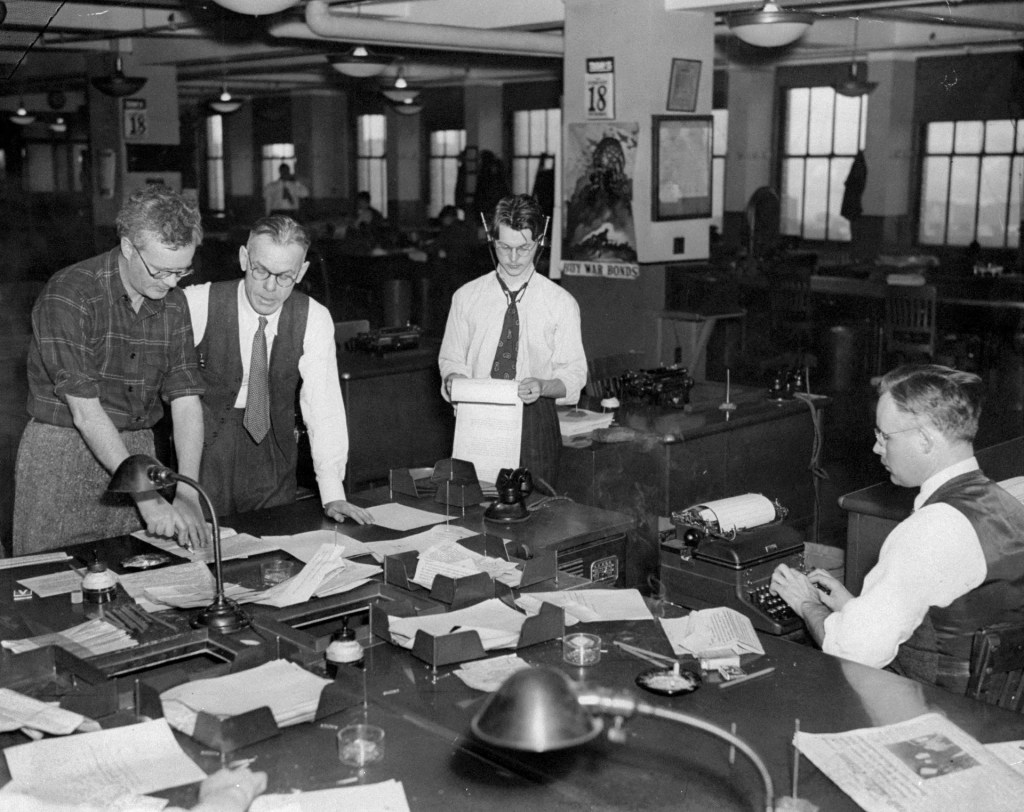
The Daily News . Photograph by Ed Jackson / New York Daily News / Getty

 Charles van Heck's Woodhull Journal
Leave a comment