A quiet, rainy morning. The rainfall began during the night, a soothing, tapping sound on the roof and windows. I am an odd duck, preferring cloudy, rainy days to cloudless ones with summer sunlight glaring down like an angry god. I take comfort in watching clouds, the swaying horse tails, or the grayish-tinged ships with unfurled sails on a sea of shades of blue. My imagination roams as it finds the earthly and mythological creatures in the cloud formations (when was the last time you lay on your back to cloud gaze?).
Shades of blue are apparent when we gaze upward, out of ourselves, and take a long moment to focus. We see the colorations of clouds against the hues of blue blended in a manner an artist cannot replicate. Those moments of pausing to look skyward allow us to collect our lives and put them in perspective as more than pursuits.
We are taught at an early age to pursue and accumulate. We chase after getting the best grades in school, then pursue acceptance into the best college or learn a trade to have the highest paying job. Money matters to have a comfortable life. We pursue love⸺ verliefd zijn ( Dutch for being in love) that we as children, teenagers and adults feel. Love is often pursued with the eccentric abandon of characters in a Nancy Mitford novel or denied like Jane Austen’s sparring characters. Shakespeare summarizes these feelings of verliefd zijn in As You Like It, Act 2, scene 3, lines 33 – 35:
“If thou rememb’rest not the slightest folly
That ever love did make thee run into,
Thou has not loved.”
We pursue and accumulate because we are told it is good. Then, we are told to give away what we have gathered because that, too, is good. We donate our time, our skills, and our money to charities. Those items we have outgrown or have no further use for we donate to the Salvation Army, Goodwill. Time is the gift we give that we can neither receive a tax break for nor get back. There is no guarantee the love we desire or give will be reciprocated.
Love has moments of folly, those moments when we tie our shoelaces together and fall flat on our faces. But, as George Sand said, “There is only one happiness in this life, to love and be loved.” If Lao Tzu were discussing love with Sand, he would no doubt respond, “Being deeply loved by someone gives you strength, while loving someone deeply gives you courage.”
To love is to find joy. Mary Ellen McCabe once inscribed in the gift of a book she gave to me:
“Your joy is your sorrow unmasked. The deeper that sorrow carves into your being, the more joy you can contain.”
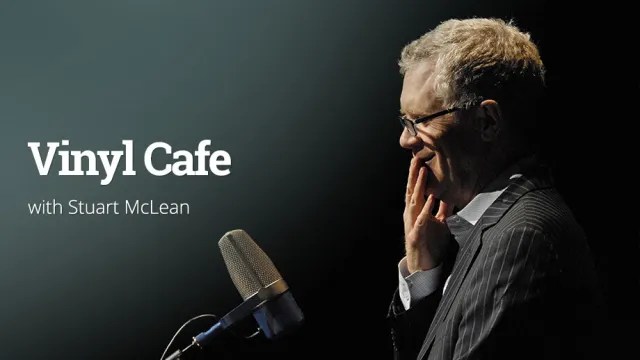
These past few days, the sky has had a strange, gray, eerie appearance. When sunlight momentarily slips through the layers of smoke from the Canadian fires, it appears on the lawn the way it would during a partial eclipse. A thin haze of smoke drifts through the trees and back pasture. For some reason, the scene has brought Stuart McLean to mind.
Mclean had a Sunday radio show on the Canadian Broadcasting Corporation called the Vinyl Café. He also taught journalism for twenty years at Ryerson Polytechnic Institute (now Ryerson University) in Toronto. The Vinyl Café, with its musical performances and McLean’s storytelling, was aired from 1994 through 2016. His stories about regular people living everyday life could make you laugh and cry. McLean’s show made you pause to open your eyes to others, the shades of blue and other colors, the shapes of clouds, and to listen to the music, the rhythms around you, the goodness of life, and appreciating life as more than a pursuit. They made you think. They opened your heart.
In November of 2015, Stuart McLean was diagnosed with melanoma. He died on February 15th, 2017, two months shy of his 69th birthday.
Stuart McLean has the last word here.
“We do this thing. We open our hearts to the world around us. And the more we do that, the more we allow ourselves to love, the more we are bound to find ourselves one day – like Dave, and Morley, and Sam, and Stephanie – standing in the kitchen of our lives, surrounded by the ones we love, and feeling empty, and alone, and sad, and lost for words, because one of our loved ones, who should be there, is missing. Mother or father, brother or sister, wife or husband, or a dog or cat. It doesn’t really matter. After a while, each death feels like all the deaths, and you stand there like everyone else has stood there before you while the big wind of sadness blows around and through you.
“He was a great dog,” said Dave.
“Yes,” said Morley. “He was a great dog.”

 Charles van Heck's Woodhull Journal
Leave a comment