I had more than a few reservations about writing a blog. In today’s environment, we are inundated with podcasts, posts, tweets, videos from various sources, and round-the-clock news. “Why bother?” I asked myself. The last time I had a blog, The Woodhull Arts Journal, a few people were offended. They took the time to send death threats. “People are reading Woodhull,” I happily announced to my wife. “I doubt this is the readership you want,” she replied. One note informed me that a militia group put me on trial in absentia for treason after I responded to a piece containing racial slurs against President Obama. Things reached a point where my wife and I had a measure of police protection. The Journal was shut down. “You need to blog again,” my wife told me late last year. This left me wondering if she had taken out a new life insurance policy on me.
Blogs are a messy business to write. My mornings begin around seven with reading The New York Times, The Wellsville Sun, news from Canada. John Glover graciously provides good articles from various sources. Then I turn to email and your blogs. By nine o’clock, I move from the computer desk, a beat up piece of furniture literally picked out of the garbage during my graduate study days, to a desk once used by a Lutheran pastor. You might say I am looking for Divine inspiration. Once a topic is decided on, it is researched, which often takes the original idea in an unintended direction.
Revision is essential. So is good spelling. Like John Dickerson of CBS News, I am in the spelling basement. A blog typically goes through seven or eight drafts before being posted. There are times when changes are made after it is released, then reposted.
For me, a blog is like an newspaper opinion column with serious thought mixed with humor, sometimes mixed in the same post, and other times separate. I try to limit my post to 750 words, though I am often unable to succeed. This approach is inspired by lessons learned from reading James Reston. There is another element that is important. Faith.
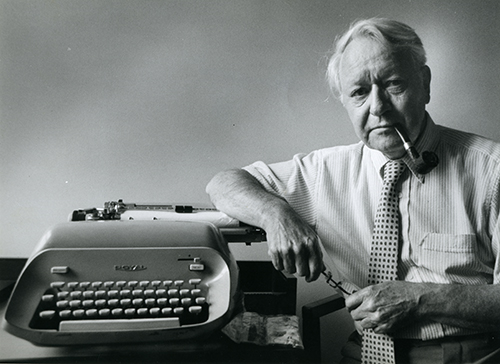
James “Scotty” Reston, a reporter, columnist and editor for The New York Times often described himself as an “unreconstructed Scotch Calvinist” and reminding people that “nothing makes Scotch Calvinists happier than misery.” However, following his death in 1995, his Times colleagues observed, “Reston saw enough pestilence and knavery to satisfy anyone’s appetite for misery. But he never much liked it, and he never succumbed to it. There was another aspect to his faith, and that was his belief in the possibility of redemption. What suffused his life and his writing were love and hope — love for his chosen profession, hope for his adopted country. ‘On the whole,” he said in the autobiography he finally got around to writing a few years ago, ‘I believe in happy endings.’”
A majority of people want to see an end to the Trumpian chaos. According to polling data collected by the Johnsonville sausage company headquartered in Sheboygan Falls, Wisconsin, Americans are exhausted by the negativity and anxiety. This is across the spectrum of political parties: 61% of Republicans, 64% of Democrats, 63% of Independents, 64% all. The majority of us are tired of being pitted against one another.*
We all have been on Trump’s divide and conquer management style rollercoaster, and Musk’s ketamine and psychedelic mushrooms trip since January. As Grace Slick wrote and sang in “White Rabbit:”
“When logic and proportion
Have fallen sloppy dead
And the White Knight is talking backwards
And the Red Queen’s off with her head
Remember what the dormouse said
Feed your head
Feed your head.”
One aspect of the illogical that should give us pause is the discontinuation of U.S. Aid. In all tracked Programs, as of June 3rd, the cut of assistance has resulted in 101,133 adult deaths, 211,030 child deaths. This is at a rate of 103 deaths per hour. Please click the link to the Impact counter below for an update.
James Reston knew how to dig for the scoop, research it, get the facts straight. There are both female and male reporters who know how to follow a lead. They, like Reston and John Dickerson (Margaret Brennan also comes to mind) know how to frame a question. But framing the question is one aspect of the skill. Listening to the answer, not just hearing it, but listening to what is actually being said is essential. This requires commitment.
A commitment to listening is absent in much of our American dialogue today. We hear what we want to say, but not what others are actually expressing. Senator Joni Ernst gives one example of this when responding to criticism of the Medicaid coverage cuts. Her glib response, “We’re all going to die,” and later her apology that referred to “a distraught woman” and “I’m glad I didn’t have to bring up the subject of the tooth fairy” is an example of not listening.
We need to renew our commitment to one another, listen, and care about what others say. James Reston teaches us the importance of respecting our writing craft, getting the facts straight, and loving what we are doing. And we need faith that there will be happy endings.
Impact Metrics Dashboard
This dashboard visualizes the human impact of funding changes for aid and support organizations. Each metric represents real people affected by policy decisions.
John Dickerson On His Spelling Skills
https://www.cbsnews.com/video/052925-cbs-evening-news-plus/
Sausage maker wants Americans to cool off on politics and hang out again
Has politics in America got you avoiding social situations? The Johnsonville sausage company wants to change that. Marketing executive Jamie Schmelzer joins “The Takeout” to explain.May 30, 2025
https://www.cbsnews.com/video/sausage-maker-wants-americans-cool-off-politics-hang-out-again/
Image: James Barrett “Scotty” Reston, circa 1980s
Source: Source: University of Illinois Archives: James B. Reston: The Life and Career of the ‘Dean of American Journalism’: Found in RS/20/120, Box 137, General Photographs, 1950s-1990s

 Charles van Heck's Woodhull Journal
Leave a comment