Sun Tzu, Sikong Shu, Dr. Martin Luther King, and Bishop Mariann Edgar Budde
A little more than a week ago, I received an angry note telling me that I am a good writer who says nothing unless I am willing to say, “Trump must go now!” Perhaps there is an element of truth in the note as it pertains to my failure to urge for the president’s immediate removal. My “failure” to demand such action is based on my understanding of the Constitutional process for removing a president and my perception of the man himself.
Sun Tzu writes in The Art of War, “If you know the enemy and know yourself, you need not fear the result of a hundred battles. If you know yourself but not the enemy, for every victory gained you will also suffer defeat. If you know neither the enemy nor yourself, you will succumb in every battle.”
Over the past week, I have been contemplating Sun Tzu and the Chinese poet Sikong Shu. A government official in the Tang dynasty, Shu wrote the poem “A World Gone Crazy” at the conclusion of the Lushan Rebellion. We are living in such a time of craziness. The difference is that it is a rebellion of a government against the people the government serves. I have also considered Dr. Martin Luther King’s “Letter from the Birmingham Jail.”
During this period of reflection, I have been painting and working on a poetry chapbook. For me, writing is a bit like dropping a pebble down a deep well and waiting to hear a plop. The pebble is a fragment of an idea. Holding the pebble is thinking about an idea, rolling it between my fingers. More often than not, this requires research to gather a deeper understanding of the subject. This is the well. Dropping the pebble is the writing process that includes numerous drafts. The plop sound is when everything comes together in the final draft. I go through a similar process when painting. Thanks to Terrill Welch, a wonderful teacher, I learned that painting is about connecting and experiencing with all of one’s senses to a subject. It is a depth experience of life.
Those who truly know me understand that I am demanding of myself. Uncompromising. George Lewis, a friend, was startled one day when I brought a car trunk full of manuscript drafts to his home to burn with his yard waste. I wanted to begin the novel over. We sat on his back porch, drinking a good Scotch and watching the fire. When I am dissatisfied with a painting, as I often am, it goes into the trash. When I engage a subject, I devour everything I can get my hands on to understand it. Academic research is my greatest pleasure. I accept people where they are in the given moment, knowing they will be in a different frame of mind when we meet again. Each person is a multi-reality, and the depth of their reality takes time to reveal. “If a man does not keep pace with his companions, perhaps it is because he hears a different drummer. Let him step to the music he hears, however, measured or far away.” Someone once said these words of Henry David Thoreau apply to me.
I once attended a meeting with President Gerald Ford. A small group of us, including both his and President Reagan’s advisors and members of Congress, were discussing an issue. President Ford asked a question. From how he framed the question, Ford’s leaning towards a position was apparent, though he hadn’t quite decided. Everyone agreed with him. Then, looking at me, he inquired my opinion. I said, “No, Mr. President.” The others were a bit taken aback. I explained my reasoning. Ford nodded. “I wish I had you in the White House,” he said. “I had too many people around me who said yes.” His former chief of staff told me later that one could disagree with Ford if you explained your position reasonably. “Then he thinks about your advice.”
We would do well to consider Dr. King’s “Letter from the Birmingham Jail” in this time of living in “A World Gone Crazy.” Ours is a period that demands reasonableness. Episcopal Bishop Mariann Edgar Budde and Dr. King provide examples of expressing our moral outrage, our “No, Mr. President.”
My degree work is in theology. I read Dr. King’s letter through that lens as I think about our “NO” to Trump and the Trumpian policies. I say with Dr. King to the Synagogue and the Church:
“I felt we would be supported by the white church and felt that the white ministers, priests, and rabbis of the South would be among our strongest allies. Instead, some have been outright opponents, refusing to understand the freedom movement and misrepresenting its leader era, and too many others have been more cautious than courageous and have remained silent behind the anesthetizing security of stained-glass windows.… I have traveled the length and breadth of Alabama, Mississippi, and all the other southern states. On sweltering summer days and crisp autumn mornings, I have looked at the South’s beautiful churches with their lofty spires pointing heavenward. I have beheld the impressive outlines of her massive religious-education buildings. Over and over, I have found myself asking: “What kind of people worship here? Who is their God?”
Dr. King’s “Letter from the Birmingham Jail”
http://law2.umkc.edu/faculty/projects/ftrials/conlaw/mlkjail.html
Sikong Shu’s “A World Gone Crazy”
https://100tangpoems.wordpress.com/category/an-lushan/
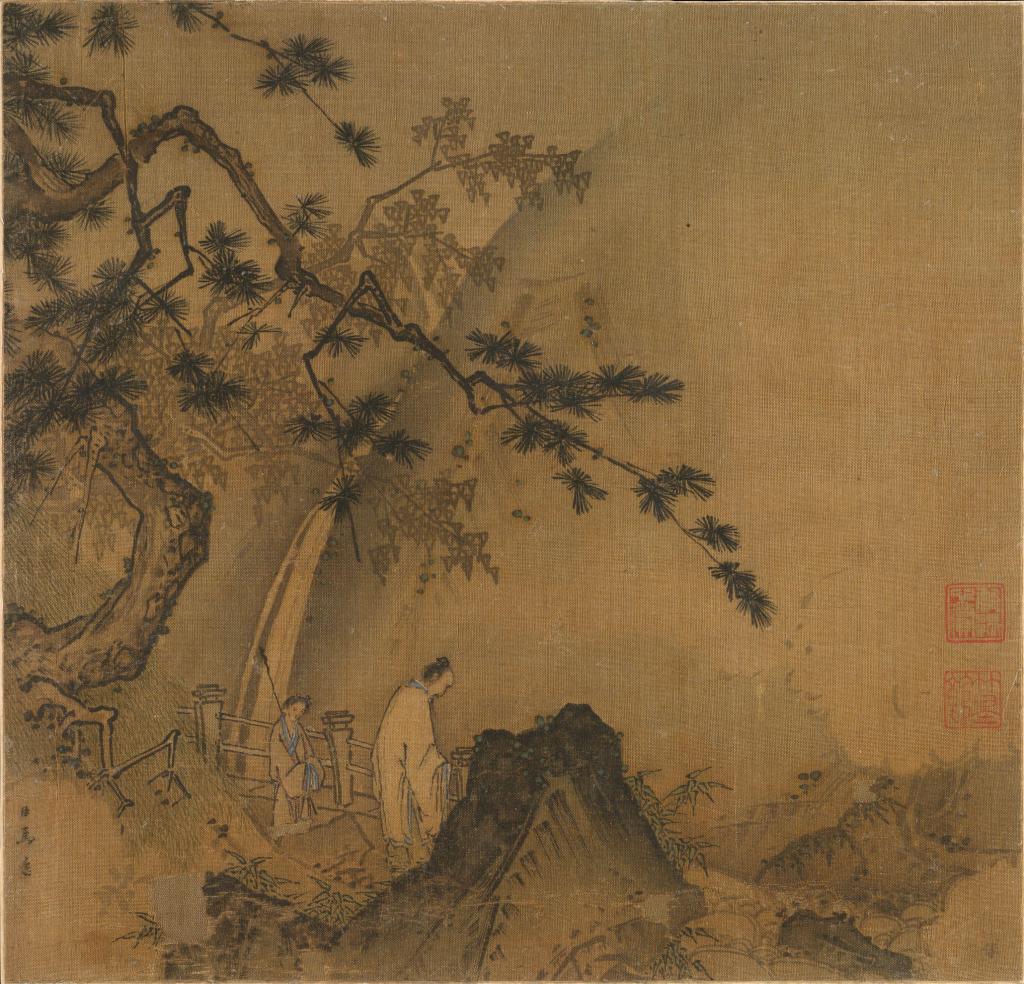
Image: Scholar viewing a waterfall
Artist: Ma Yuan (Chinese, active ca. 1190–1225)
Credit: The Metropolitan Museum of Art: Asian Art
Ex coll.: C. C. Wang Family, Gift of The Dillon Fund, 1973 1973.120.9
Scholar viewing a waterfall [1973.120.9]https://www.jstor.org/stable/community.15994486


 Charles van Heck's Woodhull Journal
Leave a comment