Letting in the Fresh Air
COMPASSION AND CHANGE
Letting in the Fresh Air
Bob, an artist friend, recounted a story to me about Cardinal Loris Capovilla, Pope John XXIII’s personal secretary. Father Capovilla told Bob that moments after being elected pope, and they were alone, Angelo Giuseppe Roncalli said, “They chose me to be pope because I am an old man, a transitional pope who will not live long. They think I will do nothing. I am going to fool them.”
A Vatican Council to reform the Church was not in Pope John XXIII’s mind until the Holy Spirit inspired this man who thought of himself as a pastor and a servant-leader. The time had come for the Church to engage the world, summon Christians to deepen their faith, and dialogue with other faith traditions. To accomplish this, Pope John XXIII initiated the Vatican Council II with the words, “…throw open the windows of the church and let the fresh air of the spirit blow through.”
This is a critical moment in the history of the Roman Catholic Church. Pope Francis followed in the footsteps of Pope John XXIII. He addressed inter-faith dialogue, compassion for the poor, and opening the door for those who are estranged from the Church because of their gender, sexual orientation, history of sexual abuse, divorce and the socially disenfranchised. Compassion is the word that comes to mind when I think of John XXIII and Francis.
The papacy is a juggling act of spiritual diplomacy for the Catholic faith, which spans the spectrum of traditionalists, conservatives, liberals, and progressives. In this regard, a pope attempts to maintain the unity of the faithful. He also has a role in the political diplomacy of international relations. He must be a moral voice in addressing the issues of war, poverty, and immigration in an age of authoritarianism, secularism, and popularism. Additionally, there is the administrative role of overseeing the byzantine bureaucracy of the Church.
Whether we want to admit it or not, a pope influences the religious thinking of Christians and Jews. Spiritually and theologically, he is a sublime figure in our dialogue on the human situation. I must acknowledge that, at times, I have been impatient with Pope Francis in my desire to hear a more decisive rebuke of those who persecute minorities and political extremists and to see him take longer strides in ecumenical dialogue with Jews. During his tenure as the archbishop of Buenos Aires, Francis’ pastoral responsibilities were often interconnected with the Jewish community with whom he maintained close ties. He and Rabbi Abraham Skorka maintained a personal, interfaith friendship. Their dialogue and, as Archbishop Bergoglio, his interactions with the Argentinian Jewish community failed to produce a theological and institutional connection during Francis’ pontificate. However, Pope Francis did, despite controversial statements of “problematic language,” strongly condemn antisemitism and unambiguously uphold the Jewish covenant with God.
In his memorial tribute to Pope Francis, Rabbi Rob Dobrusin reminds us of “His kindness and gentle way and his concern for and commitment to those who are often forgotten or disparaged in this world were evident always. In this way, he set an example for all who seek positions of leadership.”
Theologically, leadership is servanthood. Servanthood requires empathy and compassion. Empathy is the ability to recognize, relate to, share, and understand the feelings of others. It enables us to cooperate with others and is the basis for friendships. Empathy is the basis for a moral system. Compassion is the language of God. Henri Nouwen writes, “Compassion asks us to go where it hurts, to enter into the places of pain, to share in brokenness, fear, confusion, and anguish. Compassion challenges us to cry out with those in misery, to mourn with those who are lonely, to weep with those in tears. Compassion requires us to be weak with the weak, vulnerable with the vulnerable, and powerless with the powerless. Compassion means full immersion in the condition of being human.”
In Judaism, rachamim (compassion) is a core value. Compassion is an attribute of God (Exodus 34:6-7). In Deuteronomy 8:6 we read the command to “walk in God’s ways, meaning that just as God is compassionate, so must we strive to be compassionate (Sifre Deuteronomy 49). Abraham Joshua Heschel writes, “To love God means to act out of love.” We perform God’s work by loving our fellow human beings.
Despite the theological differences, this is the message of the Temple and the Church. The papacy of Francis reminds brings to mind PACEM IN TERRIS ENCYCLICAL OF POPE JOHN XXIII ON ESTABLISHING UNIVERSAL PEACE IN TRUTH, JUSTICE, CHARITY, AND LIBERTY. The dignity of each person, “… that each individual man is truly a person. His is a nature, that is, endowed with intelligence and free will. As such he has rights and duties, which together flow as a direct consequence from his nature. These rights and duties are universal and inviolable, and therefore altogether inalienable.”
In this turbulent period of human rights violations, we would do well to re-read PACEM IN TERRIS.
I hope that the next pope will be a voice summoning us to a renewed commitment to what Rabbi Bahya Iben Pakuda referred to as “duties of the heart,” which, in his words, finds expression in the “duties of the limbs” with a renewed and more profound spirituality and commitment to do God’s work.
I hope the next pope will “throw open the windows of the church and let the fresh air of the spirit blow through.”
Image
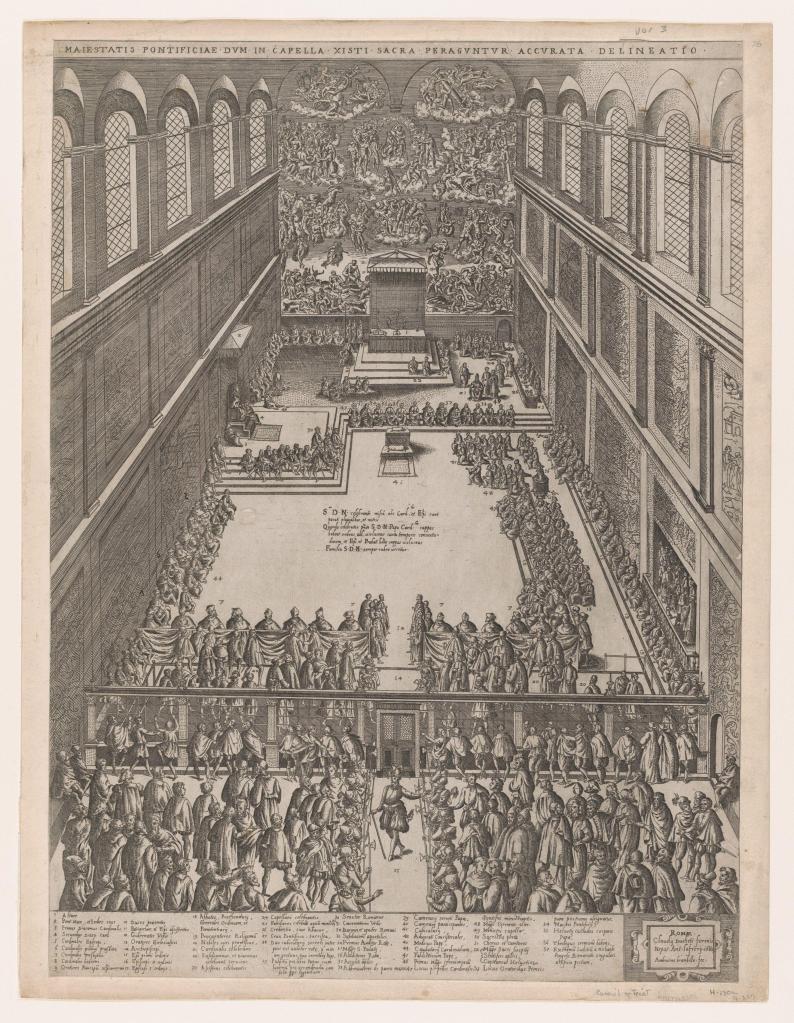
Title: Speculum Romanae Magnificentiae: A Papal Gathering in the Sistine Chapel, Michelangelo’s Last Judgement on the back wall; the crowd looks on through a screen
Artist: Giovanni Ambrogio Brambilla (Italian, active Rome, 1575–99)
Source: The Metropolitan Museum of Art: Drawings and Prints, Harris Brisbane Dick Fund, 1941, 41.72(3.76) https://www.jstor.org/stable/community.18405986


 Charles van Heck's Woodhull Journal
Leave a comment