PART ONE: THE QUESTION BEFORE US
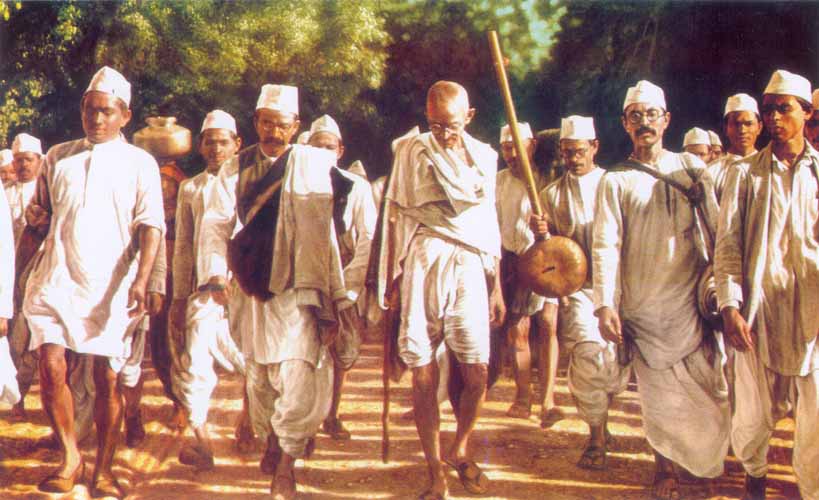
On the morning of 12 March 1930, Mahatma Gandhi began walking from his ashram in Ahmedabad towards the coastal town of Dandi on the Arabian Sea. The distance of 240 miles required walking twelve miles a day. He was 61 years old. Seventy-eight men and women left with him. Gandhi’s intention was to challenge the British Empire’s brutal colonial policies, particularly the strangling tax on salt and the law forbidding Indians from making their own salt. ‘Next to air and water, salt is perhaps the greatest necessity of life,’ he said.
For some time, Gandhi had been undecided about what measure to take to protest British policies. There were those in the Congress Party who believed in a political civil war for independence. They spoke of forming a national militia. Intellectuals and others were impatient. They wanted action. Gandhi was waiting for his “inner voice” to tell him what course to take. The message “would come from either God or the Devil, for both are wrestling in the human breast. Acts determine the nature of the Voice,” he once said.
The inner voice became clear on 2 March. When he announced his plan, including in a letter to the British Viceroy, others scoffed and were bemused, including Jawaharlal Nehru, Subhas Chandra Bose, and other members of the Congress Party. They doubted the effectiveness of Gandhi’s plan for a non-violent march. He knew this would result in his arrest, but would draw attention to the campaign for India’s independence― Self-rule. Someone asked Gandhi, “What if no one follows you?” Gandhi replied, “If no man walks with you, walk alone. Walk alone.”
Mahatma Gandhi arrived in Dandi on 5 April with over ten thousand people. The ashramites spent the night in prayer. The following morning, Gandhi entered the sea and removed salt from the mud. His actions inspired the people of India to begin making their own salt.
A friend recently asked how individuals can respond to the Trumpian policies. His question pertained to those actions beyond the mass protests. The question reminded me of Gandhi’s Dandi March⸺ his individual action. His query also reminded me of Chief Chuba Okadigbo, the Biafran diplomat who sought United States aid and recognition for his people during the Nigerian Civil War from July 1967 to January 1970. This is also known as the Biafran War, in which thousands were killed by both combat and starvation.
A relief fundraiser was organized, and Okadigbo was invited to speak. I was asked to read a few of my poems, and musicians were to perform. I would be surprised if twenty-five people were present in the auditorium that night. The organizers were disappointed. Okadigbo took the stage. He acknowledged our discouragement with optimism. “I would remind you that Jesus only started with twelve disciples,” he said. Those words have stayed with me.
Over these past weeks, a great deal has been published in justified protest against the Trumpian chaos, the violations of laws, the tearing apart of our government, the economy, and the bonds of long-established international relationships. The constant news stream and opinion pieces on revenge and retribution, greed, and unstable policy decisions are wearing, at times numbing. We have witnessed mass protests. More are being organized. But what actions can an individual person take besides joining a street protest?
But what can one person do? What actions would you propose?

 Charles van Heck's Woodhull Journal
Leave a comment